

Think about it this way: instead of buying a fleet of company cars—and dealing with all the maintenance, insurance, and upgrades—what if you could just subscribe to a transport service? One that gives you the right vehicle for the right job, whenever you need it, all managed for you.
That's the fundamental idea behind Networking as a Service (NaaS). It’s about shifting your network from a major purchase you have to own and manage, to a flexible service you simply subscribe to.
What Is Networking as a Service
At its heart, Networking as a Service is a cloud-driven approach where you consume network capabilities—things like routing, security, and user access—through a subscription. It completely changes the game for how you get and manage your network, moving away from big, upfront capital expenses (CapEx) to a predictable, ongoing operational expense (OpEx) model.
So, instead of buying, configuring, and maintaining stacks of physical hardware like routers, switches, and firewalls, you're essentially renting those capabilities. Everything is delivered and managed through a central cloud platform, giving your IT team a single, clear view of the entire network, no matter where your offices or employees are.
To better understand the shift, let's compare the old way with the new.
Traditional Networking vs Networking as a Service
The table below breaks down the key differences between the traditional, hardware-centric approach and the modern NaaS model. It highlights just how fundamental the change is, touching everything from how you buy your network to how you scale it.
As you can see, NaaS isn't just a different way to pay for your network; it’s a completely different way of thinking about what a network should do for your business—be an agile asset, not a rigid liability.
Why Is NaaS Gaining Momentum Now
The move to NaaS is really being pushed by the demands of modern business—demands that traditional networks just weren't built to handle. The old way of doing things was designed for a world where everyone sat in one central office. Today’s reality is a lot messier, and that's putting immense pressure on IT teams. To get the full picture, you have to look at the wider context of how technologies like cloud computing have already taught businesses to expect flexibility and agility.
A few key trends are really pushing NaaS into the spotlight:
- Supporting the Hybrid Workforce: With people working from home, the office, coffee shops, and everywhere in between, you need a network that delivers consistent, secure access to everyone, no matter where they are.
- Securing IoT Devices: The boom in Internet of Things (IoT) devices—from security cameras to warehouse sensors—has massively expanded the network's attack surface, demanding far smarter security.
- Market Agility: Businesses have to move fast. Whether it's opening a new retail location or scaling operations up or down, NaaS provides the network flexibility to keep pace without waiting months for new hardware.
At its core, Networking as a Service is about abstracting away the complexity. It lets you focus on the what—delivering a secure, reliable user experience—rather than getting bogged down in the how of managing hardware.
This isn't just a niche trend; the market numbers back it up. In the UK, the virtual networking market—a core component of NaaS—hit USD 2,377.2 million in 2024 and is forecast to surge to USD 9,609.5 million by 2030. The software part of that market, which drives key functions like analytics and zero-trust access, made up a massive 53.28% of revenue in 2024. This clearly shows the industry's shift towards software-defined control. You can dig into the full research on the UK virtual networking market for more detailed findings.
Ultimately, NaaS answers a critical question for modern businesses: how do we build a network that's as dynamic, scalable, and user-focused as the cloud services we already depend on? It turns the network from a static, cumbersome utility into a strategic tool that actually helps you hit your goals, improve security, and make life easier for your IT team.
Understanding Modern NaaS Architecture
To really get your head around how Networking as a Service simplifies IT, you need to look under the bonnet. A modern NaaS architecture isn't about throwing out all your physical hardware; it's about layering a powerful, cloud-based brain on top of it. This changes everything, from how you create policies to how your users actually connect.
At the very core is the cloud-native management plane. Think of this as the central nervous system for your entire network. It’s a single dashboard where your IT team can configure WiFi access, set security rules, monitor performance, and analyse user behaviour across all your locations—whether you have one site or one thousand. This is a world away from the old days of logging into individual controllers at each separate site.
This software intelligence is then layered right onto your existing physical hardware. NaaS platforms are built to work with equipment you probably already own, like WiFi access points from major vendors such as Meraki, Aruba, and UniFi. The NaaS software simply communicates with this hardware, turning it into a smart, centrally managed system without a costly "rip and replace" project.
The journey from a complex, on-premises setup to this streamlined, cloud-first approach is a simple but powerful shift.
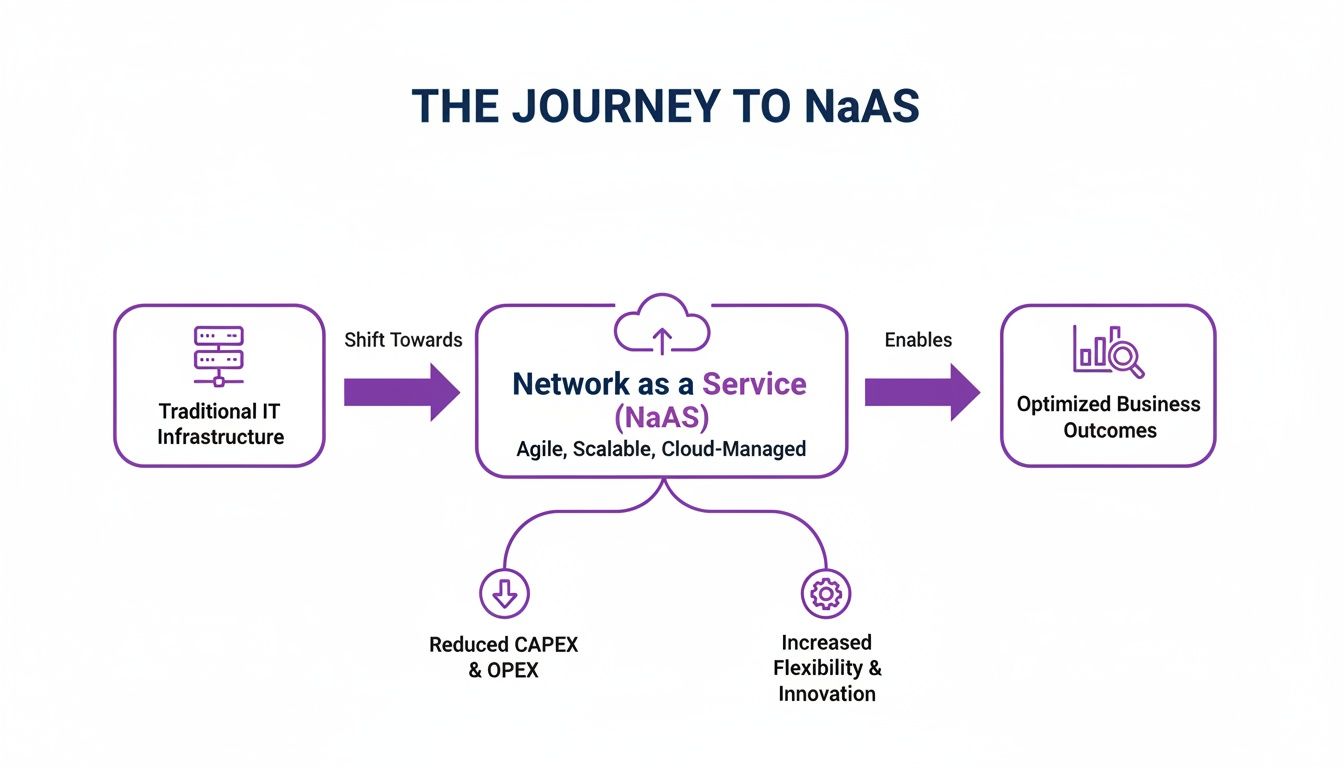
As you can see, NaaS effectively lifts the control and intelligence away from the tangled mess of on-site hardware and moves it into a far more flexible and scalable cloud model.
Moving Beyond Shared Passwords
One of the defining features of a modern NaaS architecture is its relentless focus on identity-based access. Let's be honest, the days of insecure, shared WiFi passwords for staff and clunky captive portals for guests are numbered. Instead, NaaS authenticates the user or the device, not just blindly connects them to a network name. To appreciate just how big a deal this is, it helps to understand the complexity of traditional network infrastructure it’s designed to replace.
This identity-first approach creates a much more secure and seamless experience, powered by a few key technologies:
Guest Access with OpenRoaming and Passpoint: For public-facing venues like hotels, cafés, or shops, these standards let guests connect securely and automatically. After a one-time setup, their device is recognised and connected with full encryption on future visits—and even at other enabled venues—killing login friction for good.
Staff Access with Zero Trust: For your employees, NaaS integrates directly with your company's identity provider, such as Microsoft Entra ID (what used to be Azure AD). This allows for certificate-based authentication, which is far more secure than any password. Access is granted based on an employee's role and can be instantly revoked the moment they leave the company, closing a massive security gap.
By tying network access directly to a verified identity, NaaS embeds Zero Trust principles right at the network edge. It operates on a "never trust, always verify" basis, ensuring that only authorised users and devices can get connected in the first place.
How These Components Work Together
Let's put this into a real-world context. Imagine a hotel using a NaaS platform.
From the cloud management plane, the IT team creates a couple of distinct network policies. One is for guests, enabling that seamless OpenRoaming access. Another is for staff, which integrates with Entra ID to grant secure access to internal systems based on their job—front desk staff get different permissions than the maintenance crews.
When a guest arrives, their phone automatically connects to the secure WiFi without them lifting a finger. At the same time, a member of the housekeeping team connects their work tablet, which is instantly authenticated using their corporate credentials. If you're looking at broader network improvements, it's also worth knowing how SD-WAN managed services can complement a NaaS strategy to optimise branch connectivity.
All of this happens over the hotel’s existing Aruba access points, managed entirely from the cloud. The IT manager can see exactly who is connected, monitor network health, and adjust security rules for all hotel properties from a single screen. That is the power of a unified NaaS architecture in action.
How NaaS Drives Business and Technical Value
Moving to a Networking as a Service model is much more than a simple IT upgrade. It fundamentally changes what your network can do for the business. When you stop owning hardware and start consuming a cloud-managed service, you open the door to huge financial, operational, and strategic wins. The goal shifts from just "keeping the lights on" to actively driving business results.
For anyone holding the purse strings, the most obvious benefit is financial flexibility. You're swapping a massive, upfront Capital Expenditure (CapEx) for a predictable, subscription-based Operating Expense (OpEx). That means no more sinking huge sums into network hardware that starts losing value the moment you unbox it. Instead, that capital is freed up for core business initiatives.

Financial and Operational Agility
This financial shift gives organisations the power to scale their network at a moment's notice. Opening a new retail shop, expanding to another office, or even setting up a temporary pop-up event no longer kicks off a long and costly hardware buying cycle. With NaaS, network services are rolled out through software in a fraction of the time, letting the business pounce on opportunities as they arise.
You can see this trend playing out in the wider market. The UK managed network services market—a close cousin to NaaS—was valued at USD 11.79 billion in 2024 and is on track to more than double to USD 25.09 billion by 2035. For small and medium-sized businesses, in particular, NaaS can cut capital spending by a hefty 30-35%, allowing them to focus on what they do best. For a deeper dive, you can explore the data on the UK's managed network services market .
Streamlining Technical Operations
For the tech teams on the ground, the benefits of NaaS are just as significant, mainly because it slashes the administrative workload. The old way of managing a patchwork of hardware across different sites is a huge time-drain and a recipe for human error.
NaaS brings all network management into one single cloud dashboard, giving IT teams a level of control and visibility they've never had before. This consolidation pays off in several key ways:
- Automated Provisioning: New access points and entire sites can be configured and brought online automatically, saving countless hours of manual setup.
- Simplified Troubleshooting: A bird's-eye view of the whole network helps engineers pinpoint and fix issues faster, often before users even notice something is wrong.
- Elimination of Complex Hardware: On-site hardware like RADIUS servers—which are a nightmare to configure and maintain for secure authentication—are simply replaced by cloud-native identity tools.
By taking the day-to-day headache of hardware management off the table, Networking as a Service lets your highly skilled IT pros focus on strategic projects that actually add business value, instead of getting bogged down in routine maintenance.
This operational efficiency also tightens up security. By hooking directly into identity providers like Entra ID, NaaS platforms build Zero Trust security right into the network's edge. Access is granted based on who you are, not just because you're physically in the building. Policies are applied consistently everywhere, and if an employee leaves, their access can be cut off instantly from the central dashboard, closing a major security loophole.
Transforming the Network into a Value Engine
But perhaps the biggest win is how NaaS turns the network from a necessary cost into a powerful engine for creating value. In public-facing venues like shopping centres, hotels, or transport hubs, the network is no longer just about offering an internet connection. It becomes a goldmine of business intelligence.
Modern NaaS platforms come with built-in analytics that capture anonymised, first-party data about how visitors behave. This data can unearth powerful insights, like:
- Visitor Flow and Dwell Time: See how people move through a physical space and where they spend the most time.
- Visit Frequency and Loyalty: Easily spot new vs. returning visitors to create tailored engagement strategies.
- Demographic Insights: Get a much clearer picture of your customer base to make your marketing more personal and effective.
By connecting this data to CRM and marketing automation platforms, businesses can create targeted campaigns that get real results. Imagine a retailer sending a special offer to a customer who spent time in a specific department, or a hotel welcoming a repeat guest back with a personalised message. This direct line between network investment and increased revenue makes it easy to prove a clear return on investment. You can even see how these outcomes could look for your business with our ROI calculator for WiFi analytics .
Finding the Right NaaS Provider for Your Business
Picking a partner for your Networking as a Service journey is a serious decision. It goes way beyond just choosing a piece of technology. You’re selecting a collaborator that will be woven into the fabric of your IT operations, your guest experience, and even your core business strategy. To get it right, you need a clear way to weigh up the technical nuts and bolts against your long-term business goals.
The whole process has to start with making sure the solution can play nicely with your current setup. The last thing anyone needs is a disruptive and expensive "rip and replace" project. A top-tier NaaS platform should feel more like a smart software overlay, making the hardware you already own even better.
Start with the Technical and Integration Fundamentals
Before you get dazzled by flashy features, you have to confirm that a potential provider meets your basic technical needs. A solution that can't integrate smoothly into your existing ecosystem is a non-starter, plain and simple. Getting this part right saves a world of pain down the line and makes for a much smoother transition.
Here are the critical areas to look into first:
- Hardware Compatibility: Does the platform actually work with your current network infrastructure? Look for explicit support for major vendors like Cisco Meraki , Aruba, Ruckus, and Ubiquiti UniFi to get the most out of the money you've already spent.
- Identity Provider Integration: How well does it connect with your central source of truth for user identity? Check for straightforward, native integrations with platforms like Microsoft Entra ID , Google Workspace , and Okta for secure, certificate-based staff access.
- Security and Compliance: Does the provider live and breathe modern security standards? Certifications like Passpoint and OpenRoaming aren't just nice-to-haves; they're essential for delivering encrypted, secure guest WiFi from the get-go, aligning with privacy rules like GDPR.
Look Beyond Connectivity to Business Value
A great NaaS provider gets it. They understand that a network is more than just a utility; it’s a goldmine of business insight. The ability to turn raw connectivity data into smart, actionable intelligence is what separates a basic service from a genuine strategic asset. You should be looking for partners who can help you prove a clear return on your investment.
Choosing a NaaS provider isn't just about outsourcing network management. It's about finding a partner who can help you turn your network into an engine for business growth, customer loyalty, and operational excellence.
This means hunting for features that solve specific business problems. A retail centre, for instance, needs more than just a WiFi signal. It needs analytics to understand shopper behaviour and marketing tools to encourage people to stick around longer. In the same way, a multi-tenant residential building needs solid network isolation between flats and a dead-simple onboarding process for new residents.
Create Your Provider Evaluation Checklist
To give your evaluation some structure, it’s a good idea to create a checklist of direct, pointed questions. This makes sure you’re sizing up each potential vendor against the same set of criteria—the ones that actually matter to your organisation. This checklist should cover the whole journey, from the initial setup to ongoing support and future growth.
A good evaluation process is crucial for seeing past the marketing fluff and making a decision that will pay dividends. The right NaaS partner won't just solve your technical problems today; they'll provide the platform and insights you need to hit your business targets tomorrow.
The table below offers a solid starting point for building your own checklist.
NaaS Provider Evaluation Checklist
By using a structured checklist like this, you can methodically compare providers and find the one that is truly the best fit for your specific needs, ensuring a successful, long-term partnership.
Real-World NaaS Use Cases by Industry
The real power of Networking as a Service becomes clear when you see it solving tangible problems across different sectors. It’s not just some abstract IT concept; it’s a practical tool that adapts to unique business challenges, turning the network from a background utility into a strategic asset. From creating frictionless guest experiences to securing critical infrastructure, NaaS delivers results you can actually measure.

This flexibility is driving some serious market growth. Forecasts predict the UK's NaaS market will hit USD 1.68 billion by 2026 as more industries catch on to the benefits. For instance, hospitality businesses are reporting 40% faster guest onboarding using seamless solutions like OpenRoaming, while retailers are using WiFi data to increase dwell time by 18%. These aren't just vanity metrics; they point to a clear trend towards smarter, value-driven networking. You can get a fuller picture by reading more about the networking as a service market trends .
Elevating the Guest Experience in Hospitality
For hotels, bars, and event venues, the guest experience is everything. Nothing kills the vibe faster than a clunky, old-fashioned WiFi login portal that causes immediate frustration.
A modern NaaS platform gets rid of this headache entirely. It uses technologies like OpenRoaming and Passpoint to provide seamless, secure access. A guest authenticates their device just once, and from then on, they're automatically connected to encrypted WiFi on every future visit. It completely removes the login barrier, creating a premium feel from the moment they walk in. But it goes beyond just connectivity. NaaS also delivers analytics on visitor flow, helping venues pinpoint peak times and popular areas to better manage staffing and layout.
Driving Insights and Sales in Retail
In the cut-throat world of retail and shopping centres, understanding the customer journey is non-negotiable. A huge challenge for marketing teams has always been the lack of solid, first-party data on what people actually do inside the store.
Networking as a Service flips this script, turning the store's WiFi network into a powerful data-gathering tool. By analysing anonymised visitor data, retailers gain a clear view of:
- Customer Flow: How shoppers actually move through the store or mall.
- Dwell Time: Where customers spend the most time, giving a strong indication of interest.
- Visit Frequency: The ability to distinguish new visitors from loyal, returning customers.
Armed with this intelligence, marketing teams can personalise promotions and accurately measure the impact of their campaigns, creating a direct line between network investment and increased footfall and sales.
Securing Critical Infrastructure in Healthcare
Healthcare environments pose a uniquely complex networking challenge. You've got to provide rock-solid access for staff, patients, and a growing number of critical IoT medical devices, all while protecting incredibly sensitive patient data.
NaaS tackles this head-on with a Zero Trust security model. By integrating with an identity provider like Entra ID, it ensures access is granted based on who you are, not just where you are. This is absolutely crucial, especially with NHS cyber incidents rising by 30% in 2024. For example, a doctor’s network access can be automatically revoked the second they leave the organisation, instantly closing a potential security gap. This identity-based approach secures every single connection and helps healthcare providers meet strict compliance standards.
By applying specific rules to specific roles, NaaS creates a network where clinicians can securely access patient records on their tablets while guests on the public network remain completely isolated, ensuring patient data is always protected.
Simplifying Connectivity in Residential Buildings
In multi-tenant residential properties like student housing or build-to-rent developments, the aim is to give residents a simple, home-like internet experience. At the same time, property managers need enterprise-grade security and network isolation to keep every tenant protected.
NaaS delivers the best of both worlds. Residents get a straightforward, one-time onboarding process and can connect their personal devices just like they would at home. Behind the scenes, the platform maintains strict network isolation between apartments, making sure one resident’s online activity can never interfere with another's. It's this blend of residential simplicity and enterprise security that sets modern properties apart.
Common Questions About Networking as a Service
Making the jump to a cloud-managed network is a big decision, and it's natural to have questions. You're moving away from a model you've known for years—owning and managing hardware—to a more flexible, subscription-based world. It's a significant change.
Let's walk through some of the most common queries we hear about security, hardware, implementation, and costs. Getting straight answers here is what builds the confidence to push forward with a Networking as a Service strategy.
How Does NaaS Handle Network Security and Compliance?
Forget the old "castle-and-moat" security model. It’s completely outdated for a world of hybrid work and countless connected devices. Modern NaaS platforms are built from the ground up with security at their core, not as an add-on.
They run on Zero Trust principles, which is a fancy way of saying nobody and nothing is trusted automatically. Access is granted one session at a time and is strictly policed based on a verified identity. This is often done through tight integrations with identity providers like Microsoft Entra ID. For a deeper dive into the concepts, you can learn more about the layers of security in networking .
This identity-first thinking is exactly what’s needed to meet data protection rules like GDPR, giving you granular control and a clear audit trail of who is on your network and when.
By baking security into the very fabric of network access, NaaS ensures that protection isn't just a perimeter defence but a dynamic, identity-aware function that follows the user and device everywhere.
This robust security applies to everyone who connects:
- For Staff: Certificate-based access gets rid of weak or shared passwords for good. When an employee leaves, you can instantly revoke their network access from a central dashboard, closing a huge security loophole.
- For Guests: Technologies like Passpoint and OpenRoaming encrypt guest connections from the moment they join. This completely eliminates the serious security risks that come with traditional, open public WiFi networks.
- For Multi-Tenant Venues: NaaS provides powerful network isolation. This ensures traffic from one tenant is completely walled off from another—a must-have security feature in any shared space.
Can I Use NaaS with My Existing Network Hardware?
Yes, and this is one of the biggest wins of a top-tier NaaS platform. It’s designed to be vendor-agnostic, acting as a smart software layer that works with the WiFi and network gear you already own from major brands.
This includes hardware from vendors like Cisco Meraki, Aruba, and Ubiquiti UniFi. The benefit here is massive: you get to avoid a costly and disruptive "rip and replace" of your current network infrastructure. The NaaS provider’s software simply talks to your hardware’s APIs to handle authentication, enforce access policies, and gather useful data.
It's a way to modernise your network and add powerful new features while getting the most out of the money you've already spent on hardware. Just be sure to double-check a provider’s list of supported hardware vendors before you commit.
What Does a Typical Migration to NaaS Look Like?
Migrating to a Networking as a Service model isn't a flip-the-switch affair. It’s a carefully managed, phased process designed to avoid any disruption to your day-to-day operations. Any good provider will partner with you to make the transition painless.
The process usually breaks down into four main phases:
Discovery and Planning: First things first, we need to do a full audit of your current setup. We'll work together to map out all your user groups—staff, guests, contractors, IoT devices—and define the specific access rules each one needs.
Integration: This is where the NaaS platform gets connected to your core systems. That means integrating with your identity provider (like Entra ID) and linking up with your existing network hardware across every single location.
Pilot Programme: Before going all-in, the new system gets a real-world test drive in a controlled environment. We might launch at a single site or with one user group to make sure the configuration is spot-on and everything works just as expected.
Full Rollout: Once the pilot is a success, the service is rolled out to the entire organisation. A huge benefit of NaaS is that this can all be managed from a central cloud dashboard, letting you push configurations to all sites at once with minimal on-site hassle.
How Is Return on Investment Measured with NaaS?
The ROI for NaaS isn't just about saving a few quid. It’s a mix of direct cost savings, massive operational efficiencies, and entirely new business value.
First, you have the straight financial wins. Shifting from a Capital Expense (CapEx) to an Operating Expense (OpEx) model means you no longer have to make huge, upfront investments in hardware. That frees up cash you can put towards other strategic projects.
Second, NaaS delivers huge operational savings by taking a load off your IT team. Centralised management, automated provisioning, and getting rid of complex on-premises hardware drastically cuts down the hours your team spends on manual configuration, maintenance, and firefighting.
Third, and this is often the most powerful part, is the new business value it unlocks. In places like retail or hospitality, NaaS platforms with built-in analytics can provide incredibly rich, first-party data on visitor behaviour. When you feed these insights into your marketing tools, you can create campaigns that measurably boost customer loyalty, dwell time, and repeat visits—directly linking your network investment to real business growth.
Ready to move beyond outdated passwords and unlock the full potential of your network? Purple offers a secure, identity-based networking platform that works with your existing hardware to create seamless and intelligent access for everyone. Learn how you can simplify operations and drive real business value at https://www.purple.ai .