
Hotel WiFi: complete guide for hoteliers
Discover how to design, deploy, and monetize enterprise-grade hotel WiFi networks. Covers PMS integrations (Opera, Mews), tiered bandwidth ROI, PCI DSS compliance, and guest data capture.
Video overview
Listen to this guide
View podcast transcript
Part of our core series: The Master Guest WiFi Guide →
Executive Summary
For modern hoteliers, guest WiFi is far more than a basic amenity - it is a primary driver of guest satisfaction scores, repeat direct bookings, and operational efficiency. Hotel guests expect seamless, high-speed connectivity across guest rooms, lobbies, conference spaces, and outdoor amenities. At the same time, senior IT leaders must balance high concurrent bandwidth demands against PCI DSS security compliance and data privacy regulations.
This comprehensive guide provides hotel IT managers, venue operations directors, and general managers with an actionable framework for designing, deploying, and monetizing enterprise-grade hotel WiFi networks. We explore in-room access point architecture, Property Management System (PMS) integrations, tiered bandwidth revenue models, and how to convert guest WiFi logins into verified first-party marketing data.
Listen to our companion briefing on core hotel WiFi concepts:
Technical Architecture & Network Segmentation
Logical VLAN Segmentation
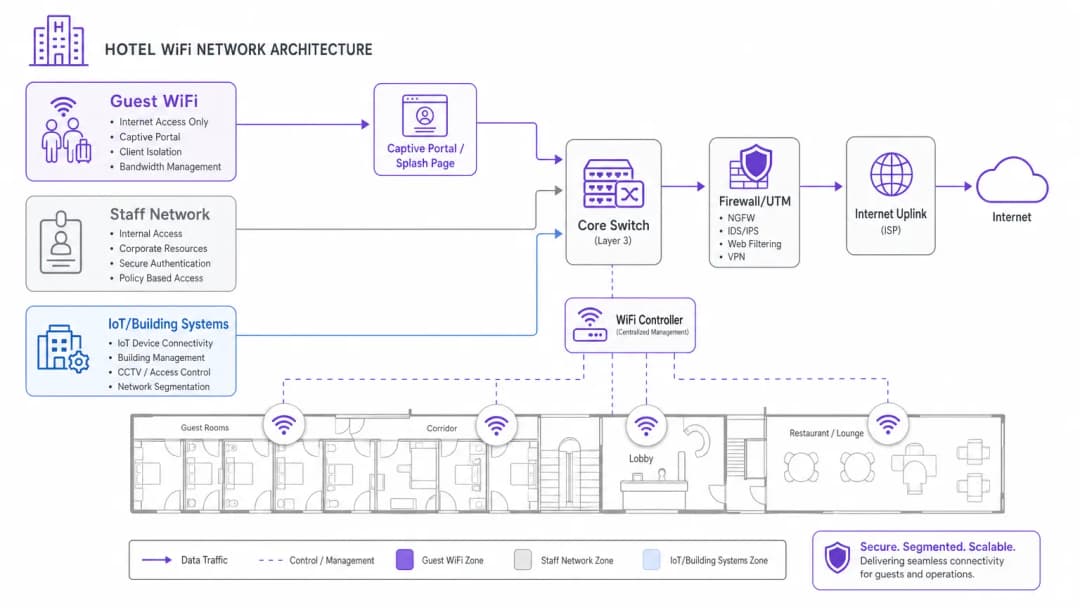
The foundation of enterprise hotel WiFi is strict logical network segmentation. A single physical infrastructure must handle distinct user groups - hotel guests, staff operations, point-of-sale (POS) terminals, and building automation (IoT/HVAC) - without compromising security or performance.
Guest traffic must be isolated on dedicated Virtual Local Area Networks (VLANs). Separating payment processing (POS) and property management systems (PMS) onto encrypted staff VLANs is a mandatory requirement for PCI DSS compliance. Furthermore, guest VLANs must enforce client isolation, preventing guest devices from communicating with one another over the local wireless network.
Wireless Density & Access Point Placement
Historical hotel WiFi designs relied on corridor-mounted access points (APs) spaced every 5 to 7 rooms. In modern hotel buildings with reinforced concrete, elevator shafts, tiled bathrooms, and foil-backed insulation, corridor signals attenuate rapidly before reaching guest beds and desks.
The current industry standard is in-room wall-plate AP deployment (1 AP per guest room or 1 AP per 2 rooms). In-room Wi-Fi 6 APs deliver clean 5GHz and 6GHz coverage, low latency for video calls, and built-in wired Ethernet ports for smart TVs, IP phones, and VoIP drop lines.
Got questions about your specific setup?
Our team works with venue operators, IT managers, and network engineers across 80,000 venues. Book a 20-minute call and we will show you how others like you solved it.
PMS Integration & Guest Authenticated Portals
Integrating your guest WiFi captive portal with your Property Management System (PMS) - such as Oracle Opera, Mews, Stayntouch, or Cloudbeds - transforms simple network access into a personalized guest experience.
How PMS Authentication Works
- Guest Association: The guest connects to the hotel WiFi SSID and is redirected to the branded captive portal.
- Room Verification: The guest enters their Room Number and Last Name (or Booking Reference).
- API Lookup: The portal queries the PMS database via secure API to verify active stay status.
- Privilege Mapping: The network applies tailored bandwidth policies based on guest loyalty tier (e.g. 50 Mbps high-speed access for VIPs vs 10 Mbps for standard guests).
Comparing Hotel WiFi Access Models
| Access Model | Authentication Method | Guest Experience | Revenue / Data Value | Security & Compliance |
|---|---|---|---|---|
| PMS Authenticated | Room Number + Last Name | Seamless, personalized welcome | High (Syncs profile & stay history) | High (Verified hotel guests) |
| Social / Form Opt-In | Email, LinkedIn, Google | Fast, single-click login | High (Captures verified email opt-ins) | Medium (Client isolated) |
| Tiered Paid Pass | Credit Card / Room Charge | Choice of free vs premium speeds | High (Direct incremental revenue) | High (Encrypted payment gateway) |
| Open Click-Through | Accept T&Cs button | Instant access | Low (No contact data collected) | Basic (Client isolated) |
Monetizing Hotel WiFi & Tiered Bandwidth ROI
High-bandwidth video streaming (4K Netflix, YouTube, Twitch) and remote work video conferencing dominate evening guest network consumption. Unrestricted open bandwidth leads to uplink saturation and bad guest reviews.
Implementing Tiered Bandwidth
Hoteliers can implement a two-tier bandwidth model:
- Free Basic Tier: 5-10 Mbps symmetric speed per device - perfect for web browsing, email, and social messaging.
- Premium High-Speed Tier: 30-50 Mbps high-priority bandwidth for $7.99 to $12.99 per 24 hours (or complimentary for loyalty members).
This strategy guarantees smooth baseline performance for all guests while generating recurring revenue from business travelers and power users.
To dive deeper into guest network strategies and enterprise security, explore our Guest WiFi Guide, WiFi Marketing Guide, and Enterprise WiFi Security Guide.
Key Definitions
PMS Integration
Connecting guest WiFi captive portals with Property Management Systems (e.g., Oracle Opera, Mews, Stayntouch) to authenticate guests by room number or name and sync profile preferences.
Essential for seamless guest check-in, VIP bandwidth rules, and automated post-stay email triggers.
Client Isolation
A security feature that prevents guest devices connected to the same wireless network from discovering or communicating with each other.
Mandatory on hotel guest networks to prevent lateral cyber attacks and data sniffing between rooms.
Tiered Bandwidth
Allocating different bandwidth limits and priorities based on guest tier (e.g., free 5Mbps for standard browsing vs. paid 50Mbps for 4K streaming and gaming).
Allows hoteliers to monetize high-bandwidth demand while protecting uplink capacity for all guests.
In-Room Access Point (AP)
Deploying low-profile wall-plate WiFi 6 access points inside guest rooms rather than sparse ceiling mounts in corridors.
Eliminates corridor signal attenuation from bathroom tile, foil insulation, and heavy fire doors.
Worked Examples
A 250-room business hotel experiences severe guest complaints regarding WiFi speeds during peak evening hours (7 PM - 10 PM). The property currently relies on a 500 Mbps broadband connection with access points mounted in central corridors. What network architecture upgrade should be implemented?
- Upgrade the internet uplink to a 1 Gbps dedicated leased line with guaranteed SLA to handle peak concurrent streaming traffic. 2. Redesign the wireless architecture to an in-room AP model (1 AP per room or per 2 rooms) to eliminate wall attenuation. 3. Implement bandwidth shaping on the guest VLAN (e.g., 10 Mbps baseline per client) alongside an optional paid 50 Mbps high-speed tier.
A boutique hotel group wants to capture verified guest contact details for direct booking campaigns while ensuring strict compliance with CCPA and privacy regulations. How should the captive portal be configured?
Deploy a captive portal integrated with the Property Management System (PMS). Configure the login screen to require an explicit, unbundled opt-in checkbox for marketing communications, separate from the network terms of service. The portal automatically records consent timestamps, IP addresses, and MAC addresses, while syncing verified guest profiles into the central marketing platform.
Practice Questions
Q1. Your hotel operations director wants to connect new mobile point-of-sale (POS) tablets on the outdoor pool terrace to the existing Guest WiFi network. How should you respond?
Hint: Consider PCI DSS compliance and network segmentation.
View model answer
Refuse the request. Connecting payment terminals to an open Guest WiFi network violates PCI DSS rules and exposes credit card data to risk. The POS tablets must connect to a dedicated, encrypted Staff/POS VLAN secured with WPA3-Enterprise, completely isolated from guest traffic.
Q2. An interior designer insists on concealing ceiling-mounted access points inside decorative brass enclosures to preserve hotel lobby aesthetics. What is the technical impact?
Hint: Consider how metallic enclosures interact with radio signals.
View model answer
Metal enclosures act as Faraday cages, severely blocking RF signals and creating dead zones. Access points must be mounted externally or behind RF-transparent enclosures (such as plastic or drywall). Vendor-approved vinyl skins can match decor without degrading WiFi performance.
Q3. The hotel marketing manager asks to automatically subscribe every guest who connects to guest WiFi to the daily hotel newsletter. How should this be handled?
Hint: Consider explicit consent requirements under CCPA and privacy laws.
View model answer
The portal cannot automatically subscribe guests. Consent must be explicit, informed, and unbundled. The splash page must feature an unticked checkbox for marketing opt-in, distinct from accepting the network terms of service.
Frequently asked questions
Why is in-room AP deployment preferred over corridor access points in hotels?
Modern hotel construction materials (reinforced concrete, foil insulation, fire doors, and bathroom tile) cause RF attenuation of 10 to 18 dB per wall. Corridor-mounted APs struggle to penetrate guest rooms, forcing client devices to transmit at maximum power and degrading battery life. In-room wall-plate APs provide line-of-sight 5 GHz and 6 GHz coverage, sub-millisecond roaming latency, and built-in Gigabit Ethernet switch ports for smart TVs, VoIP phones, and IoT thermostats.
How does hotel WiFi integrate with Property Management Systems (PMS)?
Guest WiFi captive portals integrate with hotel PMS platforms (such as Oracle Opera, Mews, Stayntouch, and Cloudbeds) via secure REST APIs or Micros FIAS protocols. When guests connect, they authenticate using their room number and surname or reservation code. The portal validates active stay status against the PMS in real time, applies VIP bandwidth profiles automatically, and posts optional tiered service charges directly to the guest folio.
How do tiered WiFi bandwidth passes generate revenue for hoteliers?
Tiered bandwidth models provide a complimentary baseline speed (such as 10 Mbps for email and social browsing) while offering paid high-speed passes (such as 50 to 100 Mbps for 4K video streaming, gaming, or remote work videoconferencing). Guests purchase 24-hour or multi-day passes via credit card, Apple Pay, or direct room charge. This protects core uplink capacity during peak evening hours while generating predictable ancillary revenue.
What network segmentation is required for hotel WiFi and PCI DSS compliance?
Hotels must maintain strict Layer-2 and Layer-3 network segmentation using dedicated Virtual Local Area Networks (VLANs). Guest WiFi traffic must be isolated on an independent guest VLAN with client isolation enabled, preventing guest devices from discovering or attacking one another. Point-of-Sale (POS) card terminals, Property Management Systems (PMS), and administrative staff devices must reside on separate, encrypted VLANs protected by next-generation firewall access control lists (ACLs) to satisfy PCI DSS Requirement 1.3.
How do hotels handle MAC address randomisation across returning guests?
iOS, Android, and Windows rotate randomized MAC addresses periodically, which can cause guests to see repeated login splash screens when returning to the hotel or moving between common areas. Enterprise platforms like Purple resolve this by issuing Passpoint (Hotspot 2.0) encrypted profiles or binding authenticated guest sessions to secure HTTP session tokens and verified user identity profiles rather than transient physical MAC addresses.
How does Purple improve guest WiFi ROI for hotels and resorts?
Purple turns hotel guest WiFi into a high-conversion marketing and operations asset. By streamlining captive portal logins with social and PMS authentication, Purple captures verified, GDPR-compliant guest profiles and syncs them with hospitality CRMs (such as HubSpot, Salesforce, and Revinate). Hoteliers leverage real-time footfall analytics, dwell times, and automated post-stay review triggers (TripAdvisor, Google Reviews) to drive repeat direct bookings and reduce OTA commission fees.
Continue reading in this series
How to Set Up Guest WiFi: A Secure Enterprise Configuration Guide
This authoritative guide provides IT leaders and network architects with a definitive blueprint for deploying secure enterprise guest WiFi. It covers essential architecture, WPA3 migration, VLAN segmentation, and captive portal integration to protect internal systems while capturing compliant first-party data.
How to Fix Slow WiFi Without Upgrading Your Internet Plan
A comprehensive technical reference guide for IT managers and network architects on optimizing enterprise WiFi performance without increasing ISP bandwidth. Covers RF tuning, client density management, QoS implementation, and how to leverage WiFi analytics to diagnose and resolve bottlenecks.
How to Build a Campus WiFi Network: A University IT Guide
This technical guide provides a comprehensive blueprint for designing and deploying high-density campus WiFi networks, covering everything from active site surveys and access point placement to controller architecture, seamless roaming, and secure guest onboarding. It is written for IT managers, network architects, and CTOs at universities and large venues who need actionable guidance to plan and execute a wireless deployment this quarter. The guide also maps Purple's Guest WiFi and analytics platform to real integration points within the deployment lifecycle.
Got questions about your specific setup?
Our team works with venue operators, IT managers, and network engineers across 80,000 venues. Book a 20-minute call and we will show you how others like you solved it.