Venue WiFi dependency and guest engagement calculator
Evaluate how heavily your visitors rely on WiFi during their visit, model first-party contact acquisition, and calculate annual CRM value.
Analysis: what this means for your venue
Critical daily utility: Guests consider seamless WiFi non-negotiable. Poor connectivity directly drives negative reviews, early venue abandonment, and lost repeat spend.
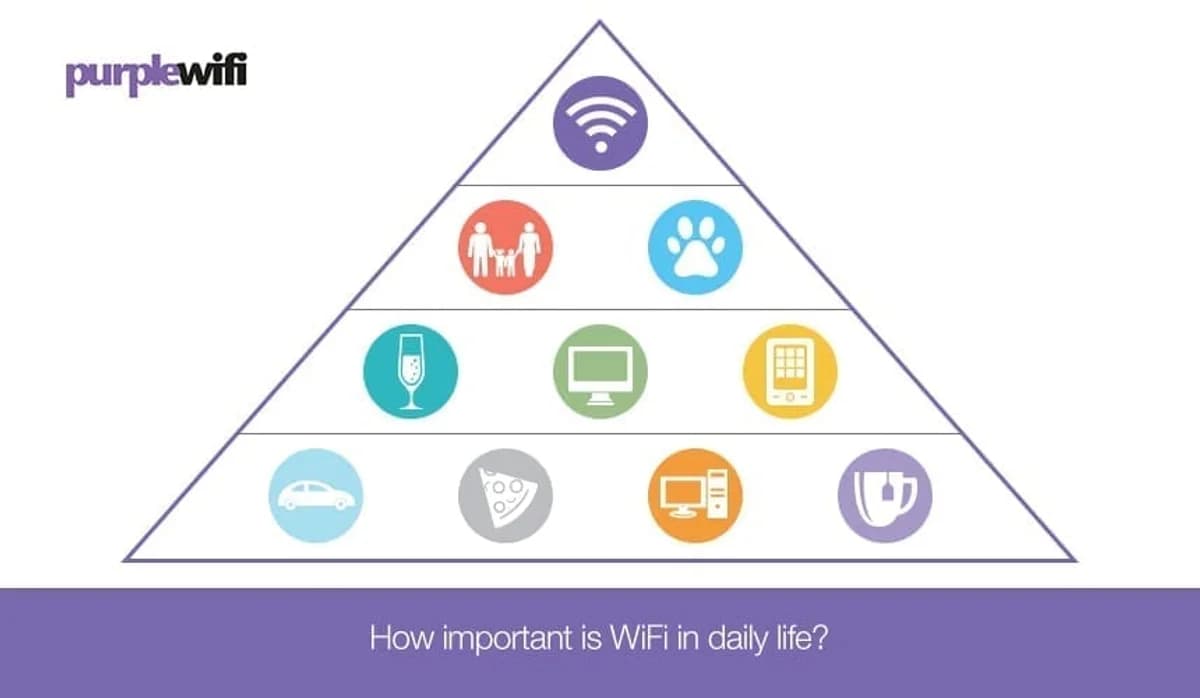
Wireless connectivity has shifted from a convenient luxury into an essential utility that powers modern daily life. From remote work and digital banking to real-time navigation and social interaction, individuals depend on continuous, high-speed WiFi access across homes, workplaces, and public venues.
For venue operators across retail, hospitality, healthcare, and transit, high daily WiFi usage presents a massive commercial opportunity. Deploying managed guest WiFi solutions alongside branded captive portal sign-in enables businesses to deliver seamless connectivity while capturing first-party data, increasing guest dwell time, and generating measurable venue revenue.
Key takeaways: Why WiFi is essential in daily life and business
- Essential digital utility: Over 85% of consumers and venue visitors consider reliable wireless access as critical as basic utilities in daily life.
- Business footfall and dwell time: Offering seamless guest WiFi increases customer dwell time by up to 45 minutes in retail, hospitality, and public venues.
- Data capture and presence analytics: Branded captive portals allow venue operators to collect compliant customer data while gaining real-time spatial movement insights.
- Enterprise security and trust: WPA3 Enterprise, 802.1X, and iPSK private network isolation protect personal and corporate devices on shared networks.
- Modern venue transformation: Integrating WiFi marketing with location analytics turns daily guest connectivity into measurable revenue growth.
The evolution of WiFi: From luxury perk to essential utility
In the early era of mobile computing, offering wireless access in coffee shops or hotel lobbies was viewed as a novel perk. Today, wireless connectivity sits alongside electricity, water, and heating as a fundamental daily requirement. Independent consumer surveys consistently confirm that access to fast, reliable internet ranks among the top daily priorities for individuals across all age groups.
Several key factors have driven this structural shift in daily connectivity expectations:
- Ubiquitous smartphone and IoT reliance: The average consumer carries multiple connected devices, including smartphones, smartwatches, and tablets, requiring constant cloud synchronization and data connectivity.
- Flexible and remote work models: Hybrid employment means professionals perform daily work tasks from cafes, airport lounges, hotel lobbies, and co-working spaces, demanding reliable corporate access.
- Shift to touchless and digital commerce: Modern retail and hospitality venues rely on WiFi for digital menu access, contactless payments, mobile app check-ins, and self-service kiosks.
- High-bandwidth entertainment: Video streaming, social media uploads, and real-time gaming require high-throughput wireless connections that standard cellular connections cannot always deliver indoors.
5 core reasons WiFi is essential in modern daily life
Understanding why WiFi is central to daily life highlights the direct connection between consumer digital habits and physical venue operations:
1. Remote work and business productivity
Cloud applications, HD video conferencing, and instant collaboration platforms depend on stable wireless connections. Employees working away from traditional offices expect public venues to provide enterprise-grade WiFi with low latency and high bandwidth to maintain productivity.
2. Digital commerce and instant transactions
Modern consumers rarely carry cash, preferring digital wallets, QR code ordering, and mobile payments. Physical stores, restaurants, and entertainment venues must maintain active WiFi infrastructure to support both customer transactions and cloud-based point-of-sale (POS) systems.
3. Indoor navigation and venue wayfinding
In large public environments such as airports, shopping malls, and hospitals, cellular signals struggle to penetrate dense building materials. High-density WiFi networks combined with location analytics allow visitors to navigate indoor spaces effectively using mobile wayfinding.
4. Social interaction and digital communication
Staying connected with family, friends, and professional networks occurs primarily through internet-based messaging and social platforms. Providing fast WiFi enables guests to share in-venue experiences immediately on social media, amplifying organic brand exposure for the venue.
5. Smart infrastructure and IoT automation
Beyond consumer devices, physical venues use WiFi to connect environmental sensors, occupancy monitors, digital signage, and automated building controls, streamlining daily facility management.
Comparing daily connectivity options for commercial venues
Not all wireless access options deliver equal value to venue operators or visitors. The table below outlines how different connectivity models compare in terms of daily usability, security, and business ROI:
| Connectivity option | Daily usability | Security tier | Venue business value | Key limitation |
|---|---|---|---|---|
| Mobile cellular data (4G/5G) | Variable indoors; subject to signal attenuation in concrete/steel venues | Standard carrier encryption | Zero venue visibility or data capture | Indoor dead zones and data plan caps |
| Unmanaged open WiFi | Easy access but prone to congestion and poor quality of service | Low (Unencrypted open network) | Basic connectivity with high operational risk | Vulnerable to man-in-the-middle attacks |
| Enterprise guest WiFi & captive portal | High-speed indoor & outdoor roaming with automatic splash onboarding | High (VLAN client isolation & WPA3) | First-party data capture, presence analytics & targeted marketing | Requires initial hardware & portal setup |
| Private PSK (iPSK) / 802.1X | Seamless auto-connect for staff, residents, and subscribers | Highest (Per-user dynamic encryption) | Complete multi-tenant isolation & zero-trust security | Designed for authenticated staff or multi-tenant residents |
Transforming daily WiFi access into measurable business growth
Delivering high-quality guest WiFi is no longer an operational expense - when executed correctly, it functions as a high-ROI revenue channel. Through a customized captive portal, venue operators turn daily network sign-ins into actionable customer intelligence:
- Compliant data collection: Gather verified customer email addresses, mobile numbers, and demographic details with clear, GDPR- and CCPA-compliant opt-in consent.
- Targeted in-venue promotions: Deliver personalized splash screen promotions, highlight daily menu specials, or encourage downloads of proprietary mobile apps during onboarding.
- Automated customer retention: Trigger automated email campaigns based on visitor visit frequency, lost-customer re-engagement rules, or birthday rewards using our WiFi marketing solutions.
- Enterprise network security: Protect network reputation with certified standards as outlined in our Enterprise WiFi Security Guide.
Optimise your daily venue WiFi experience
Purple powers secure guest WiFi, presence analytics, and automated marketing for over 80,000 venues worldwide, including McDonald's, Harrods, and Manchester Airports Group.
Enterprise security and compliance for daily WiFi users
As public WiFi usage increases, protecting user data and venue infrastructure against security threats is critical. Unencrypted open networks expose visitors to eavesdropping and credential theft. Modern venues implement comprehensive security controls to protect every connection:
- VLAN client isolation: Prevents connected devices on guest networks from discovering or communicating with each other, blocking lateral malware movement.
- WPA3 Enterprise and 802.1X authentication: Provides individual encryption keys for authenticated users on enterprise and multi-tenant networks as detailed in our multi-tenant WiFi guide.
- Private PSK (iPSK): Enables unique, individual pre-shared keys for residents, staff, or VIP guests without complex certificate management.
- Content filtering and bandwidth management: Prevents access to inappropriate web categories while applying rate limits to preserve network performance for all visitors.
Frequently asked questions about WiFi in daily life
Why is WiFi considered an essential utility in daily life?
WiFi connectivity underpins modern work, commerce, communication, and education. Consumers rely on continuous wireless access for remote working, digital payments, streaming media, and navigation. In physical venues, reliable WiFi has shifted from a secondary amenity to a baseline requirement that directly impacts visitor satisfaction and business choice.
How do commercial venues benefit from daily guest WiFi usage?
Businesses use managed guest WiFi to turn daily connectivity demand into valuable marketing assets. By requiring a quick sign-in via branded captive portals, venues collect compliant first-party data, deliver targeted promotional offers, increase dwell time, and analyze footfall patterns across physical locations.
How is public WiFi security maintained for daily users?
Enterprise guest WiFi platforms secure public browsing using VLAN client isolation, content filtering, and WPA3 encryption. These measures prevent unauthorized device-to-device visibility on shared networks while ensuring compliance with international standards such as ISO 27001, Cyber Essentials, and GDPR.
What is the difference between daily cellular data and venue WiFi?
While cellular data provides broad outdoor coverage, venue WiFi provides high-speed indoor performance in buildings where cellular signals are blocked by thick construction materials. For venue operators, guest WiFi also enables internal location analytics and direct digital customer engagement that cellular networks cannot provide.