
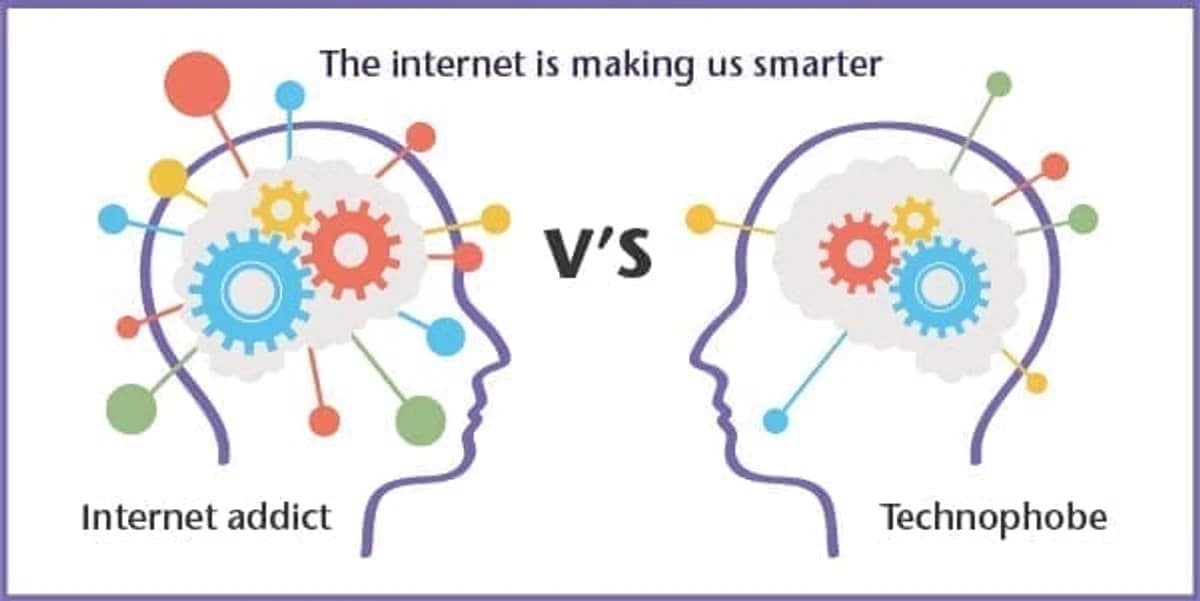
The internet is making us smarter

By Richard Ellor
30 June 2014
3 min read
The internet is making us smarter
Interactive IT Architecture Tool

Digital connectivity and cognitive productivity advisor

Benchmark how high-performance enterprise WiFi, low DNS latency, and frictionless captive portals enhance search efficiency and unlock productive visitor hours.

650

Peak simultaneous devices actively querying network resources.

18

Average information lookups, SaaS index requests, and browser searches.

14 ms

Time for resolver to complete authoritative name lookups.

12 Mbps

Bandwidth cap enforced by wireless controller per client.

How many times each seat is reused across a trading day.
A regular returning nine times a month is one person, not nine.
Only a first-time visitor creates a new CRM profile.
Ready to upgrade your venue WiFi into a productivity engine?
Explore how Purple cloud guest WiFi combines rapid onboarding, enterprise zero-trust security, and automatic visitor analytics.
Explore guest WiFi
Useful? Link to this tool

Internet searches and brain patterns

It is widely thought that mental stimulation might improve the brain's ability to function. In a study, researcher Small 2009 and colleagues suggested that simply carrying out internet searches might increase brain functioning too.

The researchers looked at a small sample (24 participants) of middle- to older-aged neurologically normal participants, who were all from a similar educational background. Half of the participants had minimal past internet search experience and these people were called the Internet Naive group. The other half were allocated into a group known as the Internet Savvy group, so-called because they had extensive past experience in searching on the internet.

During the research test the participants were required to take part in two conditions. One was to carry out a novel internet search task, the other task was a reading activity where the text had to be read off a computer screen.

The internet naive group

Participants' brain patterns during both the tasks were assessed. The Internet Naive group showed a similar brain pattern during both tests. The areas showing activation when they were completing the novel search task and when they were reading text from a screen, were the areas of the brain associated with reading, language, memory and certain visual areas.

The internet savvy group

As expected, when the savvy group were reading text from a screen, the findings mimicked those of the internet naive group. Areas of the brain activated were again reading, language and memory. However, this group, who were familiar with carrying out internet searches, were found to have greater activation in other areas of the brain when it was their turn to do the novel internet search task.

Could internet searching be more stimulating than just reading?

When the researchers looked at which areas were being activated by the savvy group when internet searching, they found that decision making, complex reasoning and additional visual areas were being activated as well. In fact, there was a twofold increase in activation of the major regional clusters in the net-savvy group.

A richer sensory experience

Although the researchers acknowledge in their concluding comments that more research needs to be carried out (larger sample sizes and taking account of other lifestyle factors that might affect the results are some suggestions they make) it seems that internet searching may indeed work other areas of the brain. Small says it's interesting to see how computerised technologies may be beneficial to improving brain function.

It's exciting to think that internet experience may increase brain responsiveness and with today's internet-savvy young children we could be looking at a much smarter next generation.


Frequently asked questions

How does internet searching stimulate brain function compared to reading?

Neuroimaging studies demonstrate that conducting online searches triggers dynamic decision-making, visual spatial processing, and complex reasoning circuits in the prefrontal cortex. While reading engages language and memory centres, interactive searching requires active evaluation of search results, link navigation, and synthesis, producing a twofold increase in activated neural clusters.

What did the 2009 UCLA study discover regarding internet experience and brain activity?

The study led by Dr Gary Small at UCLA evaluated neurologically typical adults divided into internet naive and internet savvy groups. While both groups exhibited identical brain activation patterns during passive screen reading, the internet savvy group showed significantly broader activation across frontal, temporal, and cingulate cortex regions during web searching, demonstrating experience-dependent neuroplasticity.

Why is low network latency critical for maintaining cognitive flow during research?

Cognitive flow relies on continuous working memory loops. Delays in DNS resolution, TLS negotiation, or packet loss introduce micro-delays that force task switching and cognitive fatigue. High-speed enterprise WiFi with localized caching and low latency ensures instantaneous page loading, allowing researchers, students, and professionals to sustain deep focus.

How do modern WiFi 6 and WiFi 7 architectures support high-density research venues?

Modern wireless standards utilize Orthogonal Frequency-Division Multiple Access (OFDMA), multi-user MIMO, and clean 6 GHz spectrum to divide wireless channels into sub-carriers. In high-density environments like university libraries, convention centers, and co-working spaces, this eliminates airtime contention, allowing hundreds of concurrent users to execute searches simultaneously.

How do captive portals balance frictionless access with venue cybersecurity?

Modern cloud guest WiFi captive portals provide single-click onboarding, social login, or Passpoint Hotspot 2.0 provisioning while enforcing client isolation on isolated VLANs. This ensures public visitors enjoy immediate internet connectivity for work and research while isolating their devices from other venue traffic and corporate intranet assets.

How does Purple enhance digital connectivity across public and enterprise venues?

Purple provides a cloud-based guest WiFi, analytics, and engagement platform that integrates seamlessly with existing enterprise access points from Cisco Meraki, Aruba, Ruckus, and Juniper Mist. Purple delivers reliable, high-speed connectivity for visitors while providing operators with GDPR-compliant CRM synchronization, spatial footfall insights, and automated marketing workflows.

Ready to get started?

Book a demo with one of our experts to see how Purple can help you achieve your business goals.

Speak to an expert