Discover the advantages wired network: 8 Benefits for Your Venue in 2026
In an era dominated by wireless connectivity, it's easy to overlook the foundational technology that makes it all possible: the wired network. While WiFi offers unparalleled convenience, the underlying Ethernet infrastructure remains the undisputed champion of performance, reliability, and security. For modern venues in hospitality, retail, healthcare, and residential sectors, understanding the advantages a wired network provides is not about choosing one over the other; it's about architecting a hybrid system where each excels.
A robust wired backbone is the secret to delivering a flawless, high-performance wireless experience, especially when deploying advanced identity-based networking platforms. This guide moves beyond the obvious to explore the critical, often unseen, benefits of a well-planned wired infrastructure, revealing why copper and fibre are still the bedrock of any successful, scalable, and secure digital environment. We will cover how a physical connection delivers superior speed, enhances security protocols, and ensures the deterministic performance required for critical applications.
From ensuring sub-millisecond authentication speeds for guest WiFi to providing a concrete, auditable trail for compliance, the humble cable offers strategic advantages that wireless alone cannot match. This article delves into the eight key reasons why a wired network is an indispensable investment for future-proofing your venue's connectivity and maximising the potential of your entire IT ecosystem. Let’s explore why this established technology remains essential for any forward-thinking organisation.
1. Superior Speed and Bandwidth
One of the most significant and consistent advantages of a wired network is its raw performance in terms of speed and bandwidth. While Wi-Fi technology has made impressive strides, it cannot yet match the sheer data-handling capacity and stability of a physical Ethernet connection.
Unmatched Data Transmission Rates
Wired networks deliver exceptionally high-speed data transmission with guaranteed bandwidth rates. Modern Ethernet standards, facilitated by structured cabling, offer speeds that are orders of magnitude greater than typical wireless setups.
- Category 6A (Cat6A): Supports bandwidth up to 10 Gigabits per second (Gbps), making it a powerful standard for modern enterprise and commercial needs.
- Category 8 (Cat8): Designed for data centre environments, this cabling supports staggering speeds of up to 40 Gbps over shorter distances.
Unlike Wi-Fi, where the available bandwidth is shared among all connected devices in a given area, a wired connection provides a dedicated, uncontested lane for data. Each port on a network switch offers its full bandwidth to the connected device, ensuring predictable, high-level performance free from the interference and signal degradation that affects wireless connections.
Practical Impact on Critical Operations
This dedicated bandwidth is crucial for organisations that rely on consistent network performance for their core operations. For hospitality and retail clients using platforms like Purple for guest authentication and analytics, a robust wired backbone is non-negotiable. It ensures that critical backend systems operate flawlessly, even during peak traffic periods.
For example, a large hotel chain uses a wired infrastructure to connect hundreds of guest-facing Wi-Fi access points to its central servers. This setup ensures that Purple's authentication gateways, which manage guest logins and data collection, have a stable, high-speed connection. This prevents bottlenecks, providing a seamless and quick login experience for thousands of guests simultaneously, without impacting essential back-of-house operations like CRM synchronisation or payment processing.
Actionable Tips for Implementation
To leverage the full speed advantages of a wired network, consider the following:
- Future-Proof with Cat6A: When installing or upgrading infrastructure, use Cat6A cabling as a minimum standard. This ensures your network can support high-volume authentication traffic and other bandwidth-intensive applications for years to come.
- Prioritise Wired Backhaul: Connect all Wi-Fi access points to your core network via Ethernet. This backhaul connection is critical for delivering a consistent and reliable guest Wi-Fi experience, as the wired link can handle the aggregated traffic from all connected wireless users.
- Segment Your Network: A key strategy is to use the wired backbone for management, security, and authentication traffic, while dedicating the wireless network for guest and user access. Understanding the role of each component is vital; you can learn more about how network switches form the core of this infrastructure and enable effective segmentation.
- Ensure Sufficient Power: Utilise switches with adequate Power over Ethernet (PoE) budgets to power high-performance access points that serve guest authentication portals without needing separate power supplies.
2. Enhanced Security and Encryption
In an era of increasing digital threats, one of the primary advantages of a wired network is its inherently superior security posture. Unlike wireless signals that broadcast data over the air, wired connections transmit data through physically contained copper or fibre-optic cables, drastically reducing the attack surface for interception and unauthorised access.
Mitigating Over-the-Air Vulnerabilities
Wired networks create a physically isolated environment that is immune to common wireless attacks. Data cannot be intercepted using radio frequency sniffing tools, protecting it from threats that target Wi-Fi networks. This physical security provides a strong foundation for protecting sensitive information.
- Physical Access Control: Gaining access to data on a wired network requires a physical connection to a port, which is far more difficult to achieve covertly than intercepting a radio signal.
- Contained Broadcast Domain: Data transmissions are confined to the cable itself, preventing "man-in-the-middle" attacks that are common on open or poorly secured Wi-Fi networks.
- Point-to-Point Encryption: Modern wired protocols, such as those defined by the IEEE 802.1X standard, provide robust, port-based network access control and encryption, ensuring that only authenticated and authorised devices can connect.
Practical Impact on Critical Operations
For organisations handling sensitive customer or patient data, this physical security is indispensable. Platforms like Purple rely on a secure wired backbone to protect the transmission of identity data and authentication tokens between Wi-Fi access points and central servers.
For instance, a healthcare provider uses its wired infrastructure to connect the guest Wi-Fi access points that run Purple's authentication platform. When a patient connects, their identity data is transmitted over this secure wired backhaul to the authentication servers. This setup prevents the exposure of sensitive personal information and ensures compliance with data protection regulations, such as GDPR.
Actionable Tips for Implementation
To maximise the security advantages of a wired network, implement the following best practices:
- Segment Your Network: Use Virtual LANs (VLANs) to create isolated segments. Dedicate a separate, highly secured VLAN for Purple authentication servers, keeping this critical infrastructure completely separate from general guest traffic.
- Implement Port-Based Access Control: Deploy IEEE 802.1X on wired switch ports used by staff. This ties network access directly to corporate directory services (like Entra ID or Okta), ensuring only verified users can connect company devices.
- Enable Port Security: Configure network switches to allow only specific, pre-approved MAC addresses to connect to a port, preventing unauthorised devices from being plugged into the network.
- Secure Physical Infrastructure: Regularly audit and secure physical access to network closets, patch panels, and cable runs to prevent tampering or unauthorised connections. The security of your wired network begins with its physical integrity. To understand our commitment to this, you can review Purple's comprehensive data and security overview.
3. Reliability and Uptime
One of the most compelling advantages of a wired network is its outstanding reliability and operational uptime. While wireless networks are susceptible to environmental interference, a physical Ethernet connection provides a steadfast, predictable link that is essential for mission-critical services, guaranteeing consistent performance 24/7.
Uninterrupted Service Delivery
Wired networks are inherently more stable than their wireless counterparts. They are immune to the radio frequency (RF) interference, physical obstacles, and signal degradation over distance that can plague Wi-Fi performance. This results in an exceptionally stable connection with predictable uptime, often achieving 99.99% or higher availability for core services.
- Immunity to Interference: A shielded cable is not affected by other electronic devices, neighbouring wireless networks, or physical barriers like concrete walls.
- Consistent Connectivity: Each hardwired connection provides a dedicated, stable link, ensuring that performance does not fluctuate based on network congestion or environmental changes.
This level of dependability is crucial for businesses where any network downtime directly translates into lost revenue and a poor customer experience. For platforms like Purple, which manage guest authentication and data analytics, a reliable wired backbone ensures services are always available.
Practical Impact on Critical Operations
For large-scale venues in hospitality, retail, and healthcare, network reliability is non-negotiable. It underpins everything from customer-facing services to back-end operational systems. A stable wired infrastructure ensures that Purple's authentication portals, directory integrations, and analytics data collection operate without interruption.
For example, a major hotel chain like Marriott relies on a robust wired network to connect its Wi-Fi access points across global properties. This ensures that the Purple guest authentication service maintains 99.99% uptime. This unwavering reliability means guests can always connect seamlessly, and the hotel continuously collects valuable analytics data without any service gaps, protecting both the customer experience and revenue streams.
Actionable Tips for Implementation
To maximise reliability and guarantee uptime with a wired network, consider these strategies:
- Implement Redundancy: For critical connections, such as those linking to Purple authentication servers, run redundant cabling through separate physical paths or trays to prevent a single point of failure.
- Utilise Managed Switches: Deploy managed switches with features like automatic failover and link aggregation. This ensures that if one connection or device fails, traffic is instantly rerouted, maintaining continuous service.
- Establish and Monitor SLAs: Define clear Service Level Agreements (SLAs) for your wired infrastructure. You can discover how SLAs guarantee network performance and ensure your providers meet the required uptime standards for supporting guest-facing services.
- Deploy Network Monitoring Tools: Use protocols like SNMP and NetFlow to proactively monitor the health of your network. These tools can help you identify and resolve potential issues, like a failing switch port, before they impact users authenticating via Purple.
4. Deterministic Performance and Low Latency
Beyond raw speed, a key advantage of a wired network is its ability to deliver deterministic performance. This means its behaviour is highly predictable and consistent, a stark contrast to wireless networks, which are susceptible to unpredictable fluctuations in latency, jitter, and packet loss caused by environmental interference.
Consistent Millisecond Response Times
Wired networks provide consistently low, sub-millisecond latency because the physical connection creates a direct, interference-free path for data. This predictability is measured in two key ways:
- Latency: The time it takes for a data packet to travel from its source to its destination. Wired connections reliably achieve latency under 1ms.
- Jitter: The variation in latency over time. Ethernet virtually eliminates jitter, ensuring data packets arrive in a smooth, predictable stream.
This deterministic behaviour is non-negotiable for real-time applications where even minor delays can cause significant disruption. For services like Purple's authentication infrastructure, which handles passwordless logins and real-time data analytics, the consistent performance of a wired backbone is essential for delivering an instant and seamless user experience.
Practical Impact on Critical Operations
The reliable, low-latency nature of a wired network directly impacts customer experience and operational efficiency. In environments with high user density, such as event venues or large hotels, this consistency prevents authentication bottlenecks and ensures data flows without delay.
For instance, a major event venue uses a wired backhaul to connect its Wi-Fi access points to Purple’s authentication servers. This setup guarantees that thousands of concurrent guest registrations are processed in milliseconds. As attendees connect, their authentication journey is completed almost instantly, avoiding frustrating queues and ensuring they gain access to the network without delay, all while providing the venue with reliable real-time footfall analytics.
Actionable Tips for Implementation
To harness the low-latency advantages of a wired network for authentication and analytics, consider these strategies:
- Monitor End-to-End Latency: Use network monitoring tools to track the latency from your Wi-Fi access points to the authentication servers, aiming for a target of less than 50ms to ensure a rapid login experience.
- Prioritise Authentication Traffic: Implement Quality of Service (QoS) policies on your network switches. By prioritising authentication packets, you prevent bulk data transfers, like guest downloads, from causing delays in the login process.
- Optimise Network Topology: Design a hierarchical network that minimises the number of "hops" or switches between the access points and your core servers. A flatter network architecture reduces cumulative latency.
- Analyse Switch Port Data: Regularly review switch port statistics and NetFlow data to proactively identify and troubleshoot potential latency sources before they impact the user experience. This is a crucial part of maintaining the high performance expected from the advantages of a wired network.
5. Scalability for Multi-Venue and Multi-Tenant Deployments
One of the most powerful advantages of a wired network is its ability to provide a scalable and secure foundation for multi-venue and multi-tenant environments. A robust wired infrastructure is essential for organisations that need to manage network services, like Purple's identity and authentication platform, consistently across numerous properties while ensuring strict data isolation between different tenants or locations.
Enabling Centralised Management with Secure Isolation
Wired networks, utilising structured cabling and advanced switching, create a stable backbone for connecting disparate physical locations to a centralised management system. This architecture allows an organisation to deploy a unified guest Wi-Fi experience and consistent security policies across a global portfolio of properties, from a single administrative console.
- Secure Interconnects: High-speed fibre or copper links connect individual properties to a central data centre or cloud environment where authentication services are managed.
- Virtual Local Area Networks (VLANs): VLANs are used to logically segment the network, creating isolated virtual networks for each tenant or property on the same physical infrastructure. This ensures that one tenant's data traffic is completely separate and invisible to others.
This combination of physical connectivity and logical segmentation is fundamental for large-scale operations. It provides the performance needed to handle authentication requests from thousands of users simultaneously, while offering the security required in multi-tenant settings like shopping centres or large enterprise campuses.
Practical Impact on Critical Operations
For global hospitality chains or large retail groups, this scalability is not a luxury; it is a core operational requirement. It allows them to deliver a uniform, high-quality user experience that reinforces their brand identity, regardless of which location a customer visits.
A global hotel group, for instance, relies on a wired backbone to connect thousands of properties worldwide. This allows them to use Purple for centralised identity management, enabling features like passwordless OpenRoaming authentication. A guest who registers at a hotel in London can seamlessly and securely connect to the Wi-Fi at a sister property in New York, all managed through a unified system that depends on the reliability of the underlying wired interconnects.
Actionable Tips for Implementation
To build a scalable wired network for multi-venue deployments, consider these strategies:
- Plan a Hierarchical VLAN Structure: Design a clear VLAN strategy from the outset. Assign a unique VLAN to each tenant or property to enforce strict data isolation, while using a separate management VLAN for network hardware and centralised Purple services.
- Secure Inter-Site Connectivity: Use site-to-site VPNs or MPLS circuits to encrypt all authentication and management traffic travelling between venues and your central data centre. This protects sensitive user data in transit.
- Standardise Naming Conventions: For easier management across hundreds or thousands of locations, implement a consistent naming convention for all network devices, including access points, switches, and IP addressing schemes.
- Leverage Multi-Tenant Platforms: Utilise platforms like Purple that are built for multi-tenancy. This simplifies the process of provisioning new properties, managing location-specific captive portals, and analysing user data on a per-site basis.
6. Cost Efficiency at Scale
While the initial capital outlay for cabling and hardware can seem significant, a wired network infrastructure delivers superior long-term cost efficiency and a lower Total Cost of Ownership (TCO), especially for larger venues. This advantage becomes particularly clear when comparing a wired backbone to a purely wireless mesh network at scale.
Reduced Hardware and Operational Costs
A well-designed wired network reduces overall hardware needs and streamlines operational expenditure. By providing a stable, high-capacity backhaul, fewer access points are required to deliver consistent coverage compared to a mesh system, which often requires expensive repeaters and additional nodes to overcome performance degradation.
- Lower Device Count: A wired backbone allows each access point to operate at maximum efficiency, reducing the number of devices needed. For example, a large shopping centre might reduce its access point count from 300 in a mesh setup to just 150 with a wired backhaul, significantly cutting hardware costs.
- Elimination of Repeaters: Wired connections remove the need for costly wireless mesh repeaters, which are often a recurring expense and a common point of failure in large-scale deployments.
This streamlined infrastructure directly impacts the return on investment (ROI) for platforms like Purple. With simpler management and fewer points of failure, operational costs are minimised, maximising the value derived from guest analytics and authentication services across multi-location venues.
Practical Impact on Large-Scale Deployments
The financial benefits of a wired backbone are most evident in environments with a high density of users and devices, such as hotels, hospitals, and large retail spaces. The stability of wired connections prevents performance issues that would otherwise necessitate expensive over-provisioning of wireless hardware.
For instance, a major hotel chain with 200 access points calculated over £40,000 in annual savings by using a wired backhaul instead of a wireless mesh system. These savings came from reduced hardware maintenance, lower energy consumption from fewer devices, and the elimination of recurring subscription costs for mesh management software. This allows them to invest more in the guest experience, powered by reliable Purple authentication.
Actionable Tips for Implementation
To maximise the cost-efficiency of your wired network, focus on strategic planning and long-term value.
- Calculate TCO Over 5 Years: When evaluating network options, model the TCO over a five-year period. Compare the initial cost of a wired backbone against the cumulative hardware, maintenance, and potential replacement costs of a mesh network.
- Leverage Existing Cabling: During a network refresh, audit and leverage any existing structured cabling (Cat5e/Cat6). A hospital system was able to reduce its Purple deployment project costs by 40% simply by utilising its pre-existing wired infrastructure.
- Optimise AP Placement with Analytics: Use the location analytics and heatmaps within the Purple portal to identify high-traffic zones. This data allows for precise access point placement, ensuring optimal coverage without purchasing unnecessary hardware.
- Plan for Cable Management: Invest in proper cable management and clear documentation from the outset. This small upfront cost drastically reduces future troubleshooting time and expenses, lowering long-term operational overheads.
7. Future-Proof Infrastructure Investment
Investing in a wired network is not just about meeting current operational demands; it is a strategic decision that safeguards an organisation's technological future. A well-designed structured cabling system provides longevity and adaptability, ensuring the infrastructure can support technological advances for many years without requiring a complete and costly replacement.
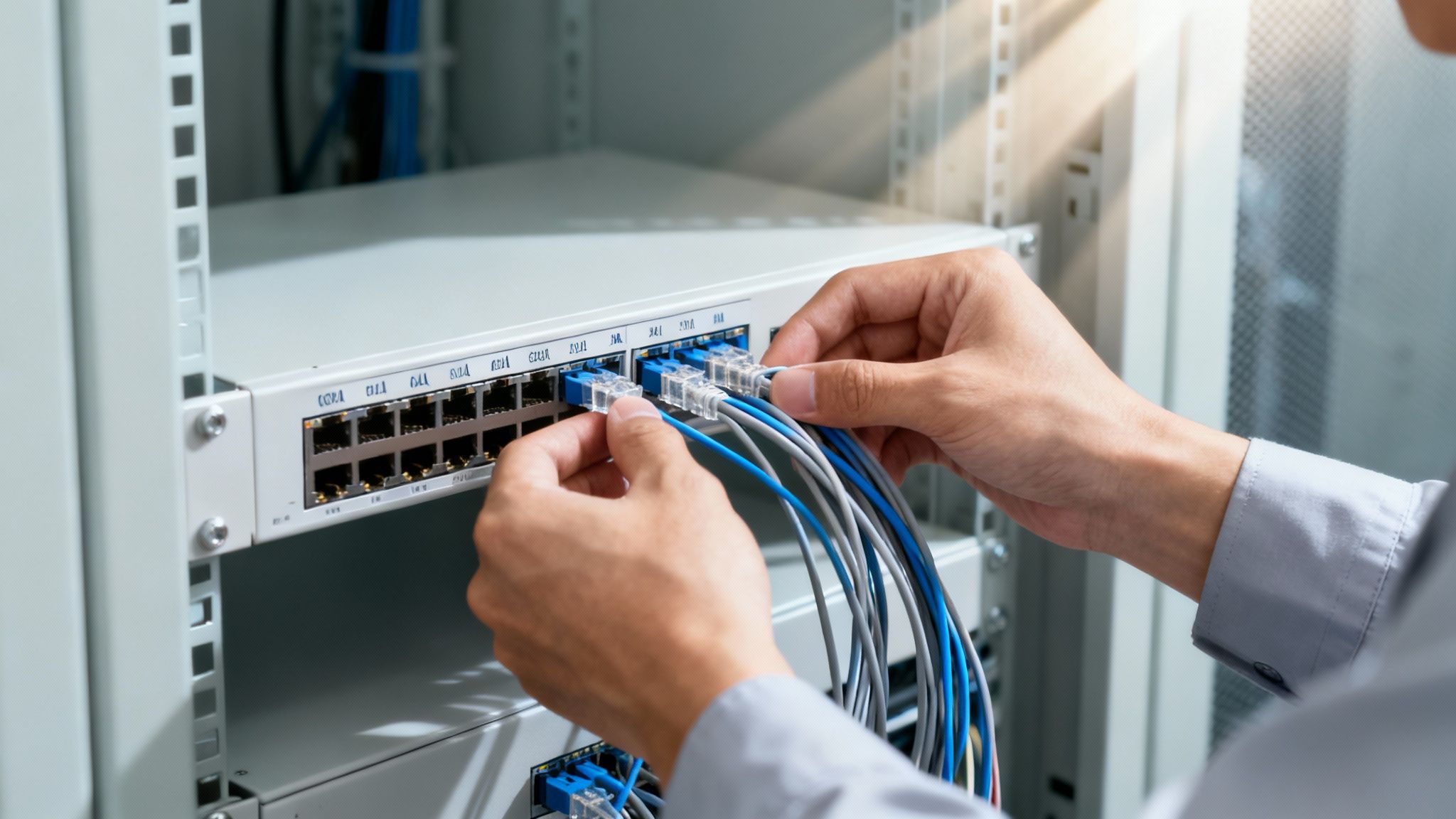
Longevity and Adaptability
Modern Ethernet cabling standards are engineered with future capacity in mind, offering a lifespan that far exceeds that of rapidly evolving wireless technologies. This longevity is a key advantage of a wired network, protecting initial capital expenditure.
- Category 6A (Cat6A): Supports 10 Gbps speeds, providing more than enough capacity for current and near-future technologies, from high-performance Wi-Fi 6/7 access points to bandwidth-intensive analytics platforms.
- Fibre Optic Cabling: For campus backbones or data centres, fibre supports speeds of 40 Gbps, 100 Gbps, and beyond, making it the ultimate future-proof medium for connecting buildings and network closets.
This built-in capacity means that as devices and applications become more demanding, the core network infrastructure remains viable. Businesses can upgrade endpoint devices and servers without having to rip and replace the foundational cabling, a significant saving in both cost and operational disruption.
Practical Impact on Critical Operations
For organisations deploying sophisticated platforms like Purple, a future-proof wired backbone is essential. It ensures that the network can handle the growing data loads from enhanced guest analytics, more complex authentication methods, and the integration of new IoT venue technologies without performance degradation.
For instance, a hotel that installed Cat6A cabling during construction in 2015 is now perfectly positioned to deploy the latest Wi-Fi 7 access points. The existing wired infrastructure can handle the multi-gigabit backhaul requirements of these new devices, allowing the venue to offer superior guest connectivity and run advanced Purple analytics without needing any new cabling, thus maximising their original investment.
Actionable Tips for Implementation
To build a truly future-proof wired network that maximises return on investment, consider these strategies:
- Standardise on Cat6A: For all new horizontal cabling installations, specify Cat6A as the minimum standard. The marginal extra cost over Cat6 is trivial compared to the cost of future replacement and provides a 10x performance ceiling.
- Plan for Fibre Backbones: In larger environments like shopping centres or hospital campuses, incorporate fibre optic runs between buildings and communications rooms to prepare for future bandwidth requirements well beyond 10 Gbps.
- Document Everything: Maintain meticulous documentation of all cable runs, termination points, and test results. This "as-built" information is invaluable for future troubleshooting, upgrades, and capacity planning.
- Size for Growth: When planning network switches, especially those with Power over Ethernet (PoE), budget for at least 15-20% spare port capacity and PoE power overhead to accommodate future device additions and more power-hungry access points. To truly achieve a future-proof network, it's essential to understand the implications of adopting the next generation of internet addressing; you can explore what is Internet Protocol Version 6 and its impact.
8. Compliance and Audit Trail Support
One of the most critical, yet often overlooked, advantages of a wired network is its inherent ability to support rigorous compliance requirements and generate indisputable audit trails. For organisations in regulated industries, the ability to prove who accessed what, when, and from where is not just a best practice, it is a legal necessity. A wired infrastructure provides a level of forensic detail that is difficult to replicate wirelessly.
Irrefutable Connection Logging
Wired networks create a direct, physical link between a device and a specific port on a network switch, generating a clear and simple audit log. This physical one-to-one mapping provides powerful evidence for regulatory audits and security investigations.
- Physical Port Security: Each connection is tied to a specific switch port, which corresponds to a physical location (e.g., Room 101, Desk 4B). This allows administrators to log all activity from an exact point on the network.
- MAC Address Binding: Managed switches can log the unique MAC address of every device that connects to a port, creating an unambiguous record of which hardware was present.
Unlike Wi-Fi, where signal bleed and roaming can complicate location tracking, a wired connection is definitive. This detailed logging is essential for meeting strict standards like HIPAA in healthcare, which requires protecting patient data, and PCI-DSS in retail, which governs the security of payment card information.
Practical Impact on Critical Operations
This robust audit capability is indispensable for venues that must prove data segregation and secure access for compliance. When combined with an identity-based platform like Purple, the wired backbone’s logs complement the user authentication data, creating a comprehensive compliance narrative.
For instance, a healthcare provider uses its wired network to demonstrate HIPAA compliance. The audit trail from its managed switches proves that the guest Wi-Fi network, authenticated via Purple, is physically and logically isolated on separate VLANs from the wired network that carries sensitive patient records. During an audit, they can present switch logs showing no cross-traffic between guest and clinical network segments, providing irrefutable proof of data protection.
Actionable Tips for Implementation
To leverage your wired network for superior compliance and auditing, consider these strategies:
- Centralise Audit Logs: Enable syslog on all managed switches and forward logs to a central, secure server. This consolidates your audit trail, making it easier to analyse and archive for the required retention period (which can be 3-7 years).
- Enforce Port-Based Access Control: Implement Network Access Control (NAC) or 802.1X on wired ports. This forces every device to authenticate before gaining network access, ensuring that only authorised and compliant devices can connect.
- Combine Physical and Digital Logs: Use Purple's guest access and authentication records alongside your wired switch MAC address logs. This creates a powerful, combined audit trail that links a specific user identity to a specific device and physical network port.
- Document Your Security Posture: Maintain detailed network diagrams that clearly illustrate security zones, VLANs, and the wired enforcement points. This documentation is vital for demonstrating your compliance strategy to auditors.
Wired Network: 8-Point Benefits Comparison
Building a Hybrid Future: Where Wired Foundations Meet Wireless Freedom
In the persistent debate between wired and wireless connectivity, the most forward-thinking approach is not to choose a side, but to recognise the symbiotic relationship between the two. While the allure of untethered freedom is undeniable, this exploration of the advantages of a wired network has demonstrated that a robust, high-performance physical infrastructure is not an outdated concept; it is the very bedrock upon which exceptional modern digital experiences are built.
We've journeyed through the core strengths that define Ethernet's enduring relevance. From the sheer, uncompromised power of superior speed and bandwidth to the unwavering reliability and uptime that mission-critical operations demand, the physical cable remains the undisputed champion of performance. For applications where every millisecond counts, such as real-time analytics, high-definition video streams, or secure financial transactions, the deterministic performance and low latency of a wired connection are simply non-negotiable.
Synthesising the Strategic Value of a Wired Backbone
The true power of these individual advantages becomes clear when viewed as a cohesive strategy. Consider the security implications: a wired network provides a physically controlled environment, making it inherently more secure and easier to segment for compliance and audit trail support. This foundational security is not replaced by Wi-Fi; it is extended. The physical ports and switches become the first line of defence, creating a trusted backbone that sophisticated wireless access and authentication systems can then leverage.
Furthermore, the long-term strategic benefits cannot be overstated. A well-planned investment in structured cabling, particularly with standards like Cat6a or fibre, represents a future-proof infrastructure decision. This physical layer will support generations of network hardware and ever-increasing bandwidth demands, offering remarkable cost efficiency at scale and a lower total cost of ownership over its lifespan. For multi-venue or multi-tenant deployments in hospitality, healthcare, or residential settings, this scalability is the key to consistent, manageable, and high-quality service delivery across an entire estate.
Actionable Next Steps: From Theory to Implementation
Understanding these benefits is the first step; translating them into action is what creates value. Your immediate focus should be on auditing your current network infrastructure with these principles in mind.
- Assess Your Core and Backhaul: Is your current wired backbone capable of supporting the peak demand of all connected devices, including your wireless access points? If your Wi-Fi feels slow, the bottleneck may very well be the wired network feeding it.
- Evaluate Your Use Cases: Identify the systems and services that require the highest levels of performance, security, and reliability. Prioritise hardwired connections for critical infrastructure like CCTV, Point of Sale (POS) systems, access control, and core administrative workstations.
- Plan for a Hybrid Future: The goal is not to eliminate wireless but to optimise it. A powerful wired foundation allows you to deploy advanced Wi-Fi solutions that focus on user experience, identity management, and data analytics, knowing the underlying performance is guaranteed. This is where the synergy between a solid infrastructure and an intelligent software layer truly shines.
Ultimately, mastering the advantages of a wired network is about building a platform for innovation. It's about creating an environment where the seamless freedom of wireless is powered by the unyielding strength of a wired core. This hybrid approach ensures that whether a guest is logging in, a doctor is accessing patient records, or a smart building sensor is transmitting data, the connection is instantaneous, secure, and reliable. This isn't just about better networking; it's about enabling better business outcomes, enhanced guest satisfaction, and a foundation ready for whatever the future holds.
Ready to elevate your guest experience by layering intelligent, identity-based Wi-Fi access over your robust wired infrastructure? Discover how Purple can transform your network into a powerful tool for marketing, analytics, and security. Visit Purple to learn how our platform integrates seamlessly with your existing hardware to create truly exceptional connected experiences.
Drafted with Outrank