A Practical Guide to Modern Guest WiFi Solutions

Let's be honest, traditional guest Wi-Fi is broken. The days of hunting for passwords scribbled on napkins or getting stuck on clunky, insecure login pages are well and truly over. Modern guest Wi-Fi solutions have grown up, evolving far beyond a simple shared password into a powerful asset for any physical venue.
Rethinking Guest Wi-Fi: Moving Beyond Passwords and Portals
For years, providing internet access felt like a basic utility, often with a user experience to match. Think of it like a hotel giving every single guest the same physical key to the front door. Sure, it works, but it’s clumsy, insecure, and offers no real value beyond entry. This old model is riddled with problems.
- High Friction: Annoying captive portals and shared passwords create a poor first impression, adding a layer of frustration before a visitor has even settled in.
- Major Security Risks: Open networks are a playground for bad actors, and a single shared key offers zero accountability, making it impossible to trace malicious activity.
- No Business Value: It’s a pure cost centre. You're paying for the connection and the hardware with no tangible return on that investment.
This approach just isn’t sustainable. Visitor expectations have been completely reshaped by the seamless, always-on connectivity of cellular networks. People now expect to connect instantly and securely, without having to jump through hoops. This fundamental shift has fuelled massive growth in the market for intelligent guest Wi-Fi solutions.
The demand for better connectivity isn’t just anecdotal. In the UK, the guest Wi-Fi provider services market is booming, projected to reach $150.536 million by 2026. This rapid expansion reflects the urgent need for secure, frictionless access in hospitality, retail, and public venues. You can explore more about these market trends and their drivers in the full report.
The New Era of Intelligent Access
The evolution of guest Wi-Fi mirrors the move from that clunky physical key to a modern, keyless entry app on your phone. It’s smarter, more secure, and offers a far more personalised experience. Today’s advanced guest Wi-Fi solutions ditch the password entirely, shifting towards an identity-driven model.
This new way of thinking centres on passwordless access and the principles of Zero Trust networking. Instead of just handing out an internet connection, these platforms are designed to:
- Drastically improve the visitor experience with truly frictionless onboarding.
- Gather compliant, first-party data with explicit user consent.
- Strengthen your overall network security by verifying every single user.
By shifting the focus from simple connectivity to intelligent access, businesses can finally turn a long-standing operational cost into a strategic asset. This modern approach sets the stage for creating tangible business value, from boosting customer loyalty to gaining deep insights into visitor behaviour—all starting with a simple, secure Wi-Fi connection.
Understanding the Technologies That Power Seamless WiFi
To really get why modern guest WiFi solutions are such a huge step up, we need to start with the technology most people are all too familiar with: the captive portal. It’s that login page that pops up, interrupting whatever you were doing to make you accept terms, hand over an email address, or watch an ad. While it’s certainly common, it’s a tool that feels stuck in a past era of connectivity.
Captive portals are a source of friction. They halt the user’s journey, are often a pain to use on a mobile, and can even be a security nightmare. The connection is usually unencrypted before you log in, making them a tempting target for attackers looking to snoop on your data. You can get the full story on these pitfalls in our guide on what a captive portal is.
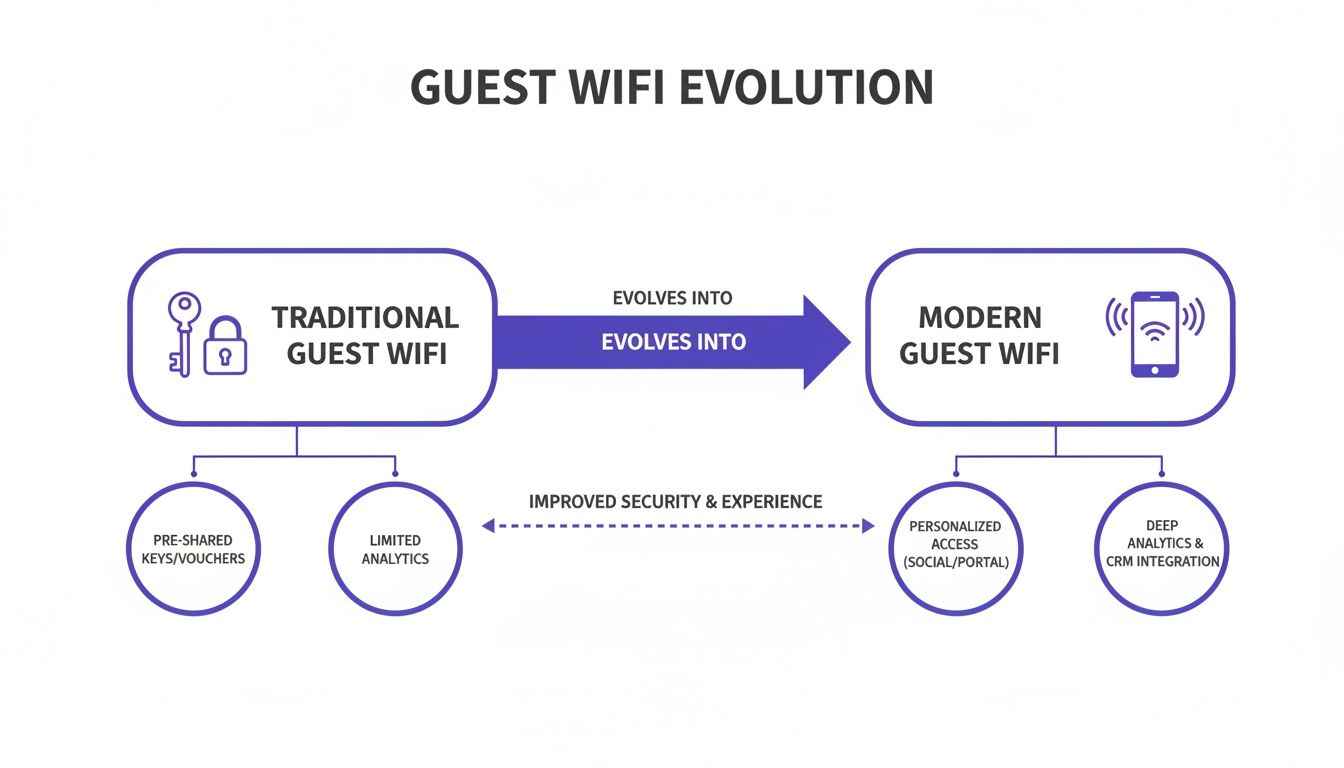
This image paints a clear picture, contrasting the clunky, insecure methods of the past with the smooth, secure experience you get with today's identity-based access.
A Comparison of Guest WiFi Authentication Methods
To see just how far we've come, it helps to compare the old ways with the new. The table below breaks down the key differences between the traditional methods most people are used to and the modern technologies that are changing the game.
.tbl-scroll{contain:inline-size;overflow-x:auto;-webkit-overflow-scrolling:touch}.tbl-scroll table{min-width:600px;width:100%;border-collapse:collapse;margin-bottom:20px}.tbl-scroll th{border:1px solid #ddd;padding:8px;text-align:left;background-color:#f2f2f2;white-space:nowrap}.tbl-scroll td{border:1px solid #ddd;padding:8px;text-align:left}MethodUser ExperienceSecurity LevelBest ForOpen Network (No Password)Very easy, but completely insecure.NoneNot recommended for any business setting.Shared Password (PSK)Simple, but a major security risk when shared.LowSmall, private settings like a home office.Captive PortalHigh friction, often clunky on mobile.Low (pre-auth)Public venues needing simple terms acceptance or data capture.Passpoint / OpenRoamingSeamless and automatic after one-time setup.High (WPA2/3-Enterprise)Large public venues, transport hubs, and multi-site businesses.iPSKSimple password entry, per device or user.Medium-HighConnecting "headless" devices like smart TVs and game consoles.Certificate-Based AccessCompletely automated and identity-driven.Very High (Zero Trust)Securing staff and corporate devices without shared passwords.
As you can see, modern solutions like Passpoint and certificate-based access aren't just about making things easier; they're a fundamental upgrade in how we manage and secure network access for everyone.
Your Digital Passport for WiFi
Think about how your phone connects to a mobile network as you travel—it just works, automatically and securely, without you having to do a thing. That’s exactly the experience that modern technologies like Passpoint (IEEE 802.11u) and OpenRoaming bring to WiFi. You can think of Passpoint as a digital passport for your device.
Once a user authenticates on a Passpoint-enabled network for the first time, their device gets this "passport." From then on, their device can automatically and securely connect to any other participating network around the globe, without ever seeing another login screen.
This automatic connection isn't just about convenience; it's a massive security upgrade. The entire connection is encrypted from the very first data packet, protecting users from the man-in-the-middle attacks that are so common on traditional public WiFi networks.
This kind of seamless roaming is no longer a luxury; it’s becoming essential. With mobile connections in the UK expected to reach 143% of the population by late 2025, and 99.5% of those being broadband, the demand for robust public networks in places like hotels and transport hubs is skyrocketing. This is where a Passpoint-certified platform like Purple comes in, enabling that secure, automatic access that users now expect.
Connecting More Than Just Phones and Laptops
Passpoint is fantastic for our phones and laptops, but what about all the other "things" that need to get online? Think about the smart TVs in a hotel, the gaming consoles in student accommodation, or the digital signs in a retail centre. These devices often can't handle the advanced enterprise security that Passpoint requires.
That's where Identity-Based Pre-Shared Keys (iPSK) come into play. An iPSK system lets an administrator generate a unique password for every single device or user group.
- For a hotel: Each room's smart TV and media hub can get its own unique key, completely isolating them from devices in neighbouring rooms.
- For student housing: A resident can receive a single iPSK to connect their laptop, phone, and PlayStation, creating a personal, secure network bubble just for them.
This approach gives you the simplicity of a password but with the security of individual accountability, making sure every device on your network is known and managed.
A Zero-Trust Approach for Your Staff
Finally, modern guest WiFi solutions also transform how your staff connect. The days of using a shared staff password—a huge security headache—are over. Instead, organisations are shifting to certificate-based access. This method perfectly aligns with a Zero Trust security model, where no user or device is trusted by default.
By integrating with an organisation's existing identity provider (like Entra ID or Okta), the WiFi system can automatically push a unique digital certificate to each employee's device. Access is then granted based on who they are and their role in the company. The best part? If an employee leaves, their access is instantly and automatically cut off the moment they're removed from the company directory. This completely closes the security hole left by old, shared passwords and makes life much easier for the IT team.
How to Navigate Security and Compliance on Guest Networks
When you offer guest Wi-Fi, you're doing more than just providing a handy service. You're opening a new door into your digital environment, and without the right locks, that door can expose your organisation to some serious security threats. Thankfully, modern guest Wi-Fi solutions are built to secure that door, striking a balance between easy access for visitors and rock-solid protection for you.
Think of an open, unsecured network like two people talking in a crowded room. An eavesdropper could easily listen in. It's the same online. On an unencrypted network, a malicious actor can intercept data in what’s known as a "man-in-the-middle" attack, grabbing everything from personal emails to sensitive login details.
This is where you need a fundamental shift in how you think about security.

Adopting a Zero Trust Security Model
The most effective way to lock down any network—guest Wi-Fi included—is to adopt a Zero Trust security model. The principle is as simple as it is powerful: never trust, always verify. This means no user or device gets access to network resources until their identity has been proven without a doubt.
For your guests, technologies like Passpoint and OpenRoaming make this happen by ensuring connections are encrypted from the very first data packet. But for your own staff, the model goes even further.
Certificate-based authentication is the gold standard for implementing Zero Trust. By integrating with identity providers like Entra ID (formerly Azure AD) or Okta, a modern Wi-Fi solution can issue a unique, tamper-proof digital certificate to each employee's device. This eliminates shared passwords and ensures that access is tied directly to a verified identity.
When an employee leaves the company, their access is instantly and automatically cut off the moment they are removed from the corporate directory. This simple action closes a common and incredibly dangerous security gap, making your network far more resilient against threats from disgruntled former employees.
Building Walls with Network Segmentation
A non-negotiable part of securing guest Wi-Fi is making absolutely sure that guest traffic can never cross over into your internal corporate network. We achieve this with network segmentation, which works like a digital wall, creating completely separate lanes for different types of traffic.
- Guest Traffic: Visitors get a direct, isolated path to the internet. They can browse to their heart's content without ever seeing or interacting with your internal servers, files, or corporate devices.
- Corporate Traffic: Your employees and company devices operate in a separate, protected lane. This is where all the sensitive resources needed to run your business live.
- Operational Traffic: Other devices, like point-of-sale systems or building sensors, can be placed in their own segmented lane. This ensures they can function without interference or risk.
This separation is your first line of defence. For businesses that handle payment data, ensuring your guest network meets standards like PCI DSS compliance is absolutely critical for protecting customer information and avoiding hefty fines.
Respecting Privacy and Ensuring Compliance
Beyond network security, data privacy is a huge piece of the puzzle. Regulations like the General Data Protection Regulation (GDPR) in the UK and Europe have strict rules on how personal data can be collected and used. Any guest Wi-Fi solution worth its salt must be built with privacy at its core.
Modern platforms like Purple are designed to gather valuable first-party data in a way that is fully compliant. This is achieved by:
- Requiring Explicit Consent: Users must actively opt-in before any of their data is used for marketing or analytics. They are always presented with clear terms of service and a privacy policy.
- Providing User Control: Guests are given simple, easy-to-use tools to manage their data, review their consent preferences, or request data deletion, fully respecting their rights under GDPR.
This responsible approach means you can use guest analytics and marketing automation tools powerfully and ethically. By putting both security and privacy first, you can turn your guest Wi-Fi from a potential headache into a trusted and valuable asset. To understand more about our commitment to this, you can review our data and security overview.
Putting Guest WiFi Solutions to Work in Your Industry
It’s one thing to talk about the technology, but how do modern guest WiFi solutions actually perform in the real world? The real value isn't in the theory; it's in how these tools solve unique challenges for specific industries, turning a simple internet connection into a powerful business asset.

This isn't just a passing trend. Across the UK, there's a massive push from both local governments and businesses to close connectivity gaps and improve digital infrastructure. A recent survey showed 80% of UK local governments now prioritise digital links, with many aiming for universal gigabit-speed broadband. This focus on better connectivity is fuelling the guest Wi-Fi market, which is on track to grow from $80.812 million to over $150 million by 2026.
A Five-Star Digital Experience in Hospitality
In hospitality, the guest experience is the bottom line. For hotels, bars, and restaurants, a modern guest WiFi setup can weave a seamless digital journey that starts the moment a guest walks in and builds loyalty long after they've left.
Imagine a hotel guest arriving and their phone connecting instantly through Passpoint or OpenRoaming. No clunky login portals, no asking the front desk for a password. Instead, the network recognises them from a previous visit and pushes a personalised welcome message straight to their device.
The connection stays flawless throughout their stay, whether they're streaming films or joining a video call. When they check out, an automated survey can pop up to capture feedback while the experience is fresh. This first-party data then becomes a goldmine for sending targeted offers, encouraging them to book another stay. We dive much deeper into these strategies in our guide to hotel WiFi solutions.
Unlocking Shopper Insights in Retail and Shopping Centres
In the hyper-competitive retail landscape, data is the difference-maker. A shopping centre's guest WiFi has evolved from a simple convenience into a powerful analytics engine, delivering deep insights into shopper behaviour.
By analysing anonymised, aggregated data, centre managers can finally see the full picture:
- Visualise Footfall Patterns: Understand which entrances are the most popular and track how people flow through the venue at different times of the day or week.
- Measure Dwell Times: See exactly how long shoppers spend in certain zones or near specific storefronts, pinpointing areas of high engagement.
- Analyse Visit Frequency: Track how often shoppers return, helping to measure loyalty and the effectiveness of marketing campaigns across the entire centre.
This information is invaluable. It helps inform marketing strategies, justify rental rates to tenants, and even optimise the physical layout of the centre to improve customer flow and boost sales.
Ensuring Ironclad Security in Healthcare
Healthcare environments have a critical balancing act to perform: they need to offer reliable internet for patients and visitors while protecting the life-or-death clinical network. This is a non-negotiable requirement where total network segmentation is paramount.
A modern guest WiFi solution achieves this by creating a completely separate, isolated network for all visitors. Think of it as a digital fortress wall that ensures guest traffic can never, under any circumstances, cross over to the network handling sensitive patient data or medical equipment.
At the same time, this provides a much better experience for people in what can be a stressful environment. A simple, secure connection for patients and their families reduces anxiety. Meanwhile, technologies like certificate-based access allow doctors and staff to roam the hospital, with their work devices connecting automatically and securely to the corporate network without any manual login steps.
Delivering Home-like Simplicity in Residential Buildings
For multi-tenant properties like student accommodation or build-to-rent (BTR) apartment blocks, connectivity has to be dead simple for residents but powerful for managers. Tenants today expect a private, secure network that feels just like what they'd set up in their own home.
This is exactly where features like Identity-Based Pre-Shared Keys (iPSK) come into their own. Each resident or apartment can be given a unique iPSK, which essentially creates a personal network bubble. This allows them to securely connect all of their personal devices—from laptops and phones to smart speakers and games consoles—without sharing access with their neighbours.
It gives residents the simplicity of a home network but with the security and isolation of an enterprise-grade system. For property managers, it means no more shared passwords, far fewer support headaches, and a clear, accountable view of network usage, all managed from one central dashboard.
Choosing and Implementing Your Guest WiFi Solution
Alright, so you understand the tech. Now, how do you actually bring it to life in your venue? This is where the rubber meets the road, and it all starts with picking the right partner and platform for your guest WiFi solutions. This is hands-down the most important decision you'll make, as it shapes everything from how easy the setup is to how well your network can grow with you.
It's not just about a list of features; it's about finding a solution that slots neatly into your existing setup and, more importantly, your business goals. A huge red flag is any vendor that tries to lock you into their specific hardware. That path often leads to expensive headaches later on. What you really want is a hardware-agnostic solution that gives you the freedom to use your current network gear or pick the best new hardware for the job.
Key Criteria for Selecting a Vendor
Before you sign on the dotted line, you need a solid checklist to properly vet potential partners. A truly flexible, future-proof platform should tick all these boxes, ensuring your guest WiFi is an asset for years to come.
- Hardware Compatibility: Does it play nice with the big names in networking like Meraki, Aruba, Ruckus, and UniFi? You shouldn’t be forced to rip and replace perfectly good access points.
- Scalability: Can the platform keep up as your business expands? Whether you’re running a single coffee shop or a global hotel chain, a cloud-based architecture is a must for scaling up or down without friction.
- Security and Compliance: Is the vendor Passpoint certified? You need to see a clear, robust strategy for GDPR compliance and data privacy that puts user consent front and centre.
- Integration Capabilities: How well does it connect with your other tools? Look for ready-made integrations with your CRM, marketing platforms, and identity providers to truly make the most of your data.
When you're choosing and rolling out your guest WiFi, especially for managed services or paid tiers, you also have to think about your back-office operations. This includes things like effective ISP billing software, which can be vital for managing different access levels and subscriptions efficiently.
A key differentiator here is the deployment model. Older, legacy systems often demanded complex, on-premise servers and RADIUS setups that could take months of IT pain to get running. A modern, cloud-native platform like Purple gets rid of all that, letting you configure and roll out a new system in a matter of weeks, not months.
A Streamlined Deployment Process
Once you've made your choice, the actual implementation shouldn't feel like a huge, resource-draining project. With a cloud-first platform, the heavy lifting is done for you, turning deployment into a simple, logical process. It’s all about configuration, not complicated infrastructure builds.
This modern deployment journey usually breaks down into a few key stages:
- Initial Network Assessment: First things first, a quick review of your current network hardware and setup is done to confirm compatibility and map out the integration.
- Cloud-Based Configuration: This is where the magic happens. All your settings, from authentication rules (Passpoint or iPSK) to the branding of your login pages, are configured in a central cloud dashboard.
- Pointing Access Points: Your existing access points are simply told to point towards the new cloud platform. This step is surprisingly simple and is what completely replaces the need for on-site controllers.
- Phased Launch and Testing: The solution is rolled out, usually starting with a pilot site. This gives you a chance to test everything and make small adjustments before a full, organisation-wide launch.
This streamlined model means you can go from making a decision to having a fully operational, modern guest WiFi solution faster than you might think. It knocks down the traditional barriers of high upfront costs and lengthy IT projects, making advanced, secure guest access a realistic goal for any business.
Measuring the ROI of Your Modern Guest Wi-Fi Platform
When you invest in a modern guest Wi-Fi solution, the conversation shifts. It's no longer just about technical specs like signal strength or connection speed. The real measure of success becomes its direct, tangible impact on your business's bottom line. Guest Wi-Fi moves from being a simple cost centre to a powerful engine for boosting revenue, improving efficiency, and building customer loyalty.
The trick is knowing what to measure. You're not just providing an internet connection anymore; you're using a strategic asset that delivers clear, demonstrable returns.
Tracking Key Performance Indicators
The return on investment (ROI) from a platform like Purple goes well beyond simply getting people online. You can now track specific metrics that tie your Wi-Fi investment directly to business growth.
Some of the most important key performance indicators to watch include:
- Increased Visitor Loyalty: By using the authentication data, you can see exactly how many visitors are returning. A steady climb in repeat customers after you've made access seamless is a direct sign of happier visitors.
- Higher Customer Lifetime Value (CLV): When you collect consented first-party data, you can build truly personalised marketing campaigns. A rising CLV proves that these targeted efforts are working, encouraging more frequent visits and bigger spends.
- Improved IT Efficiency: One of the quickest returns you'll see is the drop in IT support tickets. When you get rid of shared passwords and clunky login portals, your IT team spends less time dealing with password resets and more time on projects that move the business forward.
A Retail Chain's Story of Strategic ROI
Picture a retail chain with stores across the UK. Their old guest Wi-Fi was a constant headache, generating endless support calls and offering zero insight into their business. After upgrading to a modern platform, everything changed.
By analysing anonymised footfall data gathered through the Wi-Fi, they discovered that 30% of their weekday visitors were walking into the store, glancing at the front display, and leaving within two minutes. This single insight proved a specific marketing display was failing to grab their customers' attention.
Armed with this data, they completely redesigned the store entrance layout and refreshed their promotional messaging. The results were immediate and measurable. Dwell times in that area shot up by 70%, and sales of the promoted items saw a 15% uplift within the first month alone.
They didn't stop there. By integrating their Wi-Fi authentication data with their CRM, the chain could send targeted follow-up offers to customers who had visited but not made a purchase, successfully winning back a portion of those missed sales. This story shows that a modern guest Wi-Fi solution isn't an expense; it's a powerful investment that drives revenue, improves the customer experience, and gives you a clear competitive edge you can see on the balance sheet.
Frequently Asked Questions About Guest Wi-Fi Solutions
Stepping into new technology always brings up a few questions, even when you have a solid plan. To help you get clear on the final details, we’ve put together answers to some of the most common queries we hear about modern guest Wi-Fi solutions.
How Difficult Is It to Switch from a Captive Portal to a Seamless Solution?
Making the switch is far more straightforward than most people think, particularly with a cloud-native platform like Purple. This isn't a rip-and-replace job. Modern solutions are built to work with the network equipment you already own, from vendors like Meraki, Aruba, and UniFi.
The heavy lifting is done in the cloud. You’ll configure the new platform and simply point your Access Points to it. Since there are no on-premise servers to wrestle with, the whole process can often be wrapped up in weeks, not months. Your main effort will be focused on fine-tuning configurations and policies, not dealing with physical hardware.
Is Collecting Guest Data Through Wi-Fi Compliant with GDPR?
Yes, as long as it's done the right way. Any guest Wi-Fi solution worth its salt must be built around transparency and user consent. This isn't an afterthought for platforms like Purple; it's a core part of the design.
Before anyone connects, they are always presented with clear terms and a privacy policy. Crucially, they must explicitly opt-in if their data is going to be used for marketing. This ensures the information you gather is valuable and fully compliant first-party data, respecting your obligations under GDPR.
A key part of this is giving users an easy way to manage their data and consent preferences at any time. This control is a fundamental right under GDPR and a non-negotiable feature of any responsible guest Wi-Fi platform.
Can Modern Guest Wi-Fi Solutions Actually Improve Security?
Absolutely. In fact, modern guest Wi-Fi solutions are a huge security upgrade compared to old-school open or password-shared networks. It's a fundamental shift from a model of implied trust to one of explicit, provable verification.
Here’s how they strengthen your security posture:
- Encrypted Connections: Technologies like Passpoint and WPA3 encrypt every bit of data from the moment a device connects. This shuts the door on common 'man-in-the-middle' attacks that plague public Wi-Fi.
- Zero-Trust for Staff: By integrating with identity providers such as Entra ID or Google Workspace, you can use certificate-based authentication to build a true zero-trust environment. Every user and every device is verified, every time.
- Instant Access Revocation: When an employee leaves, their network access is cut off the moment they are removed from the company directory. This simple, automated step closes a massive security hole that many businesses overlook.
Ready to transform your guest WiFi from a cost centre into a strategic asset? Purple provides secure, passwordless access for guests and staff, integrating with your existing network hardware to deliver actionable insights and prove ROI. See how your WIFi stacks up.