Event WiFi bandwidth and high-density AP capacity planner
Calculate expected device load, internet backhaul bandwidth, access point density, and attendee lead capture yield for your upcoming venue event or conference.
Event WiFi infrastructure profile
Est. ~1,125 portal logins5,250 devices (2.1x ratio)
4.2 Gbps dedicated fibre (0.8 Mbps per device)
44 enterprise APs (WiFi 6E / 7), at 120 devices per AP
~45% of attendees; typical events range 30-60% depending on incentive
Need high-density WiFi and attendee analytics for your venue?
Purple turns event guest WiFi into a powerful marketing engine. Capture verified attendee emails, customise venue splash pages, and automate post-event engagement.
Event WiFi is a mission-critical venue utility. Whether hosting an indoor trade show, outdoor music festival, corporate conference, or stadium sports match, fast and reliable wireless connectivity directly shapes attendee satisfaction and venue ROI. Modern event attendees expect seamless internet access to check-in, use event mobile apps, share high-definition media, and maintain business communications.
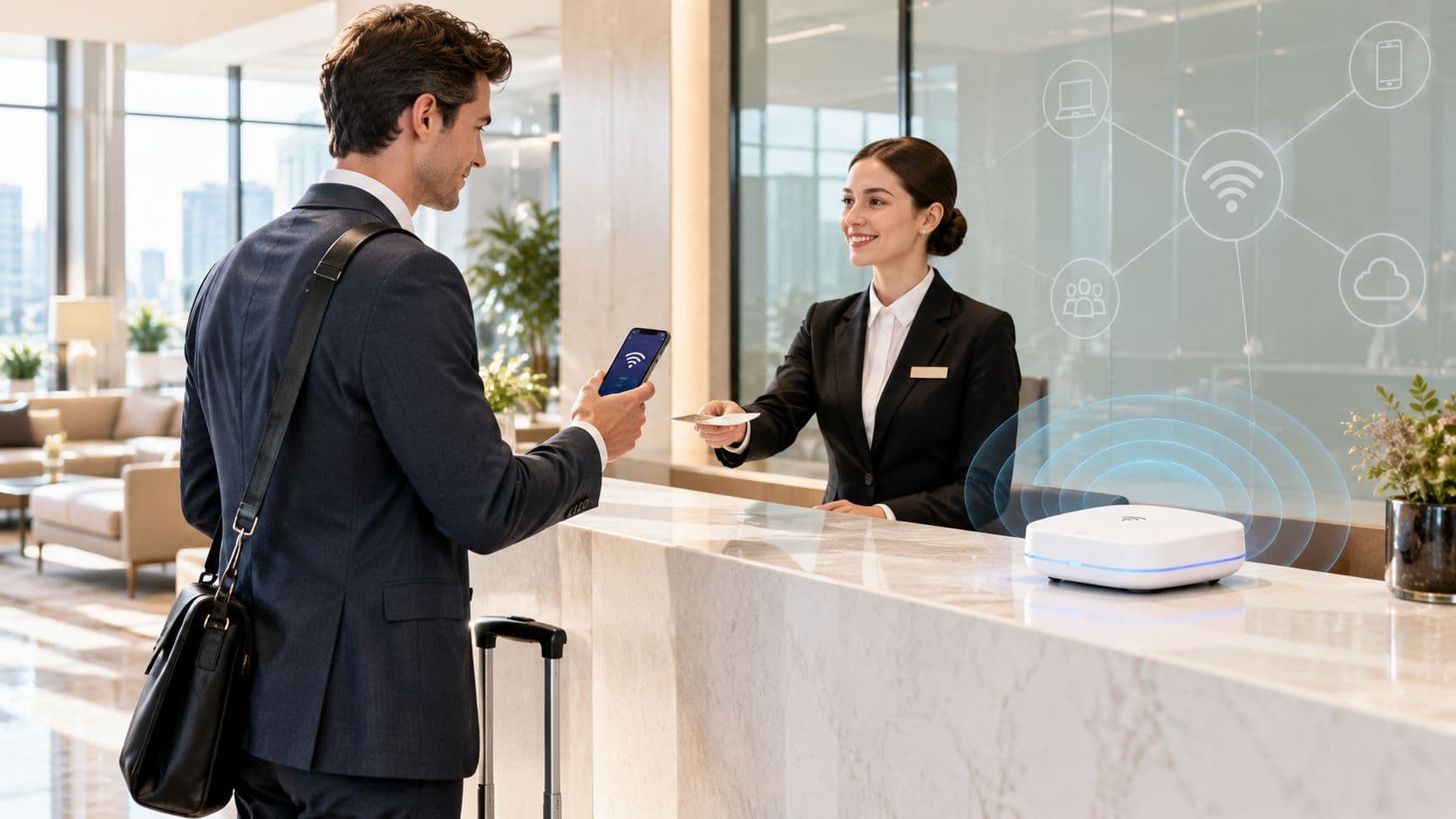
For event organizers and venue managers, guest WiFi is far more than a basic service. Paired with a enterprise splash page, high-density event WiFi captures first-party lead data, delivers measurable sponsor ad impressions, and unlocks real-time footfall analytics across high-traffic concourses.
Key Takeaways: Event WiFi Infrastructure Planning
- Capacity calculation: Plan for 1.8x to 2.5x connected devices per attendee (smartphones, laptops, wearables).
- Bandwidth sizing: Allocate 1.5 to 2.5 Mbps per concurrent device for general event traffic, or 5+ Mbps for HD livestreaming.
- Access point density: Deploy high-density Wi-Fi 6 or 6E access points rated for 150 to 250 active client connections per AP.
- Sponsor monetization: Use custom captive portal splash pages to capture GDPR-compliant leads and serve targeted sponsor ads.
Key components of high-density event WiFi infrastructure
Designing a resilient event network requires balancing RF coverage, switching capacity, backhaul bandwidth, and user access control. Failing to plan for peak concurrency leads to channel congestion, high latency, and dropped connections.
Access points and spatial RF channel planning
High-density environments like exhibition halls and stadium bowls demand enterprise Wi-Fi 6 (802.11ax) or Wi-Fi 6E access points. Wi-Fi 6 introduces OFDMA (Orthogonal Frequency-Division Multiple Access) and MU-MIMO, allowing access points to transmit data to dozens of devices simultaneously on a single channel.
Network engineers must conduct a predictive RF site survey to map access point placement. Utilizing 20 MHz or 40 MHz channel widths in the 5 GHz and 6 GHz spectrum prevents co-channel interference while ensuring maximum throughput across crowded vendor booths and main auditoriums.
Switching, Power over Ethernet, and backhaul redundancy
Behind the wireless access points sits a robust layer of Multi-Gigabit Ethernet switches supporting PoE+ (802.3at) or PoE++ (802.3bt). Access points servicing dense crowds often require 2.5 Gbps or 5 Gbps uplink ports to prevent wired bottlenecks.
For backhaul, events require dedicated, symmetrical fiber lines with SLA guarantees. Implementing secondary 5G cellular bonding or microwave wireless backhaul ensures uninterrupted uptime if the primary fiber link suffers an outage.
Temporary versus permanent event WiFi deployments
Event venues fall into two distinct infrastructure operational categories: permanent installations and temporary pop-up deployments.
| Infrastructure Metric | Permanent Venue Setup | Temporary Pop-Up WiFi |
|---|---|---|
| Deployment Speed | Fixed / Pre-installed | Rapid setup (24 - 48 hours) |
| Hardware Enclosures | Standard indoor / ceiling APs | Ruggedized IP67 outdoor APs & truss mounts |
| Backhaul Architecture | Dedicated dark fiber ring | Point-to-Point microwave / 5G bonding / Fiber drop |
| Lead Capture & Branding | Year-round custom portal & CRM sync | Event-specific sponsor splash portal |
Mobile hotspots and cellular bonding gateways
For small pop-up marketing booths, outdoor VIP lounges, or mobile registration desks, high-performance cellular bonding gateways combine multiple SIM cards (across different mobile operators) into a single logical connection. While limited in total client capacity compared to fiber, cellular bonding provides rapid connectivity without laying physical cable.
Rented outdoor mesh access points
Outdoor music festivals and multi-stage grounds often lack existing Ethernet cabling. Renting outdoor-rated (IP67) Wi-Fi 6 access points mounted on lighting rigs or temporary trussing allows organizers to build a high-speed wireless mesh network covering expansive open areas.
Indoor versus outdoor event WiFi considerations
Venue geometry and environmental factors heavily dictate access point selection and radio frequency tuning.
Considerations for outdoor event WiFi
- Environmental weatherproofing: Equipment must feature IP67 weather-resistance ratings to withstand heavy rain, wind, dust, and temperature extremes.
- Physical mounting structure: Lacking walls and ceilings, access points must be secured to structural trusses, poles, or temporary staging platforms using specialized brackets.
- Power over Ethernet distribution: Outdoor setups require outdoor-rated shielded Cat6A cabling and PoE switches powered by regulated generators or temporary power distribution units.
Considerations for indoor event WiFi
- Building material attenuation: Concrete pillars, steel reinforced walls, and temporary booth partitions absorb and reflect RF signals, creating signal dead zones.
- RF channel interference: Indoor venues often contend with existing building WiFi networks, wireless microphones, Bluetooth beacons, and AV equipment operating in shared ISM bands.
- User density management: Keynote auditoriums concentrate thousands of users in tight spaces. Deploying directional patch antennas limits each access point RF footprint to specific seating sections.
How event WiFi captive portals drive ROI and sponsor leads
Providing high-speed guest WiFi presents an opportunity to capture valuable first-party marketing data and generate sponsor revenue. When attendees connect to the event WiFi network, they are presented with a branded splash page.
With Purple's event guest WiFi platform, venue operators can:
- Capture verified attendee profiles: Collect GDPR-compliant email addresses, phone numbers, and demographics via social authentication or single-field form entry.
- Monetize sponsor splash banners: Display targeted sponsor advertising, video pre-rolls, or promotional banners on the login splash screen with measurable impression metrics.
- Drive immediate engagement: Redirect guests post-login to interactive venue maps, digital event agendas, or concession mobile ordering portals.
- Analyze footfall traffic: Track real-time visitor density, dwell times, and popular exhibit zones to optimize venue floor plans for future events.
Ready to elevate your event WiFi experience?
Turn guest WiFi into a powerful data capture and sponsor revenue engine with Purple's enterprise venue WiFi platform.