Unlocking the Real Leased Line Cost for Your Business

Trying to pin down the real leased line cost can feel a bit like nailing jelly to a wall. You'll see prices quoted anywhere from £200 to over £1,000 per month, but unlike your home broadband, there's no simple off-the-shelf package. A leased line is your business's own private, dedicated slice of the internet, so the final price tag is built around your specific needs.
Understanding Your Business Internet Investment

Think of your internet connection as the main road for your company's data. Standard business broadband is like a busy A-road; it's shared with everyone else, gets jammed during rush hour, and slows to a crawl.
A leased line, on the other hand, is your own private motorway, built just for you, leading straight to the internet exchange. No traffic jams, no sharing, just a clear, fast route.
This is why the cost structure is so different. You're not just paying for 'fast internet' – you're investing in guaranteed performance, rock-solid reliability, and security. This guide will act as your roadmap, breaking down every single element that shapes your final quote.
What Shapes Your Final Quote
Several key factors come together to determine that final monthly figure. Getting your head around these is the first step to making a smart investment.
It all boils down to a few core components:
- Bandwidth and Speed: Are you looking for a solid 100Mbps, or do you need the full power of 1Gbps? More capacity costs more.
- Geographical Location: A city centre office is usually much cheaper to connect than a remote business park out in the sticks.
- Contract Length: Committing to a longer-term deal, like 36 months, almost always brings the monthly cost down.
- Service Level Agreements (SLAs): These are the provider's promises on uptime and fix times. The more robust the guarantee, the more it adds to the value.
A leased line isn't just another bill to pay; it's an operational asset. The price reflects a cast-iron guarantee of service—uncontended bandwidth, symmetrical speeds, and promised uptime—that standard broadband simply can't touch.
The good news? The market has become incredibly competitive. The UK has seen leased line prices plummet in recent years, making this technology far more accessible. A few years back, a 1Gbps connection would have set you back thousands a month. Now, businesses can get those same speeds for as little as £139 per month, often with installation fees waived.
This shift means what was once a luxury for massive corporations is now a genuinely viable option for any growing business that simply can't afford to be offline. For businesses with multiple locations, it's also crucial to see how these connections fit into the bigger picture. To get a better sense of that, check out our guide on what a Wide Area Network is and how it works.
The Core Factors That Drive Leased Line Costs

Ever wondered why one business pays double what another does for the same advertised speed? Unlike standard broadband with its one-size-fits-all pricing, a leased line cost is a completely tailored figure. Think of it less like buying a product off the shelf and more like commissioning a bespoke suit; the final price comes down to the specific materials, fit, and features you choose.
To get a real grip on your quote, you need to understand the four main levers that providers pull to set your monthly fee. Getting your head around these is the first step to controlling your connectivity budget and making sure you get exactly what your business needs—without paying for what you don't.
Your Required Bandwidth and Speed
The most straightforward factor in your monthly cost is how much bandwidth you need. Bandwidth is simply the capacity of your connection. Think of it as your own private motorway; a wider motorway lets more data travel at top speed all at once, while a narrower one has a much lower limit.
A small business with 10-15 staff who mainly use email and cloud apps might find a 100Mbps connection is more than enough to keep things running smoothly. On the other hand, a larger firm with 50+ employees hammering video calls, shifting huge files, and using cloud databases will likely need the grunt of a 1Gbps (1,000Mbps) circuit to prevent frustrating bottlenecks.
Providers offer a whole range of speeds, and each tier has a distinct price point. Here’s a quick look at what you can typically expect in the UK for a standard 36-month contract.
Typical UK Monthly Leased Line Costs by Speed
This table breaks down the average monthly costs for different leased line speeds, giving you a ballpark idea for budgeting.
As you can see, the price jumps are significant, and even the choice of provider can create a £40-£80 difference each month for the same speed. For a more granular look, you can explore a detailed breakdown of these UK leased line cost tiers on leasedline.io.
Your Business's Physical Location
Where your building is physically located has a massive, and often surprising, impact on the final price. It all comes down to the "last mile"—the actual physical distance from your office to the provider's nearest network point of presence (PoP), which is usually a local telephone exchange.
If your office is in a well-connected city centre like London or Manchester, chances are the fibre infrastructure is already there and easy to tap into. The engineering work needed is minimal, which keeps installation charges and your monthly costs down.
But if your business is in a rural spot, a new business park on the edge of town, or even just a few streets away from existing fibre, the cost can rocket. The provider might have to carry out major civil engineering work—digging up roads and laying new ducting—just to run a dedicated fibre cable to your door.
The "Last Mile" Challenge: The cost to bridge that final physical gap between your building and the provider's network is the single biggest variable in leased line pricing. An urban office might be metres away, while a rural site could be kilometres away, adding thousands to the setup cost.
The Underlying Access Technology
While full-fibre is the gold standard, it’s not the only way to get a leased line. The technology used to build your dedicated connection has a direct say in both its performance and its price tag.
- Fibre (Ethernet over Fibre): This is the top choice. It offers the fastest speeds (up to 10Gbps and beyond), rock-solid reliability, and symmetrical performance. It provides the best long-term value but can have higher setup costs if there's no fibre nearby.
- Ethernet First Mile (EFM): A more affordable alternative, EFM uses bundles of existing copper phone lines to create a dedicated connection. Speeds typically top out around 35Mbps. It has built-in resilience (if one copper pair fails, the service keeps going), but it's an older technology being phased out in favour of fibre.
- Wireless Leased Lines (Microwave): In places where digging is just too difficult or expensive, a wireless link can be set up using microwave dishes. This creates a direct, line-of-sight connection between your building and the provider's mast, delivering high speeds and reliability without needing physical cables.
Your Service Level Agreement (SLA)
Finally, your Service Level Agreement (SLA) is the provider's contractual promise to you. The guarantees it contains are a core part of what you're paying for. An SLA defines critical performance promises, especially uptime and fix times.
A standard leased line SLA will guarantee 99.99% uptime, which works out to no more than 52 minutes of potential downtime across an entire year. More importantly, it specifies a target fix time—often around 4-6 hours. This means if something goes wrong, an engineer is contractually bound to fix it within that window, 24/7/365. This level of assurance is what separates a leased line from business broadband, which might only offer next-business-day support at best.
Naturally, a tighter SLA with a faster fix time will increase the monthly cost, as it requires the provider to have more engineers on standby, ready to go at a moment's notice.
Looking Beyond the Monthly Fee to See the Full Picture
It's tempting to judge a leased line purely on its monthly quote, but that's like buying a car based only on the monthly payment. You're missing the big, upfront costs that can seriously throw your budget off course. To get a real handle on the leased line cost, you need to think in terms of Total Cost of Ownership (TCO), which shines a light on all the one-off fees you'll face before the service is even switched on.
A smart business leader knows to dig deeper than that recurring charge. While the monthly fee covers your ongoing service, it's the setup, hardware, and potential construction charges that form a massive part of the initial financial hit. Ignore them, and you could be looking at a surprisingly hefty bill right out of the gate.
Understanding Installation and Construction Charges
The biggest and most unpredictable one-off cost is almost always the installation itself. You’ll see plenty of providers advertising "free installation" on longer contracts, but that offer has its limits. It really only covers a simple, textbook setup where existing fibre is already nearby and easy to get to.
The real costs start to mount when your building is a fair distance from the nearest telephone exchange or network point of presence. This physical gap, often called the "last mile," is where expenses can suddenly spiral. If engineers need to dig up roads, get permission to cross private land, or lay brand new ducting to run fibre to your door, the provider will pass these costs directly on to you as Excess Construction Charges (ECCs).
These charges aren't just small extras; they can be a major financial roadblock. It is absolutely essential to get a detailed site survey and a firm quote for any potential ECCs before you sign anything. This one step will save you from a world of pain later.
Industry data shows that installation costs are a huge factor in UK leased line projects. A standard installation might set you back £2,000 to £5,000, but this figure can easily jump to £15,000 or more for tricky rural sites that need a lot of engineering work. You can discover more insights about how distance impacts leased line installation costs on amvia.co.uk. This is where a sharp negotiation strategy really pays off.
The Power of Contract Length
Here’s your secret weapon in any negotiation: the contract term. Providers are in the business of securing steady, long-term revenue. They are far more likely to absorb those chunky setup costs if they know you're committed for the long haul.
This creates a simple trade-off for your business:
- 12-Month Contract: You get maximum flexibility, but you’ll pay the highest monthly fee and almost certainly foot the entire installation bill yourself, which could be thousands of pounds.
- 36-Month Contract: This is usually the sweet spot. The monthly cost drops significantly, and providers will often waive the standard installation fees completely, saving you a cool £4,000-£6,000 upfront.
- 60-Month (5-Year) Contract: This might offer the rock-bottom monthly price, but it's a very long time to be tied to a technology contract. Prices can drop and better tech might come along, leaving you stuck in an old deal.
For most businesses, a 36-month term strikes the perfect balance. It transforms a potentially budget-busting installation fee into a predictable, manageable operating expense.
Other One-Off Costs to Watch For
While installation is the main event, a few other charges can sneak onto your first invoice. It's vital to get clarity on these from any provider before you commit.
Always make sure to ask about:
- Managed Router Fees: Does the provider include a proper, enterprise-grade router in the monthly fee, or is that a separate one-off purchase or rental? A cheap router will just bottleneck your expensive, high-speed connection.
- Activation Fees: Some providers tack on a small admin fee for setting up the service and getting your account live on their network.
- Early Termination Penalties: It’s not an upfront cost, but you absolutely need to understand the financial penalty for breaking a contract early. These fees are usually substantial, often forcing you to pay out the rest of the contract's value.
By looking past the headline monthly figure and getting forensic about these one-off costs, you can build a complete, accurate budget. It’s the only way to ensure your new leased line delivers value from day one, without any nasty financial shocks.
Calculating the Return on Your Connectivity Investment
It’s easy to look at a leased line as just another expense on a spreadsheet. That's a mistake. The true leased line cost isn’t the monthly bill; it's an investment in your operational stability and future growth. To make a solid business case, you have to look past the price tag and calculate its Return on Investment (ROI). And the best way to do that is to measure the cost of not having one.
This flips the conversation from, "How much does it cost?" to, "How much revenue does it protect and generate?" The answer is found by putting a number on the huge cost of downtime and poor performance. Every dropped video call, every failed card payment, and every minute your staff can't work has a real, tangible financial impact.
Framing the Cost of Downtime
For any business, downtime is more than a small headache—it’s a direct hit to your bottom line.
Picture a typical office with 25 employees. If your standard broadband goes down for just four hours, that’s 100 hours of productivity straight down the drain. Even if your team can cobble together some offline tasks, the chaos it causes for collaborative work, cloud access, and customer communication is massive.
A leased line with a 99.99% uptime guarantee and a four-hour fix time completely changes this risk. It’s basically an insurance policy against lost wages, missed sales, and damage to your reputation.
A leased line isn't purchased for the days everything works perfectly. It's an investment for the critical moments when a standard connection would fail, protecting your revenue, productivity, and customer trust when it matters most.
Getting your head around this financial protection is the first step. Next, you need to apply it to your specific industry, where the benefits become even more powerful.
Industry-Specific ROI Scenarios
The value of guaranteed, rock-solid connectivity shoots up in environments where a stable connection is absolutely mission-critical. Let's break down how a leased line delivers a clear ROI across different sectors.
- Hospitality (Hotels and Venues): A hotel's reputation is built on guest experience. A leased line ensures perfect Wi-Fi for guests, which leads directly to those coveted five-star reviews. It also supports essential services like the Point of Sale (POS) systems in your restaurant and provides the reliable connections needed for corporate events, driving revenue from multiple streams.
- Retail Chains: Symmetrical speeds are crucial for modern retail. They mean instant payment processing during busy periods, preventing lost sales from customers who won't wait. This connection also supports real-time inventory management across all your stores and powers bandwidth-heavy CCTV security without slowing down the Wi-Fi for your shoppers.
- Healthcare Clinics: In healthcare, reliability isn't a feature; it's a requirement. A leased line guarantees secure, immediate access to patient records (EHR systems). It provides the stable, high-speed connection needed for life-saving telehealth consultations and makes sure critical medical devices stay connected to the network without fail.
Proving the Business Case
When you connect the features of a leased line to these specific business outcomes, you can build a powerful argument for ROI. This principle of calculating ROI isn't unique to connectivity; it applies to any business operation, like improving efficiency with tools such as customer services automation. The logic is identical: you invest in a system to prevent a much larger financial loss or to unlock new ways to grow.
To build your own business case, start by calculating the cost of a single hour of downtime for your organisation. Factor in lost revenue, staff wages, and any potential recovery costs. Once you have that number, comparing it against the monthly leased line cost often makes the decision incredibly straightforward.
For a deeper dive into putting real numbers to these benefits, check out the metrics we use in our connectivity ROI calculator. It's designed to help you quantify the value of superior connectivity for your business.
How Leased Lines Stack Up Against the Alternatives
Deciding on the right internet connection can feel like a high-stakes choice. While the dedicated power of a leased line is clear, is it always the right tool for your specific job, or would another option be a better fit? The real leased line cost isn't just the monthly fee; it's about the value it delivers compared to the alternatives.
To make the right call, you need a clear-eyed comparison that goes way beyond the price tag. Let's break down how a leased line truly measures up against its main competitors: high-speed business broadband and other forms of Dedicated Internet Access (DIA).
The Private Motorway vs The Public A-Road
The single most important difference between a leased line and standard business broadband comes down to one thing: the contention ratio.
Think of it like this. Business broadband is the local A-road. It's a public resource, shared with every other business and home in the area. During peak times—like the afternoon school run or when everyone starts streaming Netflix—it gets congested and slows to a crawl for everybody.
A leased line, on the other hand, is your own private, three-lane motorway, built just for your business. The connection is uncontended, meaning you get 100% of the bandwidth you pay for, 100% of the time. This is why your office broadband grinds to a halt at 4 PM, but a leased line never does.
For any business, contention is a hidden productivity killer. A leased line's uncontended nature means performance is guaranteed, predictable, and totally consistent, no matter what your neighbours are doing online.
This dedicated performance is the core reason for the price difference. You're not just buying speed; you're buying exclusivity and reliability that shared connections simply cannot promise.
The flowchart below gives you a simple framework for deciding if this level of investment is right for your industry, based on the financial hit you'd take from any downtime.
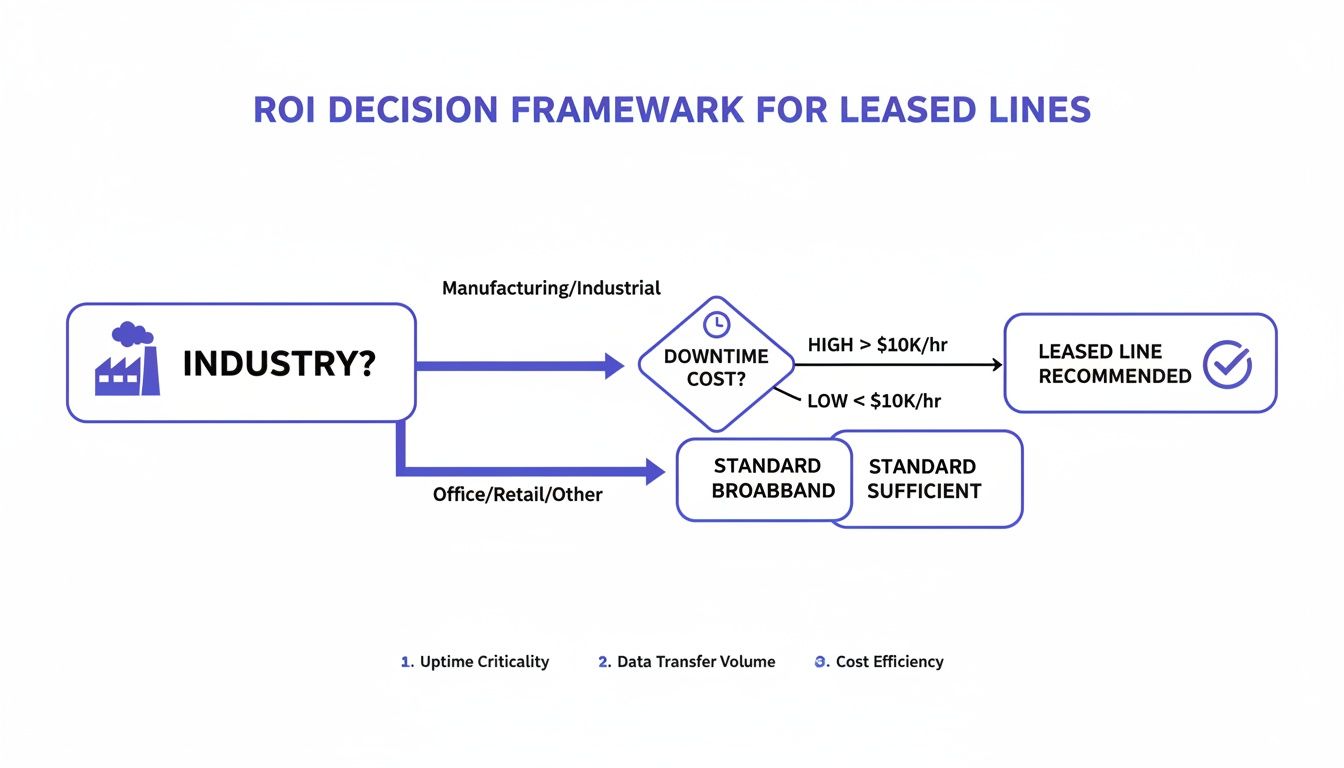
As you can see, for industries where downtime has a direct and significant financial consequence, a leased line often provides a clear and rapid return on investment.
Symmetrical Speeds: The Unsung Hero
Another critical, and often overlooked, differentiator is speed symmetry. Standard broadband connections, even fancy Fibre-to-the-Premises (FTTP), are asymmetrical. This gives you fast download speeds but significantly slower upload speeds. For just browsing the web at home, that's usually fine.
But modern businesses rely heavily on uploading data:
- Video Conferencing: Sending your high-definition video feed to others requires serious upload bandwidth.
- Cloud Backups: Pushing gigabytes of data to services like Dropbox or OneDrive is an upload-heavy task.
- VoIP Phone Systems: Crystal-clear calls depend on consistent upload and download performance.
- Remote Access (VPN): Staff working from home need to access files on the office network, an action that completely depends on the office's upload speed.
A leased line provides symmetrical speeds. If you buy a 1Gbps connection, you get 1Gbps for both downloads and uploads. This two-way power is essential for cloud-first businesses and prevents the frustrating bottlenecks that cripple asymmetrical connections. When you start exploring high-speed options, it's vital to understand the nuances of alternatives like FTTP on Demand and its true costs and the installation hurdles they can present.
Guarantees That Matter: SLAs and Fix Times
Finally, the Service Level Agreement (SLA) is where the value becomes undeniable. A business broadband connection might come with a "best effort" promise, meaning the provider will try to fix it when they can get around to it. A leased line, however, is backed by a legally binding SLA.
This contract guarantees specific levels of performance, including:
- Uptime Guarantee: This is typically 99.9% or higher, ensuring your connection is incredibly resilient.
- Guaranteed Fix Time: A target fix time, often around 4-6 hours, means an engineer is contractually obliged to resolve any issues within that window, 24/7. No waiting in a queue.
This level of assurance is really a form of business insurance. While other businesses are offline waiting days for a fix, yours is back up and running in a matter of hours. This reliability is especially vital when your connection underpins complex network solutions. To see how this plays out in the real world, check out our deep dive into SD-WAN managed services and see how they rely on stable, high-performance connectivity.
Connectivity Options Compared Head-to-Head
To help you weigh the options, here’s a straightforward comparison of the key features. This table cuts through the jargon and lays out the practical differences between the main contenders.
While high-speed broadband like FTTP is an excellent and cost-effective choice for many small businesses, a leased line is purpose-built for organisations where connectivity isn't just a utility—it's the foundation of the entire operation. Ultimately, the choice comes down to one question: can you afford to gamble with your performance?
Your Guide to Negotiating the Best Possible Deal
Getting the best possible leased line cost isn't about luck; it's a strategic process. When you get to the procurement stage, having a clear plan is what turns knowledge into real, tangible savings on your bottom line.
The first, non-negotiable step is to get quotes from multiple providers. Never, ever accept the first offer that lands in your inbox. Having several competing bids in hand immediately gives you leverage, forcing providers to sharpen their pencils and get more competitive on both price and terms to win your business.
Create Leverage and Compare Quotes
Once you have at least three quotes, lay them out side-by-side and compare them line-by-line. It's crucial to look beyond the headline monthly fee.
- Installation Costs: Is setup included, or are you exposed to potential Excess Construction Charges (ECCs)? Make sure to ask for a worst-case scenario figure so there are no nasty surprises.
- Hardware: Is a high-quality, managed router part of the deal, or is that an extra cost they'll add on later?
- SLA Terms: Compare the uptime guarantee (e.g., 99.99%), but pay closer attention to the guaranteed fix time. A 4-hour fix is infinitely more valuable than a vague next-business-day response when you're offline.
This detailed comparison arms you with specific, hard-hitting points for negotiation. You can go back to your preferred provider and say, "Provider X is offering free installation and including a Cisco router. Can you match that?"
Use Your Contract as a Bargaining Chip
The single most powerful negotiation tool you have is the contract term. Providers crave predictable, long-term revenue and will offer significant incentives for a longer commitment. This is your primary bargaining chip, so use it wisely.
Negotiation Tip: Always start the conversation with a 36-month contract in mind. It hits the sweet spot, offering a lower monthly fee and often waived installation costs, saving you thousands upfront without locking you in for too long.
Make it clear that your decision hinges on the provider absorbing all standard installation fees. A 12-month term will almost always see you paying the full setup cost, but on a 3-year deal, "free installation" becomes a reasonable and expected part of the agreement.
Finally, always scrutinise the fine print for hidden clauses, especially around annual price hikes and early termination penalties. A fantastic deal today can quickly become an expensive mistake if you’re not careful. Question every charge and insist that all verbal promises are put in writing before you sign anything. That diligence is what ensures the price you agree on is the price you actually pay.
Your Leased Line Cost Questions, Answered
When you start digging into the details of a leased line, the conversation quickly moves past the core costs. A few practical questions almost always pop up, focusing on the real-world logistics of getting your service installed and running smoothly.
Getting straight answers to these common queries is vital for planning your installation and making sure there are no nasty surprises down the line. We’ll tackle the most frequently asked questions head-on, giving you the clear information you need to move forward confidently.
How Long Does a Leased Line Installation Take?
Patience is a virtue with leased line installations. It’s a far more involved process than getting standard broadband hooked up. For a typical installation where fibre is already close by, you should plan for a lead time of 60-90 working days.
But that timeline can stretch out, sometimes significantly. If civil engineering work is needed—think digging trenches to lay new cable or getting special permission to cross private land—the process can easily take 120 days or more. It is absolutely crucial to get a specific, confirmed timeline from your chosen provider as early as you can, especially if you're trying to coordinate the installation with an office move.
Can I Upgrade My Speed During My Contract?
Yes, in most cases, you can. Bumping up your bandwidth mid-contract is usually a simple and straightforward process. The underlying fibre optic cable installed for your service has far more capacity than what you'll initially sign up for.
This means that jumping from, say, 100Mbps to 500Mbps can often be done remotely by the provider with just a few configuration tweaks. The one thing you can't do, however, is downgrade your speed. Always double-check your provider’s specific policy on upgrades and any associated costs before you sign the contract.
Key Takeaway: You can easily scale your bandwidth up as your business grows, but you're locked into your chosen speed for the duration of the contract. It's wise to pick a speed that meets your current needs with a bit of headroom for future growth.
What Are Excess Construction Charges (ECCs)?
Excess Construction Charges (ECCs) are the gremlin in the machine. They are additional, one-off costs that can be applied if the physical installation turns out to be more complex or expensive than the provider's initial quote. These charges are the single most common cause of budget overruns in a leased line project.
ECCs usually crop up after the detailed site survey, when an engineer discovers something unexpected. This could be anything from blocked ducts under the pavement to needing to cross a motorway or dealing with difficult terrain that requires specialised engineering. Always ask a potential provider to clarify exactly when ECCs might apply and confirm you have the right to cancel the order without penalty if the charges are unacceptably high.
At Purple, we understand that reliable connectivity is the foundation of a great on-site experience. Our WiFi authentication platform leverages your network to deliver secure, passwordless access for guests and staff, turning your internet connection into a powerful tool for engagement and data-driven insights. Learn how Purple can help you prove the ROI of your network investment.