Beyond the Walled Garden Login Rethinking Guest WiFi Access
Think of the last time you connected to the WiFi at a local café. You tapped the network name, but instead of getting straight online, your browser popped open a branded login page. That, in a nutshell, is a walled garden login.
It’s a clever method for controlling network access, holding you in a digital "lobby" with limited or no connectivity until you complete a specific action. You’re intentionally kept within a controlled environment—the “garden”—and that login page is the “wall” you have to get past.
This whole process is powered by a technology called a captive portal. It acts as a digital gatekeeper, intercepting your very first attempt to browse the web and redirecting you to its own page. Until you authenticate by providing an email, logging in with a social account, or simply ticking a box to accept the terms, you remain captive.
This visual flow shows how a user is first stopped by the captive portal before being allowed through to the wider internet.
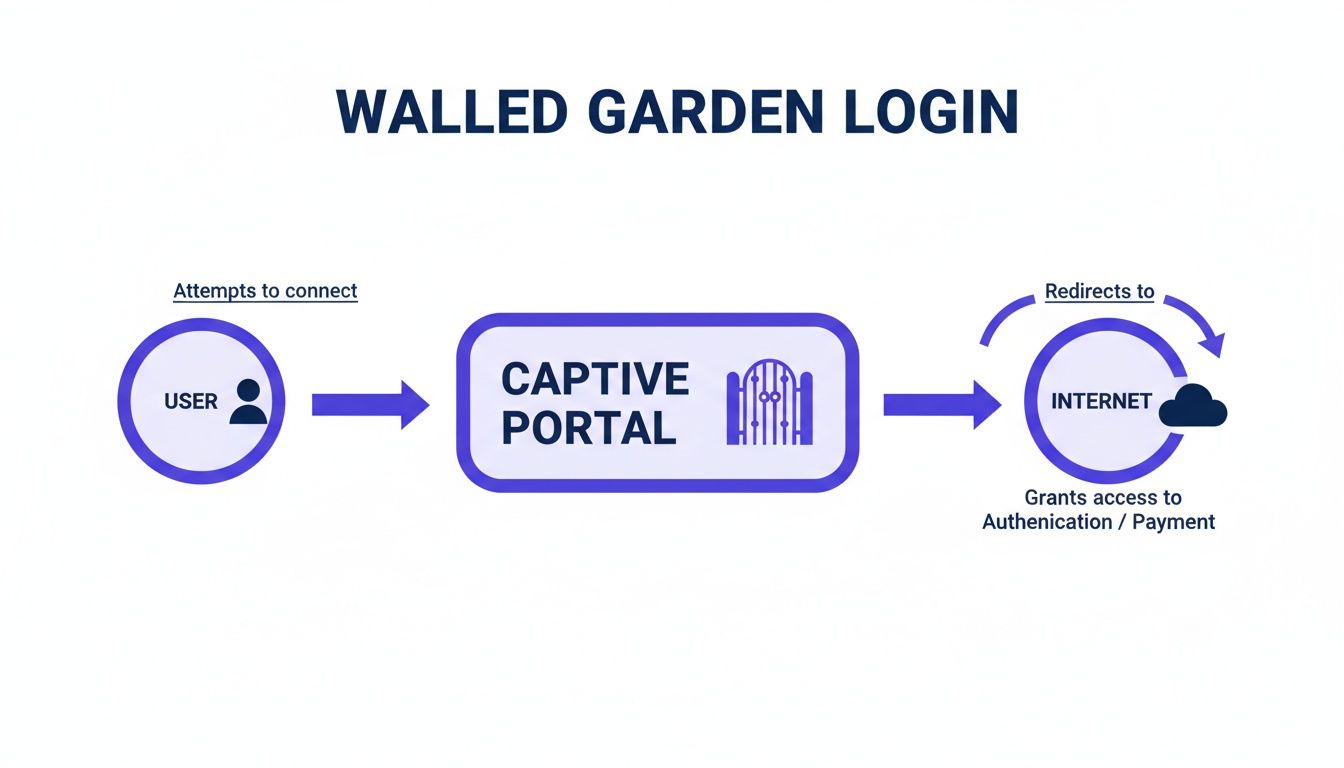
As the diagram shows, the whole experience hinges on that mandatory authentication step, which is a fundamental point of friction that interrupts what could otherwise be a seamless connection.
The Technical Mechanics Simplified
So, how does it all work behind the scenes? While the full technical breakdown can get quite complex, the basic idea is refreshingly simple. A few key components work together to create this controlled experience.
Let's break down the essential moving parts that make a walled garden login function, using some everyday analogies to make sense of the tech.
| Core Elements of a Walled Garden System |
| :--- | :--- | :--- |
| Component | Real-World Analogy | Technical Role |
| DNS Redirection | A receptionist giving everyone the same room number (the lobby) until they've checked in. | When you try to visit a website, the network's DNS server doesn't give you the real address. Instead, it directs all your requests to the captive portal page. |
| HTTP Redirection | A security guard at a door who stops everyone and points them toward the registration desk first. | Any web traffic you generate is intercepted and rerouted to the login page until your device is recognised as authenticated. |
| The "Allow List" | The hotel's official guest list that the concierge checks before letting you past the lobby. | Once you complete the required action, the system adds your device's unique identifier (its MAC address) to an approved list, granting you access. |
Essentially, the system gives network owners total control over who gets onto their WiFi.
A walled garden login creates a temporary, isolated network for anyone who hasn't authenticated yet. The captive portal is the only door out, and it only opens after the user provides the required credentials or accepts the terms of use.
This level of control, however, often comes at a price. As we'll explore, it can lead to user frustration and create barriers where there should be opportunities. You can dive deeper into the specifics of this technology in our detailed guide on what captive portals are and how they work. Understanding this foundation is key to appreciating why modern, frictionless alternatives are quickly becoming the new standard.
The Hidden Costs of Traditional Guest WiFi
At first glance, a walled garden login seems like a sensible way to manage network access. But this traditional method comes with a whole host of hidden costs that can seriously impact your guest experience, security, and ultimately, your bottom line. It’s a legacy system that, in today's world, often creates more problems than it solves.
The most immediate cost is a frustrated visitor. We all expect instant, frictionless connectivity. Forcing someone through a clunky portal, making them fill out multiple fields just to get online, creates a terrible first impression. This friction leads directly to high login abandonment rates, turning potential customers away before they’ve even connected.
This isn’t just a minor inconvenience; it’s a massive missed opportunity. Every user who gives up on your WiFi is a lost chance to engage, market, and gather the kind of insights that help your business grow.
Security and Compliance Headaches
Look beyond the poor user experience, and you'll find that traditional walled garden setups are often riddled with security vulnerabilities. By their very nature, they typically operate as open, unencrypted networks before a user authenticates. This design can expose user data to all sorts of risks, making your venue a less-than-ideal place for visitors to connect.
On top of that, the way these old portals collect data can quickly become a compliance minefield. Regulations like GDPR have strict rules on how personal data is collected, stored, and used. A poorly configured walled garden can easily fall foul of these requirements, opening you up to hefty fines and serious damage to your brand’s reputation.
An Ofcom study revealed that a staggering 68% of guests in the UK hospitality sector have been frustrated by walled garden login systems. This frustration doesn't just annoy people; it causes a significant drop in connection rates, undermining the entire point of offering guest WiFi in the first place.
These compliance and security burdens add yet another layer of operational cost. Your IT team ends up spending valuable time managing what is essentially an outdated and insecure system, pulling them away from projects that could actually move the business forward.
The True Price of Friction
When you add it all up—the poor user journey, the security gaps, and the compliance risks—the picture becomes pretty clear. The old way of doing things just doesn't cut it anymore.
- Lost Revenue: When customers abandon the login process, you lose out on valuable dwell time, marketing opt-ins, and potential sales.
- Damaged Reputation: A frustrating or insecure connection experience reflects badly on your brand, hitting customer loyalty and sparking negative reviews.
- Operational Drag: Managing these legacy systems eats up IT resources without delivering the security or data benefits you'd get from a modern solution.
Ultimately, the hidden costs of a traditional walled garden login are huge. They create a direct barrier to building strong customer relationships and gathering the first-party data that modern businesses need to thrive. This is precisely why so many venues are now moving towards secure, passwordless solutions that eliminate friction and unlock the true potential of their guest WiFi networks.
Fixing the Hospitality Guest Experience
Picture this: a business traveller lands at their hotel after a long, draining flight. All they want to do is connect to the WiFi and prep for tomorrow's meeting. But instead of a quick connection, they're stopped by a clunky, multi-step walled garden login page that wants their email, a brand new password, and their room number. It’s a small moment, but that single point of friction can sour their entire stay and influence whether they ever book again.
This isn’t a rare occurrence. For hotels, restaurants, and event venues, this is an all-too-common scenario, and it's incredibly costly. A difficult login process is no longer a minor hiccup; it's a direct threat to guest satisfaction and loyalty. Every moment a guest spends wrestling with a confusing captive portal is a moment they aren't relaxing, ordering room service, or sharing a positive experience online. The frustration is real, and it has measurable consequences.

This isn’t just a feeling, either. In the UK hospitality sector, walled garden logins via captive portals have historically frustrated 68% of guests, according to a 2023 Ofcom report. The survey found that nearly seven in ten visitors simply give up on a login attempt after hitting a clunky form, which leads to a 25% drop in session completion rates. You can find more insights on these consumer connectivity experiences on SEJ.
The Shift to a Seamless Connection
The answer is to tear down the wall completely. Modern authentication platforms, like Purple, are designed to replace these frustrating old systems with secure, passwordless access. This approach totally transforms the guest experience from the very first tap.
Instead of a cumbersome form, guests are met with a simple, one-click login method. This might be through a social media account they already use every day or a simple verification that doesn't force them to create and remember yet another password. The whole process is instant, secure, and completely effortless.
By removing the friction of a traditional walled garden login, hospitality venues can dramatically boost guest satisfaction, increase WiFi adoption rates, and create a positive digital experience that aligns with their brand promise of excellent service.
Benefits Beyond the First Visit
The perks of a modern system go far beyond that initial connection. When you bring in technologies like OpenRoaming integration, the benefits grow exponentially for both the guest and the venue.
- Automatic Reconnection: Once a guest authenticates at one participating venue, their device is securely recognised across a global network. When they come back to your hotel or pop into a partner café down the road, they connect automatically and securely without ever seeing a login screen again.
- Increased Dwell Time and Spend: A hassle-free connection naturally encourages guests to stay longer and engage more with digital services. Think online menus, loyalty programmes, and special offers—all of which can directly increase revenue.
- Powerful Analytics: With more guests successfully getting online, operators unlock a goldmine of anonymised, permission-based data. This gives you deep insights into visitor behaviour, peak traffic times, and demographics, helping you make smarter business decisions.
Ultimately, by moving beyond the outdated walled garden, hospitality businesses create an environment where connectivity is an asset, not an obstacle. You can explore further strategies for optimizing hotel WiFi in our comprehensive guide. This shift turns a basic utility into a powerful tool for building guest loyalty and driving real business growth.
Transforming Retail Beyond the Login Page
For retailers and shopping centres, the traditional walled garden login has always been a bit of a costly paradox. The entire point is to capture valuable customer data for marketing, but the clunky, high-friction captive portal experience often drives shoppers away before they even connect. It’s a classic case of the solution becoming part of the problem.
This turns guest WiFi from a powerful engagement tool into a point of frustration. Instead of building a relationship, you’re putting up a barrier, forcing shoppers to choose between a difficult login and just using their own mobile data. More often than not, their mobile data wins, and the marketing opportunity vanishes into thin air.
This isn’t just a minor inconvenience; the scale of the problem is huge. A 2024 British Retail Consortium analysis found that walled garden login hurdles in the UK slash customer engagement by a staggering 55%. According to the study, these frustrating portals deter 62% of mobile users from even trying to access venue WiFi, which contributes to an estimated £320 million in lost marketing opportunities every year. You can dig deeper into these findings on first-party data challenges.
From Simple Utility to Business Intelligence
This is where a modern platform like Purple changes the game, transforming guest WiFi from a basic utility into a rich business intelligence engine. By moving past the restrictive login page, retailers unlock a wealth of anonymised, first-party data that paints a detailed, real-time picture of shopper behaviour. We do this by replacing those frustrating forms with seamless, secure ways to get online.
Think one-click social logins or simple email opt-ins that just work. Because the process is frictionless, WiFi adoption rates skyrocket. This allows for the collection of accurate, permission-based data that can be plugged directly into your existing CRM and marketing automation systems.
A seamless connection is the first step in building a detailed customer profile. It turns anonymous footfall into known visitors, allowing for personalised marketing journeys that are relevant, timely, and far more effective than generic campaigns.
Benefits for Multi-Tenant Retail Environments
In large shopping centres with dozens of individual stores, this approach becomes even more powerful. A unified, multi-tenant solution creates a win-win-win situation for shoppers, individual retailers, and the mall management team.
- For Shoppers: A single, easy login provides seamless connectivity across the entire property. They connect once and stay online as they move from shop to shop, creating a fluid and genuinely positive experience.
- For Retailers: Individual tenants get access to valuable analytics about visitors to their specific store. They can understand dwell times, visit frequency, and customer demographics without needing a separate, complicated system.
- For Mall Operators: Management gets a holistic view of traffic flow across the whole venue. They can identify popular zones, peak hours, and overall shopper behaviour to optimise operations and leasing strategies.
This identity-based networking approach is what makes it possible to create sophisticated, personalised marketing journeys that drive both sales and lasting loyalty.
Securing Access in Healthcare and Residential WiFi
In places like hospitals and large residential properties, secure and reliable WiFi isn't just a nice-to-have—it's absolutely essential. Patients, residents, and visitors expect a fast, simple way to get online, but administrators have the tough job of maintaining ironclad security and privacy. The traditional walled garden login just doesn't cut it anymore, creating risks that are simply unacceptable in these settings.
The problem goes much deeper than user frustration. In a hospital, protecting sensitive patient data is paramount. Any open network, even one with a captive portal login page, can be a weak link. What's more, the delays that are so common with these older systems can cause real stress for patients and their families who need to connect quickly during difficult times.
This isn't just anecdotal. A 2024 NHS Digital survey of 150 facilities found that 73% of 10,000 surveyed patients faced connection delays that averaged a frustrating 4.2 minutes per session. These outdated portals were also responsible for a 35% spike in support calls, adding yet another burden to busy hospital staff.
A Modern Zero-Trust Security Environment
Instead of relying on outdated portals, a modern authentication platform offers a much stronger solution built on a zero-trust security model. This approach throws out the old "inside vs. outside" thinking of a walled garden. Instead, it treats every single connection attempt with suspicion, verifying its legitimacy before granting access and ensuring security right from the very first packet of data.
This is all made possible through a few key features that are perfectly suited to the unique demands of healthcare and residential environments.
By getting rid of the open-network vulnerability that comes with traditional captive portals, a modern authentication system protects sensitive data while dramatically improving the experience for patients and residents. In these competitive sectors, that's a crucial advantage.
Here’s how it enhances security:
- Certificate-Grade Access: For staff and other trusted users, digital certificates provide encrypted, passwordless access. This is leagues more secure than shared passwords, which are notoriously easy to compromise.
- Secure Traffic Isolation: The network can be smartly divided to keep different user groups completely separate. This means guest and patient WiFi traffic never touches the secure network used for clinical operations, eliminating any risk of crossover.
- Instant Credential Revocation: If a device is lost or a resident moves out, their access can be cut off instantly from a central dashboard. This removes lingering security risks without needing any complicated on-site changes.
Protecting Data and Improving Lives
For organisations dealing with sensitive information, like those in healthcare, regulatory compliance is always top of mind. Moving to a secure, identity-based network is a huge step toward meeting strict data protection standards, providing clear audit trails and enforcing tight access controls. You can dig deeper into this by understanding the impact of HIPAA privacy rules and how they apply to digital systems. Ultimately, this modern approach doesn't just lock down the network—it turns WiFi into a reliable, stress-free utility for everyone.
Your Roadmap to Modern Network Authentication
So, you’re ready to leave the high-friction world of the walled garden login behind? Good. Creating a modern, secure, and genuinely seamless network experience is more achievable than you might think. This is your practical roadmap, a clear plan for enterprise IT and network administrators looking to upgrade their authentication strategy. The goal is simple: deliver an exceptional user experience while tightening security and cutting down on admin headaches.
The whole journey starts with defining who gets to go where. You need to segment your users into distinct groups—think guests, permanent staff, and temporary contractors—and then map out the exact level of access each group really needs. Getting this foundation right means security is baked in from the ground up, not just sprinkled on as an afterthought.
Integrating for a Seamless Experience
Next up, integration. A modern authentication platform shouldn't operate in a silo; it needs to connect effortlessly with your existing identity providers like Entra ID or Google Workspace. This is how you deliver single sign-on (SSO) for staff, which immediately kills off a huge chunk of password-related support tickets and gives them a familiar, frictionless way to log in. For guests, you can look to standards like OpenRoaming, which allows for a one-time authentication that provides automatic, secure connections on future visits and across a global network of participating venues.
A modern, vendor-agnostic platform isn’t about ripping and replacing your current infrastructure. It’s about intelligently layering a software solution over your existing network hardware to reduce complexity, cut down on support tickets, and deliver a clear, measurable return on investment.
Best Practices for a Successful Migration
To make sure the transition is smooth and the benefits stick for the long haul, keep these key practices in mind:
- Prioritise Data Privacy: Make sure any solution you choose is fully compliant with regulations like GDPR right from day one, with clear, unambiguous user consent mechanisms in place.
- Embrace Passwordless Methods: For corporate devices, certificate-based authentication is the way to go. It creates a zero-trust environment where access is granted based on verified device identity, not just a password. You can learn more about this in our guide to the benefits of 802.1X authentication.
- Plan for All Devices: Don’t forget about the odd ones out. Include solutions like Individual Pre-Shared Keys (iPSK) to securely connect legacy or IoT devices that just don't support modern authentication standards.
Common Questions About Walled Garden Logins
Even as businesses adopt more modern WiFi systems, a few common questions about the traditional walled garden login still pop up. Getting these points clear is the key to understanding just how much value you can get from upgrading your network access strategy.
Is a Captive Portal the Same Thing?
They're deeply connected, but they aren't identical. Think of it this way: the captive portal is the actual webpage a user sees—it's the gate they have to pass through. The walled garden is the restricted digital space that gate creates, limiting what someone can do online until they've logged in.
So, one is the tool (the portal), and the other is the result (the garden).
Can We Still Collect Marketing Data?
Absolutely, and the data you'll get is far more valuable. Modern systems do away with clunky, frustrating forms and replace them with simple, one-click social logins or a quick email opt-in. Because the process is so much smoother, far more people actually complete it and get online.
This approach gives you accurate, permission-based first-party data that can flow directly into your CRM and marketing platforms. You end up with much richer customer insights without the high drop-off rates that plague a traditional walled garden login.
How Difficult Is Replacing an Old Portal?
Making the switch is simpler than you might think. Modern, cloud-based platforms are built to work with the network hardware you already have from major vendors like Meraki, Aruba, or Cisco.
Because the solution is software-defined, the whole process boils down to reconfiguring your WiFi settings to point to the new service and then setting up your preferred login methods through an easy-to-use dashboard. This can often slash deployment time from months down to just a matter of weeks.
Ready to move beyond the limitations of a traditional walled garden? See how Purple can deliver secure, passwordless authentication for your guests and staff. Explore our platform today.