Hotel WiFi capacity, network segmentation and ROI planner
Model access point density, internet circuit size, VLAN isolation, PMS sign-in and the direct booking value of guest WiFi data for your property.
Corporate and leisure mix. Cloud-managed APs and reliable video calls.
Identity comes from the reservation; email consent is an optional tick box on the login page.
Access point placement and power
Put APs inside guest rooms rather than in corridors. Fire-rated doors, tiled bathrooms and masonry walls commonly cost 10 to 20 dB between a corridor AP and the bed, which is enough to drop a 5 GHz client to its lowest data rates.
Rate limits and fair sharing
Per-device limits stop one guest's 4K stream or game download from starving the floor:
- Standard guest tier: 15 Mbps down, 5 Mbps up per device (enough for 4K streaming at about 15 Mbps or a 1080p video call).
- Premium or loyalty tier: 50 Mbps down, 20 Mbps up, marked for priority queuing.
- Staff and front desk: a reserved 100 Mbps that guest peaks cannot consume.
- Guests = rooms x occupancy x 1.35. Staff and IoT = 1.8 devices per room. Events = 1.5 devices per meeting seat (100 seats in this profile).
- Circuit = 50% of guest devices at 3 Mbps sustained (510 Mbps) + event devices at 1 Mbps (75 Mbps) + operations (92 Mbps) + 25% burst. Floor 150 Mbps, capped at 10 Gbps. 245 devices active at peak.
- Stays = room-nights / 2.2. Connect and opt-in rates vary by onboarding method and are illustrative; replace them with your own portal analytics. Consent must be a separate, unticked opt-in under GDPR and PECR.
- AP counts are a planning estimate. Confirm with a predictive and on-site survey before ordering.
Want this sized against your floor plans?
Purple works with Cisco Meraki, HPE Aruba, Ruckus, Juniper Mist, Ubiquiti UniFi, Cambium, Extreme and Fortinet networks to add PMS sign-in, Passpoint and guest data capture to the hardware you already run.
Optional: get a bill of materials, AP placement guidance and a PMS integration checklist for your hotel.
Hotel WiFi solutions are far more than just a way to get guests online. They're a complex blend of enterprise-grade hardware, like access points, and sophisticated software that handles everything from guest management and security to analytics. A great WiFi setup has moved beyond being a simple amenity; it's now a core strategic asset that has a direct, measurable impact on guest satisfaction, online reviews, and ultimately, repeat bookings.
Why Modern Hotel WiFi Is a Strategic Asset
Think of your hotel’s WiFi as its digital front door. For most guests, it's their very first interaction with your services when they arrive, immediately setting the tone for their entire stay. The days when simply offering any connection was enough are long gone. Today’s guests expect instant, secure, and seamless internet access that’s just as good, if not better, than what they have at home.
This shift in expectation transforms WiFi from a basic IT cost into a powerful business tool. Get it right, and you build loyalty and watch the positive reviews roll in. Get it wrong, however, and it quickly becomes one of the most common complaints. A subpar WiFi experience doesn't just frustrate a guest trying to stream a film or join a video call - it actively damages your brand’s reputation.
The New Standard for Guest Expectations
Across the UK, guest expectations for digital experiences in hotels have soared, with mobile-first technology like secure WiFi leading the charge. This trend is directly shaping booking habits and guest loyalty. We’re seeing a significant 7% year-on-year increase in mobile bookings in key markets, including the UK and Ireland, which shows just how vital seamless connectivity is to the modern guest journey.
By 2026, features that once seemed futuristic - like contactless check-in and smart rooms - will be standard. Yet, for all this progress, poor WiFi remains a nagging issue, popping up in 25% of negative UK hotel reviews, according to recent hospitality reports.
This growing demand means your network has to deliver much more than a basic signal. Let’s look at how guest expectations have evolved.
The Evolution of Guest WiFi Expectations
As the table shows, the game has completely changed. Your network now needs to be:
- Fast and Reliable: It must effortlessly support high-bandwidth activities like 4K streaming, online gaming, and video conferencing across hundreds of devices at the same time.
- Secure: Protecting guest data with modern security protocols isn't just a feature; it's a fundamental requirement. Guests must feel safe connecting their devices.
- Effortless: The connection process should be almost invisible. Guests want to connect once and stay connected for their entire visit, without wrestling with clunky login pages or repeatedly entering passwords.
- Personalised: A modern WiFi network is a gateway to engaging with your guests, offering them personalised promotions or gathering valuable feedback to make their next stay even better.
A well-implemented WiFi strategy is a direct investment in the guest experience. It is the invisible thread that connects a guest's digital life to their physical stay, and its quality is a clear reflection of the hotel's commitment to modern hospitality standards.
Investing in a high-quality hotel WiFi solution is fundamental to your operational success and profitability. As we'll explore, the right system not only meets today's demanding guest expectations but also provides invaluable data to help you understand guest behaviour, streamline operations, and drive new revenue. You can find out more about how tailored hospitality WiFi solutions can directly benefit your property.
Designing a High-Performance Hotel Network
A great hotel WiFi experience doesn't just happen. It's the result of thoughtful design, much like the architecture of the hotel itself. While the technology can feel complex, it all boils down to a few core principles that ensure every guest and staff member gets a fast, secure, and reliable connection.
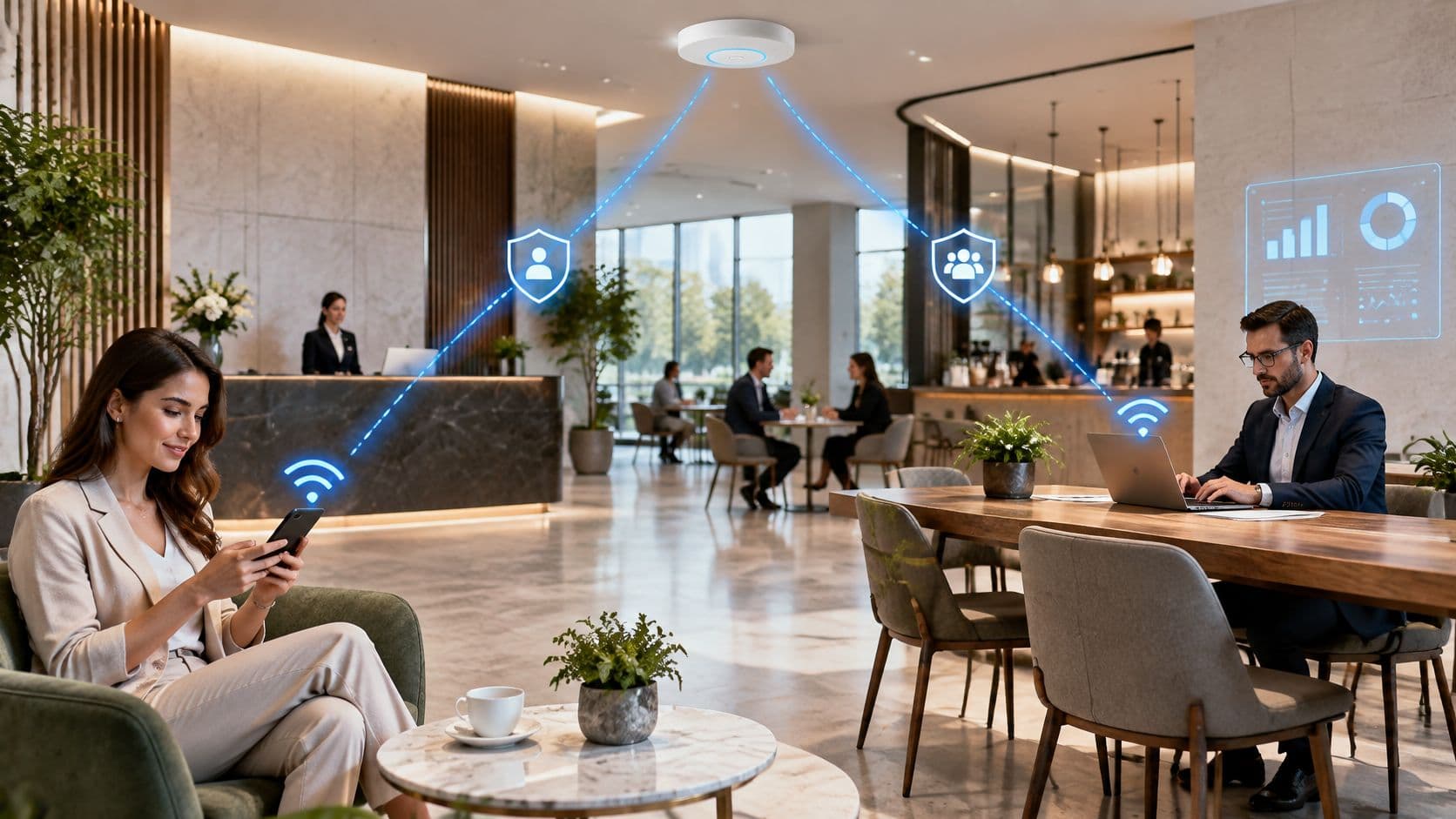
At the heart of any modern hotel WiFi solution is a blend of key hardware and smart management. Access Points (APs) are the small devices, often mounted on the ceiling, that broadcast the wireless signal throughout your property. Think of them as individual light fittings in a hallway - you need enough of them, placed correctly, to illuminate the entire space without leaving any dark spots.
These APs don't work in isolation. They're managed by either an on-site controller or, far more commonly these days, a cloud-based system. This move to cloud-managed networks has been a game-changer for hospitality. It allows hotel operators to monitor performance, make adjustments, and fix issues for an entire property (or even a whole chain) from a single, simple dashboard.

As you can see, WiFi isn't just another utility. It's the starting point of a value chain that directly impacts your bottom line.
The Power of Network Segmentation
One of the most critical design concepts is network segmentation. Imagine your hotel's master keycard system. You have different levels of access: a guest keycard opens one specific room, a housekeeper's key opens a set of rooms on one floor, and a manager's key might open all of them. Each key works on the same system but is restricted to its designated zone for security and efficiency.
Network segmentation works exactly the same way for your WiFi. It creates separate, secure "digital zones" - often called Virtual LANs (VLANs) - for different types of users and devices.
- Guest Network: This is the public-facing WiFi for your guests. It’s walled off so that the guest in room 201 can't see the laptop of the guest in room 202.
- Staff Network: A secure, private network for employees to access internal systems like the property management software (PMS) and internal comms.
- Operational Network: This is for the hotel's mission-critical infrastructure, like your point-of-sale (POS) systems, security cameras, and smart room controls.
By keeping these traffic types separate, you ensure that a surge in guests streaming films doesn't slow down your front desk's payment terminals. More importantly, it builds a security firewall that stops a compromised guest device from ever accessing your critical operational systems.
Architectures for Scalability and Control
How you put all these components together determines your network's performance. Two main approaches dominate hotel WiFi design today, each with its own pros and cons.
1. On-Premises Controlled Networks
In this more traditional model, a physical controller box is installed right there at the hotel. It acts as the central brain, managing all the APs on-site. This gives IT teams direct, hands-on control over the network hardware. However, it can demand more specialised technical staff to manage and isn't as flexible for remote management or multi-property oversight.
2. Cloud-Managed Networks
This has become the modern standard for hospitality, and for good reason. Instead of a physical box on-site, the network's "brain" lives in the cloud. This approach offers some massive advantages:
- Centralised Management: You can configure, monitor, and update the WiFi for multiple hotels from anywhere with an internet connection.
- Zero-Touch Provisioning: New APs can be shipped directly to a property, plugged in, and they'll automatically download their configuration from the cloud. This simplifies new installations or replacements massively.
- Easy Scalability: Adding new APs or even a whole new wing to your hotel is incredibly simple, as the cloud infrastructure just scales with you.
- Reduced On-Site IT Burden: Routine updates and maintenance are handled automatically by the provider, freeing up your staff to focus on other things.
Ultimately, designing a high-performance network is about choosing the right components and architecture to create a system that is secure, segmented, and dead simple to manage. This foundation is what allows you to deliver the seamless connectivity that modern guests don't just want - they expect.
Untangling The Knot Of WiFi Security And Access
For any modern hotel, the central puzzle of WiFi is getting the balance right. How do you give guests the instant, hassle-free connection they expect, while wrapping your network in iron-clad security? It often feels like these two goals are pulling in opposite directions. Too many hotels are still stuck with old-school methods that just end up frustrating guests and leaving glaring security holes.
Think about the last time you were handed a tiny slip of paper with a WiFi password that looked like a cat walked across the keyboard. Or when you had to keep logging back into a clunky portal every time your phone went to sleep. It’s not just annoying; it’s a security nightmare. A single shared password, once it’s out there, puts every single connected guest at risk.
Thankfully, there’s a much better way. By focusing on who is connecting, rather than just what password they have, we can solve both the access and security problems in one elegant move.
Your Guest’s Digital Passport For WiFi
What if your guests had a universal digital passport for WiFi? Imagine them walking into your hotel and their devices just connect. Automatically, securely, and instantly. No passwords, no portals, no fuss. This isn't some far-off future concept; it's exactly what technologies like Passpoint and OpenRoaming deliver today.
Here’s how it works: a guest signs on just once. After that first connection, their device is given a secure digital certificate. This certificate is their passport. It automatically authenticates them on your network for their entire stay, and it will even recognise them when they come back for their next visit.
This completely transforms the guest experience. It shifts the entire process from a clunky, repetitive login to an invisible, 'it-just-works' connection that feels as natural as being at home. It’s the new gold standard for hotel WiFi.
This passwordless approach isn't just about making things easy. Each connection is individually encrypted right from the start, creating a secure, private tunnel for every guest. It's a world away from a shared password, where everyone is essentially shouting in the same open room. You can get a deeper dive into the importance of guest data privacy and compliance in our detailed guide.
Choosing the right authentication method involves weighing security against the guest's journey. Some methods are incredibly secure but might add a little friction, while others are all about speed. Let's break down the common options.
Hotel WiFi Authentication Methods Compared
Ultimately, a modern solution like Passpoint offers the best of all worlds: top-tier security for the hotel and a completely frictionless, premium experience for the guest.
Zero Trust Security For Hotel Staff
While seamless access is the name of the game for guests, the priority for your staff and operational networks has to be absolute security. This is where a zero-trust network access (ZTNA) model is essential. The principle behind zero trust is simple: never trust, always verify. It works on the assumption that a threat could come from anywhere, even from inside your own network.
Instead of a single "staff WiFi" password, ZTNA gives access to employees on a per-user, per-device basis. Each staff member gets a unique digital identity, often linked to their main work login (like their Google Workspace or Entra ID account). This identity grants them access only to the specific systems they need to do their job, and nothing else.
- Front Desk Staff: Can get to the Property Management System (PMS) and booking tools.
- Maintenance Crew: Can access the work order system on their tablets.
- Management: Can view financial reports and operational dashboards.
If an employee leaves the company, their access is switched off instantly from one central dashboard. No more worrying about old passwords floating around. This precise level of control delivers military-grade security without the usual headache of managing complex firewall rules or on-site servers.
The financial and legal risks have never been higher. For UK hospitality businesses, rock-solid cybersecurity is no longer optional. A breach or significant downtime can easily cost over £10,000 per incident in lost revenue and cleanup, and the average UK GDPR fine for data breaches is a jaw-dropping £1.2 million. As detailed in this Gallagher analysis of UK hospitality risks, insurers are looking much more closely at cyber hygiene. By adopting modern security frameworks, you’re not just protecting your guests and your business - you’re proving your commitment to data protection and compliance.
Connecting Every User and Every Device
A modern hotel is a hive of digital activity. It's no longer just guests with laptops and smartphones. It’s a complex mix of people and gadgets, each with its own needs and security expectations. Your network has to gracefully handle everyone from conference attendees who need a private online space, to the retail tenants in your lobby, and the countless “headless” devices guests now travel with.
Offering a one-size-fits-all connection just doesn't cut it anymore. True hospitality today means creating a secure and effortless digital experience for every single person who walks through your doors. This calls for a hotel WiFi solution that is both incredibly powerful and remarkably flexible.
Creating Private Digital Suites
Imagine you’re hosting a major corporate conference. Those attendees need more than just a quick internet connection. They need a private, secure network for their presentations and internal chats, completely walled off from the main guest WiFi. In the same way, the coffee shop or boutique operating in your lobby needs its own isolated network for their point-of-sale systems and staff devices.
This is where the idea of multi-tenancy comes into play. A smart hotel WiFi solution can carve out virtual "private digital suites" on your existing network hardware.
- For Conference Centres: You can offer up a dedicated, branded network name (SSID) just for the event, complete with the organiser's logo on the login page.
- For Retail Tenants: A shop can run its payment processing and operations on its own secure network, keeping it entirely separate from public guest traffic.
- For Long-Stay Residences: You could provide residents with their own private network, letting their devices talk to each other just like they would at home.
This capability turns your WiFi from a simple amenity into a valuable, revenue-generating service. It allows you to confidently cater to high-value business clients and commercial partners.
Think of it this way: true network flexibility means you can partition your digital space just as you do your physical space. A single, powerful network can serve multiple distinct groups, each with its own secure, branded, and private online environment.
Solving the Smart Device Headache
One of the most common frustrations for hotel guests is connecting devices that can't handle a normal login page. We're talking about all the gadgets that make a hotel room feel less like a hotel and more like home:
- Smart TVs and streaming sticks (like an Amazon Fire TV or Roku)
- Gaming consoles (like a PlayStation or Xbox)
- Smart speakers and digital assistants
These devices don't have web browsers to click "I agree" on a pop-up portal. Making guests call the front desk for help is a terrible experience and puts a huge strain on your staff. And just giving out a shared, simple password for these devices is a massive security risk.
The answer lies in a technology called Individual Pre-Shared Keys (iPSK). Instead of one password for everyone, iPSK lets you generate a unique, secure password for each guest room, or even for each individual device. The guest can easily create this key themselves through a simple online portal and get their smart devices connected without any fuss.
This approach strikes the perfect balance. It delivers the home-like simplicity guests want, while maintaining the enterprise-grade security your hotel needs. Every device gets online easily and securely, ensuring every guest feels completely at home.
Transforming WiFi from a Cost to a Revenue Driver
For years, hotel operators saw guest WiFi as a necessary evil - another line item on the budget that just had to be paid. Modern hotel WiFi solutions, however, completely flip that script. They’re no longer just about providing internet access; they are powerful engines for generating valuable, first-party data that can directly increase your revenue and prove a tangible return on investment.

The secret is in the WiFi analytics. Every time a guest connects, your network can gather anonymised, aggregated data that reveals powerful insights into their behaviour. This isn't just dry technical data; it's genuine business intelligence that helps you understand how your physical space is actually being used. It's about moving beyond cost and embracing the wider digital transformation that a smart WiFi system can bring.
Unlocking Guest Behaviour with Analytics
Think of your WiFi network as a set of digital eyes and ears across your entire property. It can tell you things that were previously impossible to measure accurately, painting a clear picture of guest movement and engagement.
Here are a few of the key metrics you can start tracking:
- Footfall Patterns: Pinpoint which areas of your hotel are the busiest and at what times of day. Is the lobby bar packed at 5 p.m. but a ghost town by 7 p.m.? Now you have the hard data to prove it.
- Dwell Times: See exactly how long guests are spending in specific zones, like the restaurant, spa, or conference areas. This is gold for measuring the effectiveness of promotions or layout changes.
- Visit Frequency: Your WiFi can recognise returning guests without them even needing to log in, giving you a crystal-clear metric on loyalty and repeat business.
This information lets you shift from making decisions based on gut feelings to making them based on solid evidence. You can visualise all this activity on a simple dashboard, turning abstract numbers into genuinely actionable insights.
Turning Data into Direct Revenue
Of course, just gathering data is only the first step. The real magic happens when you use these insights to create new revenue streams and enhance the guest experience, making your WiFi actively pay for itself.
Imagine a few of these real-world scenarios:
1. Personalised Offers for Returning Guests
When your WiFi system identifies a returning guest, it can automatically talk to your Customer Relationship Management (CRM) system. This could trigger a personalised welcome-back email or SMS with a special offer, like a complimentary drink at the bar or a discount on a spa treatment. It's a small touch that feels premium and drives immediate upsell opportunities.
2. Data-Driven Staffing and Promotions
Your footfall analytics show that the poolside bar is consistently quiet between 3 p.m. and 5 p.m. With that knowledge, you can launch a targeted "happy hour" promotion during that window and schedule just the right number of staff. You’ve just optimised labour costs while boosting sales during a historically slow period.
A strategic WiFi platform becomes a revenue-generating asset that proves its value time and time again. It bridges the gap between the digital and physical guest experience, creating opportunities for personalisation and profit at every touchpoint.
This isn't just theoretical. In the fiercely competitive London hotel scene, for example, reliable and secure WiFi is now a vital tool for boosting revenue. Forecasts for 2026 project that Revenue Per Available Room (RevPAR) in London hotels will climb by around 1.8%, an increase driven largely by these kinds of tech-enabled guest experiences. With 80% of UK travellers expecting seamless connectivity, any network downtime can cost an average of £500 per hour in lost upsell opportunities and negative reviews.
By turning your WiFi network into an intelligence hub, you can finally stop seeing it as an expense and start treating it as one of your most valuable business assets. If you're curious about the potential return for your own property, you can calculate your WiFi ROI with our specialised tool.
Choosing a Modern Hotel WiFi Solution
Picking the right hotel WiFi solution is where all the concepts we've talked about - from network design to making money from your WiFi - really come together. You're not just looking for a provider; you're choosing a platform that will become the very heart of your digital guest experience. It means looking past basic connectivity and finding a partner who gets the whole puzzle of modern hospitality.
A truly great solution has to nail both access and security, and make it all look easy. For your guests, this means offering password-free, automatic connections using tech like OpenRoaming and Passpoint. This "it-just-works" feeling is the new normal, getting rid of annoying login pages and shared passwords to create a smooth, premium experience that feels just like home.
Key Capabilities for Your Shortlist
When it comes to your staff and operational networks, the gold standard for security is now zero-trust network access (ZTNA). The right platform will work with your existing identity systems (like Entra ID or Google Workspace) to give people access only to what they absolutely need. This keeps your critical systems safe without bogging your team down with complicated setups, hitting that sweet spot between security and simplicity.
Beyond just getting people online, your chosen solution has to be ready for the unique challenges of a hotel. This includes:
- Multi-Tenancy: The power to create secure, separate virtual networks on your existing hardware for conference clients or the coffee shop in your lobby.
- Legacy Device Support: A simple, secure way - like Individual Pre-Shared Keys (iPSK) - to connect smart TVs, games consoles, and streaming sticks that can't handle a normal login portal.
The most valuable hotel WiFi solutions are software-defined and hardware-agnostic. This means they can be layered right over your existing network gear from vendors like Meraki, Aruba, or UniFi, saving you from a costly and disruptive "rip and replace" hardware overhaul.
Connecting Technology to Business Outcomes
Finally, the right platform pulls everything back to real, tangible business results. It should effortlessly feed the analytics and guest data it gathers into your marketing and operational tools, like your CRM. This is what turns your WiFi from a necessary expense into a proven revenue driver.
By using insights from your WiFi, you can automatically send personalised welcome offers to returning guests or use footfall data to figure out the best staffing levels for your restaurant. This direct line between connectivity and profitability is the hallmark of a truly modern hotel WiFi solution. When looking at providers like Purple, the real question isn't just about great connectivity, but how their platform empowers you to better understand and serve your guests - ultimately boosting both satisfaction and your bottom line.
Got Questions About Hotel WiFi? We’ve Got Answers.
When you're looking at a new WiFi solution for your hotel, a few common questions always pop up, usually centring on cost, hassle, and security. Let's tackle these head-on and clear the path to a high-performance network that keeps both your guests and your management team happy.
How Big of a Headache Is It to Upgrade Our Current WiFi?
Honestly, it’s far more straightforward than you might think. Modern hotel WiFi platforms are mostly software-driven and designed to be hardware-agnostic. This is a fancy way of saying they can be layered right on top of the network gear you already have, whether it’s from big names like Meraki, Aruba, or UniFi.
The whole process is managed through the cloud, which means you can forget about a disruptive and costly "rip and replace" of all your access points. A typical deployment is often wrapped up in a matter of weeks, so there's very little impact on your guests or your day-to-day operations.
Will Adding More Security Slow Down Our Guest Internet?
Not at all. In fact, a well-designed secure network actually boosts overall performance. The secret is something called network segmentation, which creates separate virtual 'lanes' for different types of traffic - guests, staff, IoT devices, and so on. This stops one group from causing a digital traffic jam for everyone else.
It means a huge conference call happening in the business centre won't slow down the card machine at the front desk or a guest trying to stream a 4K film in their room. On top of that, smart traffic management tools can prioritise what’s most important, ensuring a fast and solid connection for everybody.
It's a common myth that robust security creates bottlenecks. The reality is that a modern, segmented network organises data flow much like adding dedicated lanes to a motorway. This separation prevents digital gridlock and actually leads to a faster experience for every single user.
Is It Okay to Collect Guest Data Through WiFi Under UK GDPR?
Yes, absolutely - as long as you’re using a platform built specifically with compliance in mind. Any reputable hotel WiFi solution worth its salt is built on a 'privacy by design' foundation, making sure that following the rules is baked into its very core.
These platforms keep you compliant by:
- Getting Clear Consent: When guests connect, they see transparent terms of service they must agree to before getting online. No surprises.
- Providing Data Management Tools: The system gives you full control to manage data retention and easily handle guest data requests, like the 'right to be forgotten'.
This approach doesn't just tick a box; it seriously strengthens your data governance and makes meeting strict regulations like UK GDPR much less of a chore.
Ready to turn your guest WiFi from a simple utility into a strategic powerhouse? Purple offers a secure, passwordless, and data-rich platform that works with the hardware you already own. Find out how our hotel WiFi solutions can boost guest satisfaction and drive real revenue.