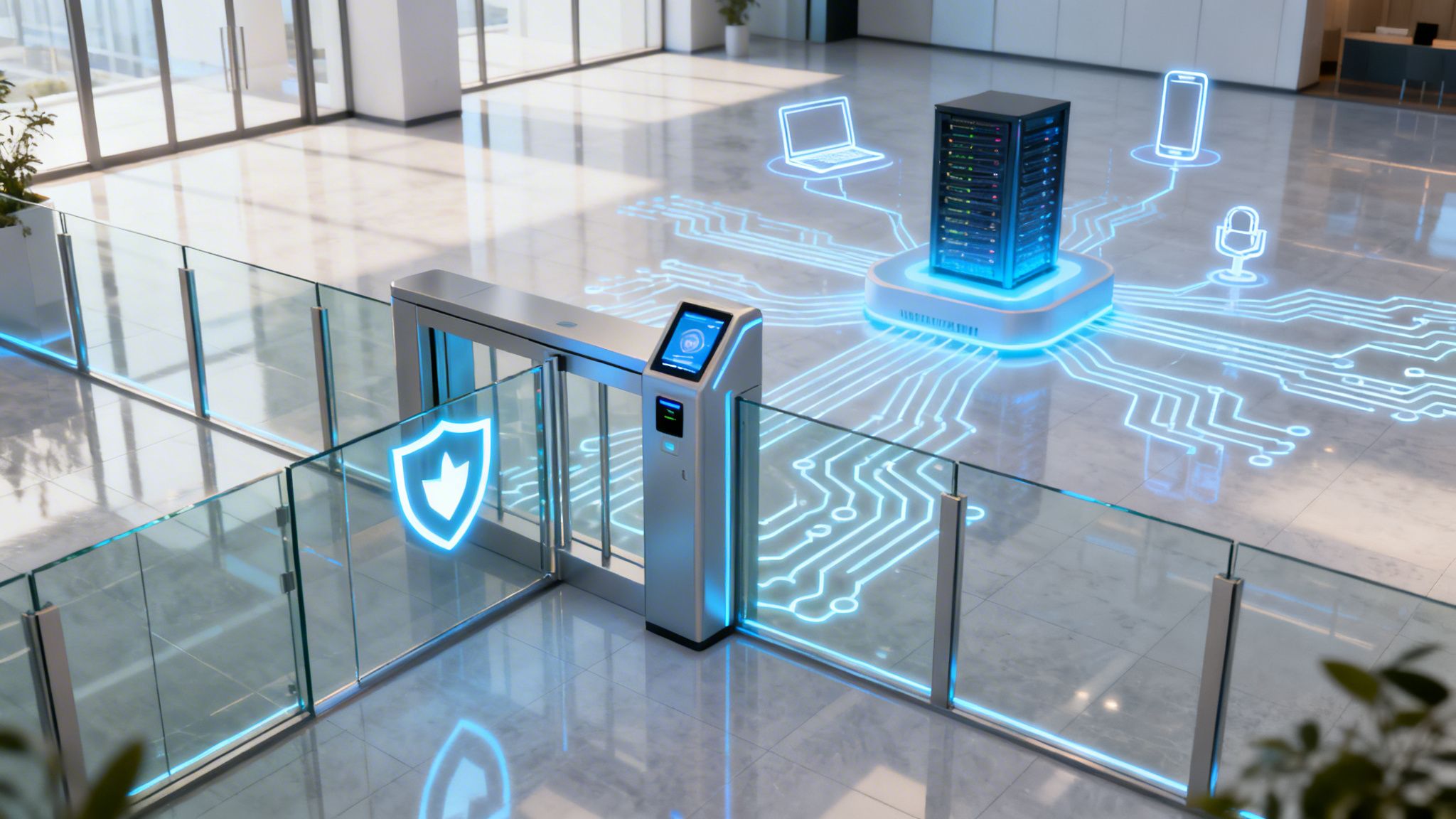
A Guide to WiFi for Vehicles and Connected Fleets
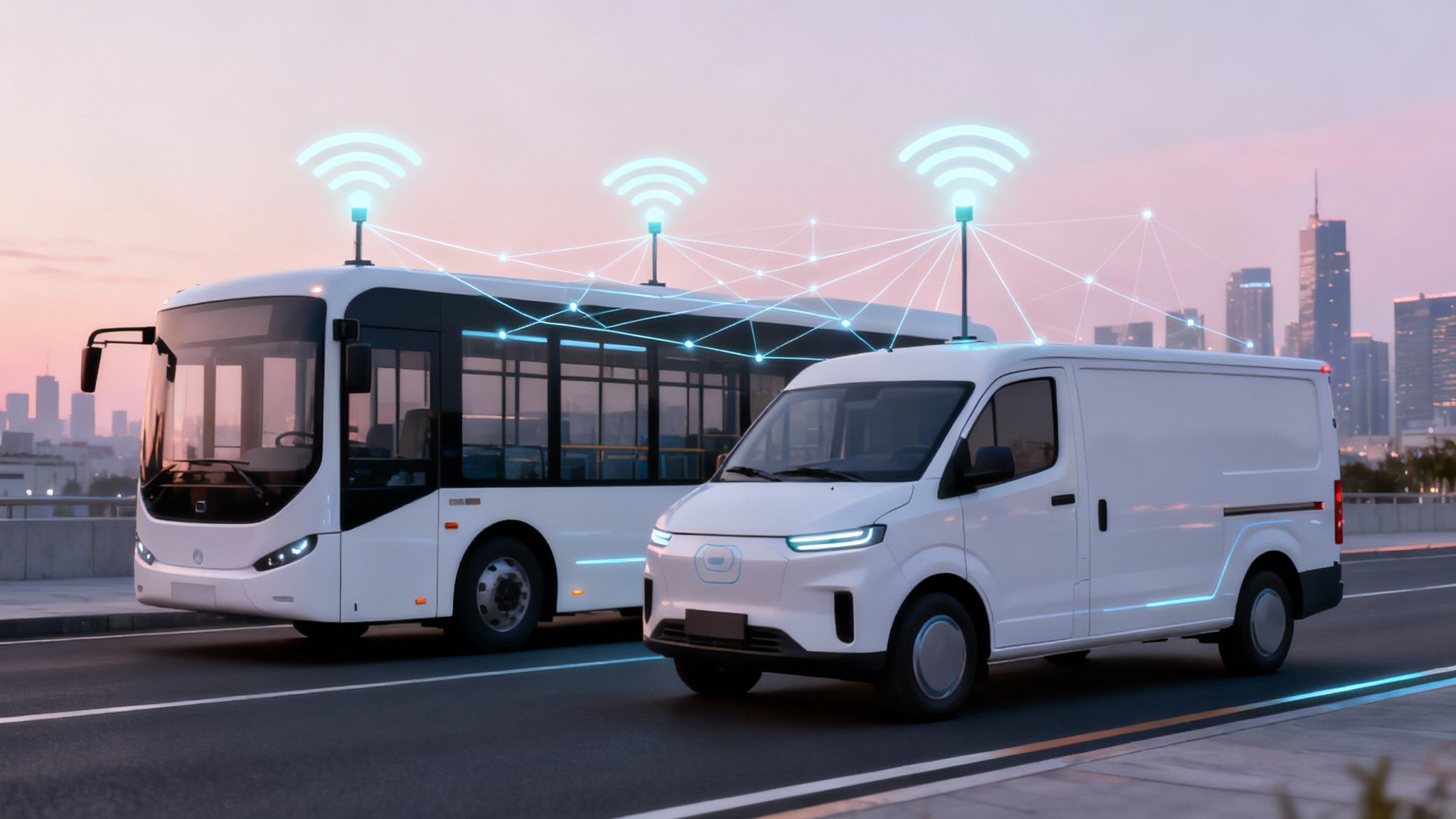
In its simplest form, WiFi for vehicles works by taking a mobile signal, like 4G or 5G, and cleverly converting it into a stable, local wireless network right inside the vehicle. This allows passengers and any onboard devices to get online seamlessly, turning what was once dead travel time into productive, or entertaining, time. It’s a shift that has turned in-vehicle connectivity from a nice-to-have into a core utility for modern transport.
Why In-Vehicle WiFi Is No Longer a Luxury
The role of the modern vehicle has changed dramatically. It's no longer just a way to get from A to B; it's a mobile office, a moving entertainment centre, and for many businesses, a critical operational hub. This evolution means that having consistent, high-quality connectivity on the move isn't an optional extra anymore—it's a fundamental expectation for passengers and fleet operators across the UK.
For any business that operates vehicles, providing reliable WiFi is a direct investment in customer happiness and operational smarts. Whether you're running a hospitality shuttle, a public bus service, or a fleet for a build-to-rent community, the demand for a smooth digital experience is everywhere. This guide will demystify the technology, starting with the basics and moving all the way to advanced, real-world setups for connected fleets.
The Driving Forces Behind Vehicle Connectivity
Several key trends are pushing the rapid adoption of in-vehicle WiFi. The explosion of remote work means more professionals are trying to stay productive during their commute. At the same time, we've all come to expect on-demand entertainment and information wherever we are.
A major catalyst here in the UK is the incredible growth of electric vehicles (EVs). With 36% of drivers now owning or leasing an EV, people are spending more time on the road or at charging stations, relying on WiFi to get work done or stream content.
This creates a clear business case for investing in solid mobile networks. The benefits speak for themselves:
- Enhanced Passenger Experience: Offering free, secure WiFi is a proven way to improve satisfaction and build loyalty, whether it's on a daily bus route or a luxury tour.
- Increased Productivity: Staff in fleet vehicles can finish reports, join video calls, and access cloud tools without a single dropped connection.
- New Revenue Opportunities: A WiFi portal can become a platform for targeted advertising, special promotions, or even be offered as a premium, paid-for service.
- Operational Data: Gaining insights into how passengers connect and where vehicles are being used can help you optimise routes and improve services. You can learn more about how people use WiFi in public places from our research.
Understanding the Core Technologies
To deliver reliable WiFi on the move, you first need to get your head around the different technologies that make it all possible. Each approach solves a specific problem, from getting a single delivery van online to keeping an entire fleet of luxury coaches connected. Think of these as different tools in your connectivity toolbox—each one perfect for a particular job.
At the heart of almost every in-vehicle WiFi setup is a cellular gateway. This device is basically a rugged, super-powered version of the mobile broadband router you might have at home. It grabs a 4G or 5G signal from a mobile network and creates a local WiFi hotspot right inside the vehicle for passengers and their devices.
This is the most common and straightforward solution out there. It’s perfect for individual vehicles like taxis, shuttles, or small commercial vans where you just need to cover a single, contained space. It’s the foundational piece of the puzzle that more complex systems are often built upon.
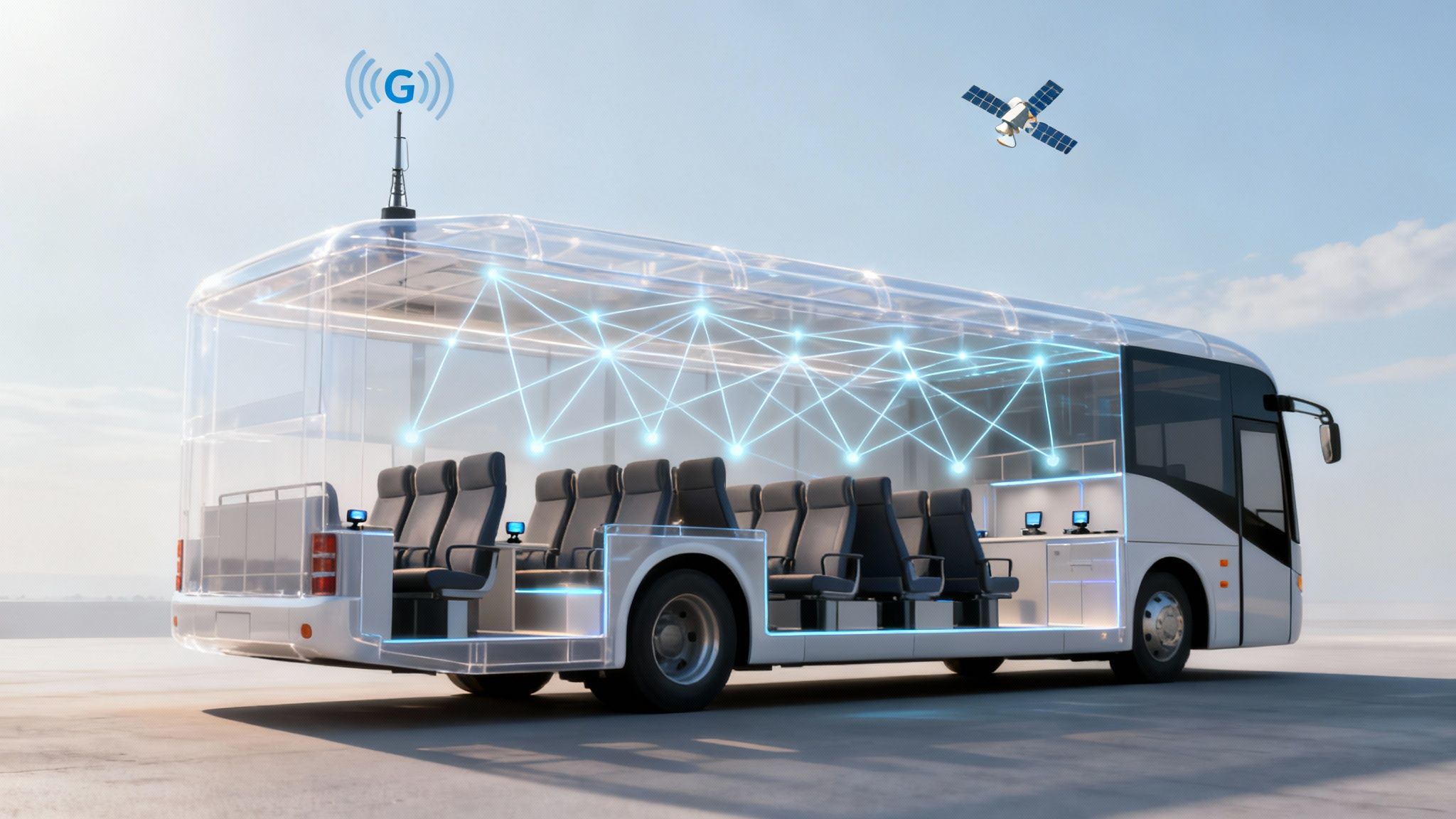
The image below shows how today's vehicles are becoming fully connected hubs for both work and play, all powered by these core technologies.
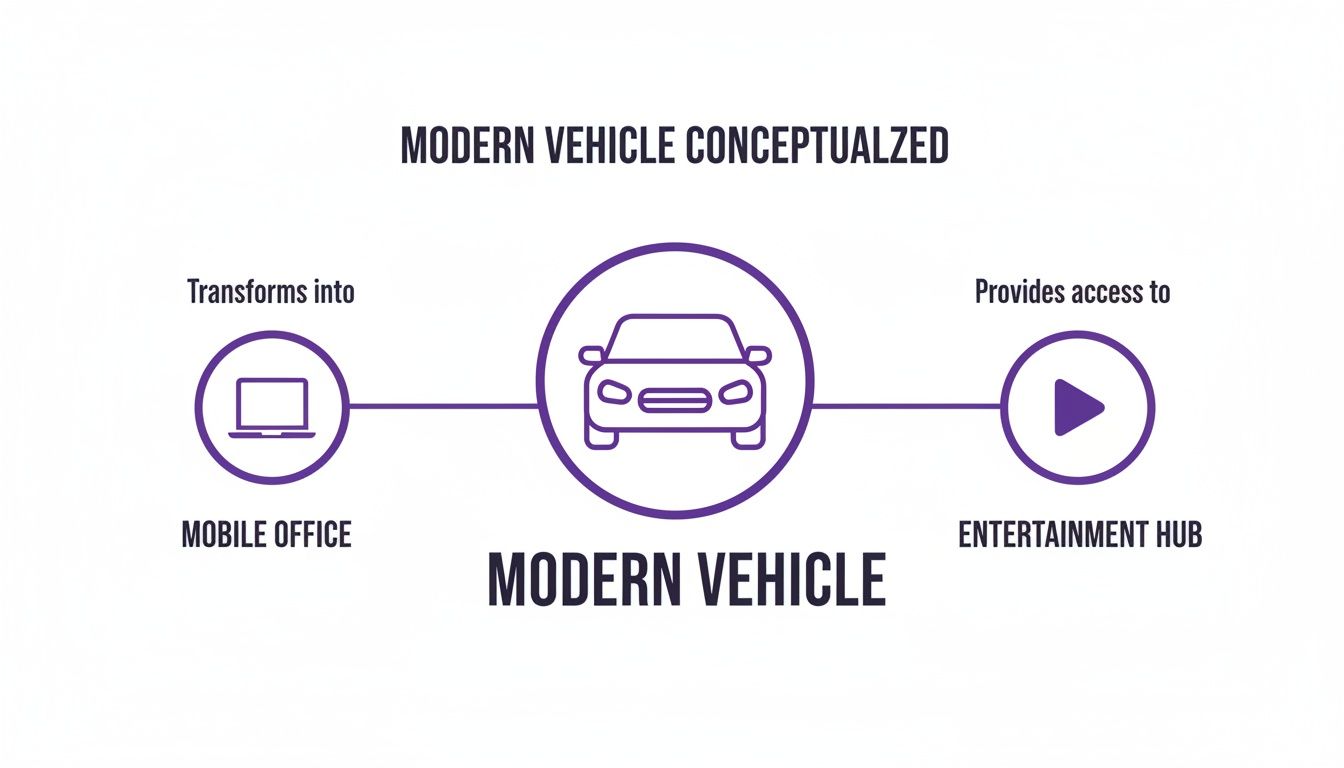
This really brings home the shift from a vehicle being just a mode of transport to a mobile environment where productivity and entertainment are completely integrated.
Scaling Connectivity With Mesh Networks
So, what happens when you need to cover a much larger area, like a long coach or an articulated bus? A single cellular gateway might struggle to push a strong signal from one end to the other. This is where mesh WiFi steps in.
Think of a mesh network as a smart "daisy-chain of signal boosters." It uses multiple access points, or nodes, that talk to each other to blanket the entire vehicle in one seamless network. One node connects to the main cellular gateway, and the others intelligently relay the signal, eliminating dead zones and ensuring a solid connection everywhere.
The handover between these nodes is completely seamless, so users won't experience dropped video calls or buffering streams as they move around. It just works.
Reaching Beyond Mobile Coverage With Satellite
Cellular networks are fantastic, but let's be honest, they don’t cover every single square mile of the country. For vehicles travelling through remote, rural, or genuinely "off-grid" areas, satellite connectivity is the ultimate answer.
Picture satellite internet as your direct line to the sky. A terminal on the vehicle's roof communicates with satellites orbiting the Earth, providing an internet connection where mobile towers simply can't reach. This tech is absolutely vital for sectors like adventure tourism, remote logistics, or emergency services that have to operate in challenging terrains.
While once seen as prohibitively expensive, the costs for satellite hardware and data plans have dropped dramatically. This makes it a genuinely viable option for specialised fleets that demand 100% uptime, no matter their location.
Of course, all this great tech needs a steady stream of power to work reliably. For more advanced setups, knowing the basics of a solid RV inverter installation is essential for ensuring your equipment never lets you down.
Comparing In-Vehicle WiFi Technologies
To make the right call, you need to understand how these technologies stack up against each other. The best choice for a city bus fleet will be completely different from what an overland tour operator needs. This simple comparison table breaks down the main options to help you see what fits best.
By understanding the strengths and weaknesses of each, you can start to layer these technologies. The goal is to build a resilient, adaptable network that keeps passengers and operational systems connected, no matter where the journey takes them.
Securing Your Mobile Network
Great WiFi in vehicles isn't just about speed; it's about building a digital fortress around your connection. In a moving environment where passengers, staff, and operational tech all share the same network, a single, shared password just doesn't cut it anymore. That's an outdated model. Modern security is about a layered approach that intelligently authenticates every single user and device.
This means you need different security rules for different groups. Your passengers need simple, safe access. Your staff need a rock-solid connection tied to their corporate login. And all your onboard IoT devices—like payment terminals or sensors—need their own secure channel so they don't become a backdoor into the network.
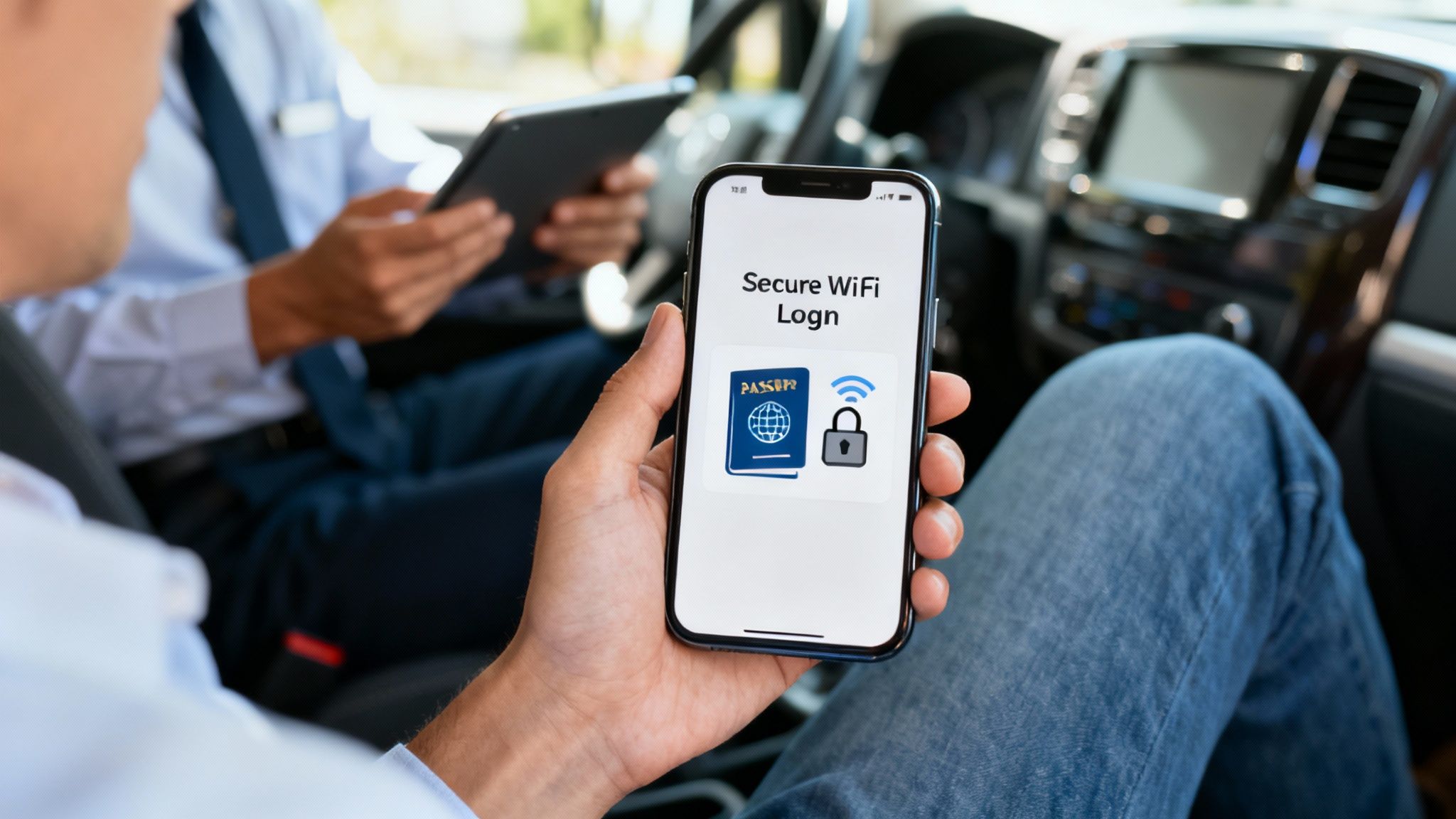
This image nails the end goal: giving every user a seamless and secure 'digital passport' that protects their connection from the moment they step on board.
Seamless and Secure Guest Access
For passengers, the gold standard for secure, friction-free connectivity is OpenRoaming and Passpoint. Think of it like a universal WiFi passport. Once a guest authenticates with a trusted provider (often just by using their email), their device can automatically and securely connect to any participating network across your entire fleet. It even works at thousands of other venues worldwide—no more hunting for networks or typing in passwords.
This approach is a game-changer for a few reasons:
- Enhanced Security: Connections are encrypted from the very first packet, wiping out the risks that come with open networks or shared passwords.
- Frictionless User Experience: Passengers connect the moment they're in range. It’s a premium, hassle-free experience that builds real loyalty.
- Scalability: The same secure profile works across every single vehicle in your fleet, making management a breeze and ensuring a consistent experience for everyone.
To create a truly resilient mobile network, it's also critical to implement strong measures for security in embedded systems.
Zero-Trust Access for Staff and Operations
While guest access should be easy, connections for staff and operational devices need a much stricter, identity-first approach. This is where a zero-trust model is essential. Instead of trusting a device just because it has the right password, zero-trust verifies who is trying to connect, every single time.
The best way to do this is by integrating your vehicle WiFi with a central identity provider, like Microsoft Entra ID (formerly Azure AD) or Google Workspace. When a staff member tries to connect, the network checks their credentials against your company's central directory. This ensures only current, authorised employees can get onto sensitive internal systems. If someone leaves the company, their access is revoked everywhere, instantly.
Securing Legacy and IoT Devices
Let's be realistic—not every device can handle fancy certificate-based authentication. Onboard systems like ticketing machines, digital signs, or older hardware often need a simpler way to connect. For these situations, Individual Pre-Shared Keys (iPSK) are the perfect fix.
iPSK bridges the gap between modern security and legacy hardware. It assigns a unique, individual password to each specific device, acting like a 'unique key for every lock.' This contains any potential breach to a single device, preventing it from spreading across the network.
By combining these methods, you create a powerful, multi-layered security strategy. OpenRoaming delivers a premium experience for guests, zero-trust integration secures your staff, and iPSK locks down your operational hardware. This comprehensive framework protects every part of your mobile network, turning your vehicle WiFi from a potential weak spot into a secure, trusted asset. If you want to dive deeper into the tech, you can learn more about Passpoint and public WiFi security tips in our dedicated guide.
Designing Resilient WiFi Architectures
Moving from individual bits of kit to a complete system, the design of your vehicle WiFi architecture is where reliability is really put to the test. A well-thought-out architecture guarantees consistent connectivity, whether you're managing a single luxury shuttle or a whole fleet of public buses. The goal is a network that's tough, scalable, and can handle the constantly changing world of transport.
The foundation of any mobile network design is understanding how the data flows. It all starts with the backhaul—the vehicle's main connection to the internet via 4G, 5G, or satellite. Think of this link as the lifeline; if it goes down, everything onboard goes offline. From that connection, onboard access points and switches share the internet with passengers, staff, and operational gadgets.
Single Vehicle Architecture: A Simple Blueprint
For a single vehicle, like a hotel shuttle or a small tour bus, the setup can be refreshingly simple. The core components are a cellular gateway and one or more access points.
- Cellular Gateway: This is the brains of the operation. It's kitted out with one or more SIM cards to connect to 4G/5G networks. For real resilience, using a gateway with dual-SIM capabilities is a smart move. This allows it to automatically failover to a backup mobile network if the main one drops out.
- Access Point (AP): In a smaller vehicle, the gateway's built-in WiFi might be enough. But for larger vehicles or those with metal partitions, a separate, strategically placed AP ensures you get even coverage everywhere.
This straightforward pattern gives you a cost-effective yet reliable solution for individual vehicles. It’s the perfect starting point for businesses just dipping their toes into providing in-vehicle WiFi.
Fleet-Wide Architecture Patterns
When you scale up to a whole fleet, the challenge changes. It's less about a single vehicle's connection and more about centralised management, security, and consistency across the board. A unified architecture makes sure every vehicle offers the same secure, reliable experience, no matter where it is.
A popular approach is to have a standardised set of hardware in each vehicle, all managed from a single cloud dashboard. This lets network admins keep an eye on performance, push out configuration updates, and sort out issues across the entire fleet from one place, remotely.
A key principle for fleet architecture is vendor interoperability. While sticking to one vendor (like Meraki, Aruba, or Ruckus) makes management easier, real-world fleets often end up with a mix of hardware. A flexible software layer that can work across different brands is crucial for creating a cohesive, manageable network without getting locked into a single ecosystem.
Designing for Multi-Tenancy
Many modern transport services are multi-tenant environments. A residential community shuttle, for instance, serves residents, staff, and maybe even temporary guests. Each of these groups needs a different level of access and security.
A solid multi-tenant architecture uses network segmentation to create separate, isolated virtual networks for each user group:
- Residents/Guests: Connect using an OpenRoaming or Passpoint-enabled SSID. This gives them secure, seamless access that feels just like their home network.
- Staff: Authenticate with their corporate logins (SSO) to securely access operational systems and internal resources.
- IoT/Operational Devices: These get their own firewalled network using iPSK for secure, managed access. This is for things like payment terminals or vehicle telematics.
This separation is vital for both security and performance. It stops a security hiccup on the guest network from affecting critical operational systems. It's a design pattern that’s becoming more and more important as vehicles get smarter. The UK's Automated Mobility Network, for example, highlights WiFi's central role in scaling self-driving vehicles, where secure, segmented connectivity is non-negotiable for remote operations and passenger services. You can learn more about the future of automated mobility in the UK and its reliance on these advanced network designs.
By building these principles into your architecture from day one, you create a future-proof platform for reliable WiFi in your vehicles.
Putting Vehicle WiFi into Practice
It's one thing to talk theory, but seeing how in-vehicle WiFi delivers real value on the road is where it all clicks. Across the UK, businesses are weaving connectivity into their fleets not just as a nice-to-have, but as a core part of their strategy to sharpen operations, elevate the customer experience, and even open up new ways to make money.
From the daily grind of a city bus to the refined comfort of a hotel shuttle, a solid WiFi connection solves unique problems and delivers tangible results. It turns dead travel time into a productive, engaging extension of a brand’s promise.
Public Transport: Elevating the Passenger Journey
For public transport operators, the name of the game is making the daily commute a better, more efficient experience. Offering reliable onboard WiFi is a massive differentiator. Suddenly, a standard bus or train ride becomes a mobile office or a place to stream a show, directly boosting rider satisfaction and keeping them coming back.
But it goes way beyond just keeping passengers happy. A connected vehicle unlocks a whole suite of smart transit solutions:
- Smart Ticketing: Syncing data for contactless payments in real-time. This cuts down boarding queues and makes fare collection a breeze.
- Live Passenger Information: Pushing accurate, up-to-the-minute arrival times and service updates to digital screens inside the vehicle.
- Operational Telemetry: Sending vehicle performance data back to a central depot for predictive maintenance and optimising routes on the fly.
A typical setup here involves a ruggedised 5G cellular gateway for the backhaul connection, paired with a mesh network of access points inside longer vehicles like trains or coaches to guarantee wall-to-wall coverage. Security is handled by segmenting the network; passengers get secure, certificate-based access via OpenRoaming, while critical operational systems are kept completely separate on their own firewalled network.
Hospitality on the Move: Creating Premium Experiences
Think about luxury tour coaches or executive transport services. Their entire brand is built on a promise of premium quality. In this context, in-vehicle WiFi isn't just a feature; it's a critical part of that promise. A patchy, unreliable connection can shatter the illusion of luxury in an instant, while seamless, high-performance internet reinforces it.
The big challenge is maintaining that connection across diverse, sometimes remote, travel routes. A resilient setup here might blend 5G cellular with a satellite backhaul, guaranteeing uptime even when mobile signal disappears. The goal is simple: provide a consistently high-end digital experience that lets guests stream HD video or jump on a critical video call without a single stutter.
For these operators, the WiFi login portal becomes a valuable marketing touchpoint. It can be customised with brand messaging, promote upcoming tours, or gather feedback through optional surveys, turning a simple connection process into an opportunity for engagement.
Hotel and Residential Shuttles: Making a Great First Impression
That journey from the airport to a hotel, or from a build-to-rent community to the local Tube station, is often the very first physical interaction a person has with your brand. Getting the WiFi right in your shuttles sets the tone for everything that follows. It lets guests catch up on emails, coordinate their plans, or just unwind with a bit of Netflix after a long flight.
This is where frictionless authentication really shines. By using a Passpoint-certified network, a guest’s device can connect automatically and securely the moment they step on board. It’s an invisible but powerful touch that extends that feeling of a connected, welcoming environment beyond the front door of the property, creating an unforgettable first impression.
This is especially critical for UK fleet operators, who are increasingly looking to Automotive IoT and vehicle WiFi to trim costs and boost efficiency. With over 2 million plug-in vehicles now on the roads, fleets are facing mounting pressure from the ZEV Mandate, making every part of the user experience absolutely vital. You can find more insights about the rise of Automotive IoT in the UK on statista.com.
Measuring Performance and Calculating ROI
A connected fleet is more than just a convenience for passengers; it's a powerful source of data that can drive serious business growth. Rolling out wifi for vehicles is just the start. The real value gets unlocked when you start measuring its performance and proving its return on investment (ROI). This is how you transform your network from an operational cost into a tangible asset for business intelligence.
Your first port of call should always be network health and performance. These are the foundational metrics that ensure people have a good experience. Keeping a close eye on them allows your team to spot issues before they become problems, optimise your data plans, and deliver the reliability that both passengers and staff expect.
Key Performance Indicators for Network Health
Monitoring the core technicals of your vehicle WiFi is non-negotiable. These numbers give you a crystal-clear picture of how the system is performing out in the real world and where you can make improvements.
Start by tracking these essential KPIs:
- Uptime and Availability: What percentage of the time is the WiFi service actually working across your fleet? This is your single most critical measure of reliability.
- Data Usage: How much data is being chewed through per vehicle, per day, or even per user? This helps you right-size data plans with mobile carriers and dodge costly overage fees.
- Client Count and Session Duration: How many unique people are connecting, and how long are they staying on? This is a great indicator of user engagement and how much value passengers see in the service.
- Signal Strength and Quality: Keeping tabs on the 4G/5G backhaul connection helps you pinpoint routes with dodgy coverage, giving you the chance to make adjustments or even switch carriers.
These technical stats are crucial, but they only tell half the story. The true financial return is realised when you dig into the first-party data captured when users log in.
Transforming Data into Business Intelligence
Modern authentication isn't just about secure access; it's about creating a direct line to your customers. When a passenger logs in using a seamless method like OpenRoaming or even a simple email form, you gain valuable, consent-based insights that can be used to personalise their experience and build loyalty.
This is where your WiFi network becomes a strategic business tool. By connecting the dots between who is travelling and how they interact with your brand, you move beyond providing a simple utility and start building valuable customer relationships.
This first-party data can include key information like passenger demographics, how often they travel with you, and how long they spend on board. By feeding this information directly into your Customer Relationship Management (CRM) system, you can unlock some seriously powerful marketing and operational opportunities.
For instance, a hotel shuttle service could automatically send a welcome message with a restaurant discount to a guest who has just connected for the first time. A public transport operator could identify its most frequent riders and offer them exclusive loyalty rewards. This level of personalisation drives repeat business and gives customer lifetime value a significant boost.
You can get a clearer picture of the potential returns by using our dedicated tool to calculate your WiFi ROI and see how these insights translate into tangible financial benefits.
Frequently Asked Questions
When you start digging into WiFi for vehicles, a lot of practical questions bubble up. It's one thing to understand the tech on paper, but how does it actually perform out on the road? From data bills to the nuts and bolts of installation, getting straight answers is the only way to build a mobile network you can rely on.
We've tackled some of the most common questions we hear from network teams to give you clear, straightforward answers. Think of this as the groundwork for a solid fleet connectivity strategy.
How Much Data Will My Fleet Actually Use?
This is the big one for most fleet managers, and for good reason—nobody likes surprise data charges. The truth is, data consumption depends entirely on what people are doing on the network, but you can get a pretty accurate estimate by looking at a few key things.
- What Passengers are Doing: Video streaming is the real data hog, burning through as much as 3 GB per hour for HD quality. On the other hand, simple web browsing, checking emails, or scrolling through social media uses a fraction of that.
- Your Own Operational Needs: Don't forget to account for your own data usage. If you're pulling back CCTV footage or running vehicle telematics over the same connection, that steady stream of data needs to be factored into your monthly plan.
- Putting Some Guardrails in Place: You're not powerless here. Setting bandwidth limits per user or filtering out high-consumption content can dramatically rein in data usage by stopping excessive streaming or huge downloads in their tracks.
Most good cellular gateways provide detailed reports, so you can see exactly what’s happening across your fleet and tweak your data plans accordingly. It’s often a smart move to start with a slightly larger data plan than you think you need and then optimise it downwards once you have some real-world usage data.
As a rough guide, a shuttle bus with typical passenger use (a mix of browsing, social media, and a bit of light streaming) often lands somewhere between 100-200 GB per month. But for a coach where passengers are settling in for a long trip and streaming movies, that number could easily jump past 500 GB.
How Do I Handle Installations Across All My Different Vehicles?
Managing a fleet with everything from small vans to double-decker coaches can make installations feel like a logistical nightmare. The secret to keeping things simple for both deployment and future maintenance is to create a standardised plan.
You need a repeatable installation blueprint. This means figuring out the best spots to mount the cellular gateway and any external antennas for the strongest possible signal, no matter the vehicle. For larger vehicles like buses or trains, a quick site survey is invaluable for mapping out where to place mesh access points to kill any dead zones.
By creating and documenting a clear process, you ensure every installation is consistent and reliable. It makes life so much easier for your technical teams when it comes to troubleshooting or rolling out upgrades down the line.
Purple offers a unified, identity-based networking platform that makes secure access across your entire fleet simple. Our cloud-managed solution integrates with the hardware you already trust, delivering a consistent, passwordless experience for everyone on board. It’s about turning your vehicle WiFi into a genuine tool for better engagement and operational insight. Find out more at https://www.purple.ai.