

A leased line for your business is a private, dedicated internet connection that’s exclusively yours. Think of it as your company's private data highway, delivering guaranteed speeds, serious reliability, and symmetrical performance. It’s a genuine foundational asset for any modern business.
What Is a Leased Line in a Business Context?
Let's think about the daily commute. Standard business broadband is like jumping onto the M25 during rush hour. It gets you where you're going, but you’re sharing the road with everyone else. When it's busy, traffic jams are inevitable, slowing you down and making your arrival time a guessing game. This is exactly what happens when your internet connection is "contended"—shared among multiple users in your area.
A leased line, on the other hand, is your own private road, built just for your business. There’s no traffic, no congestion, and zero unexpected slowdowns. The speed you pay for is the speed you get, 24/7. This is the whole point of a leased line business solution: you get an uncontended, private circuit running straight from your premises to the provider's network.
Symmetrical Speeds: The Unsung Hero
One of the most powerful features of a leased line is its symmetrical bandwidth. This simply means your upload speed is identical to your download speed. With standard broadband, upload speeds are often just a fraction of the download rate, which can create a massive bottleneck for how businesses operate today.
Just think about these everyday activities that are hammered by slow upload speeds:
- Cloud Applications: Pushing large files up to platforms like Dropbox or Microsoft 365.
- VoIP and Video Calls: Sending your voice and video data for crisp, lag-free meetings on Teams or Zoom.
- Data Backups: Transmitting your critical company data to off-site storage for disaster recovery.
- Hosting Servers: Letting remote employees or clients access data you store on-site.
With symmetrical speeds, all these tasks happen without a hitch and without grinding your network to a halt. It guarantees the two-way flow of information is equally strong, easily supporting the demands of a digitally-focused workplace.
A leased line isn't just about faster internet; it's about securing a predictable, high-performance foundation that lets your entire technology stack run flawlessly. It completely removes the element of chance from your connectivity.
More Than Just Speed: A Bedrock for Operations
At the end of the day, a leased line is an operational asset, not just another IT expense. It’s the bedrock that supports everything from crystal-clear VoIP calls and high-performance staff WiFi to robust cloud services and secure remote access.
For a deeper dive into the nuts and bolts of this dedicated connection, you can explore a comprehensive guide on what a business leased line truly involves. It’s the core infrastructure that ensures your business stays productive and resilient, no matter what your neighbours are doing online.
Leased Lines vs Business Broadband
Choosing between a leased line and business broadband can feel like deciding between a private jet and a commercial flight. Both will get you where you’re going, but the experience, reliability, and performance are in completely different leagues. For any business, this choice hits right at the heart of productivity, customer experience, and your ability to stay online when it matters most.
Business broadband is what’s known as a "best-effort" service. Think of it like a public motorway; your data travels alongside traffic from local homes and other businesses, which means you’ll inevitably hit rush hour and experience slowdowns. A leased line, on the other hand, is your own private, uncontended data highway. The speed you pay for is the speed you get, always.
This dedicated connection is the core difference, but its implications run deep, touching everything from day-to-day tasks to your long-term strategic plans.
The Power of Symmetrical Performance
One of the biggest distinctions is how each service handles your uploads. Business broadband is almost always asymmetric, meaning your download speeds are much faster than your upload speeds. This was fine in a world where we mostly just consumed content—browsing websites or streaming video.
But modern businesses are active creators and collaborators. They depend on serious upload power for:
- Cloud Operations: Pushing huge datasets to cloud apps like Microsoft 365 or Salesforce.
- Remote Work: Supporting smooth remote desktop and VPN connections for staff working from anywhere.
- Communication Tools: Ensuring video conferences and VoIP calls are crystal-clear, without frustrating lag or jitter.
- Data Protection: Running consistent, timely backups of critical business data to off-site servers.
A leased line’s symmetrical speeds mean your upload and download capabilities are identical. A 1Gbps connection delivers 1Gbps in both directions, completely removing the upload bottleneck that can cripple a business running on standard broadband. For an architectural firm uploading massive design files or a hotel processing hundreds of online bookings at once, this isn't a luxury; it's essential.
Guarantees vs Hopes: The SLA Difference
Perhaps the most critical factor for any serious business is the Service Level Agreement (SLA). An SLA isn't just a piece of paper; it's a contractual guarantee from your provider that outlines specific performance standards, uptime promises, and fix times.
With a leased line, you get a robust, legally binding SLA. If your connection ever fails, the provider is obligated to fix it within a tight window, often as short as four to six hours. This is your business’s insurance policy against the crippling cost of downtime.
By contrast, business broadband typically comes with no meaningful SLA. A fault might be fixed within a few days, but there are zero guarantees. For any organisation where every hour offline means lost revenue and a damaged reputation, this "best-effort" approach is simply too big a risk to take.
This decision tree shows how your operational needs should guide your choice.
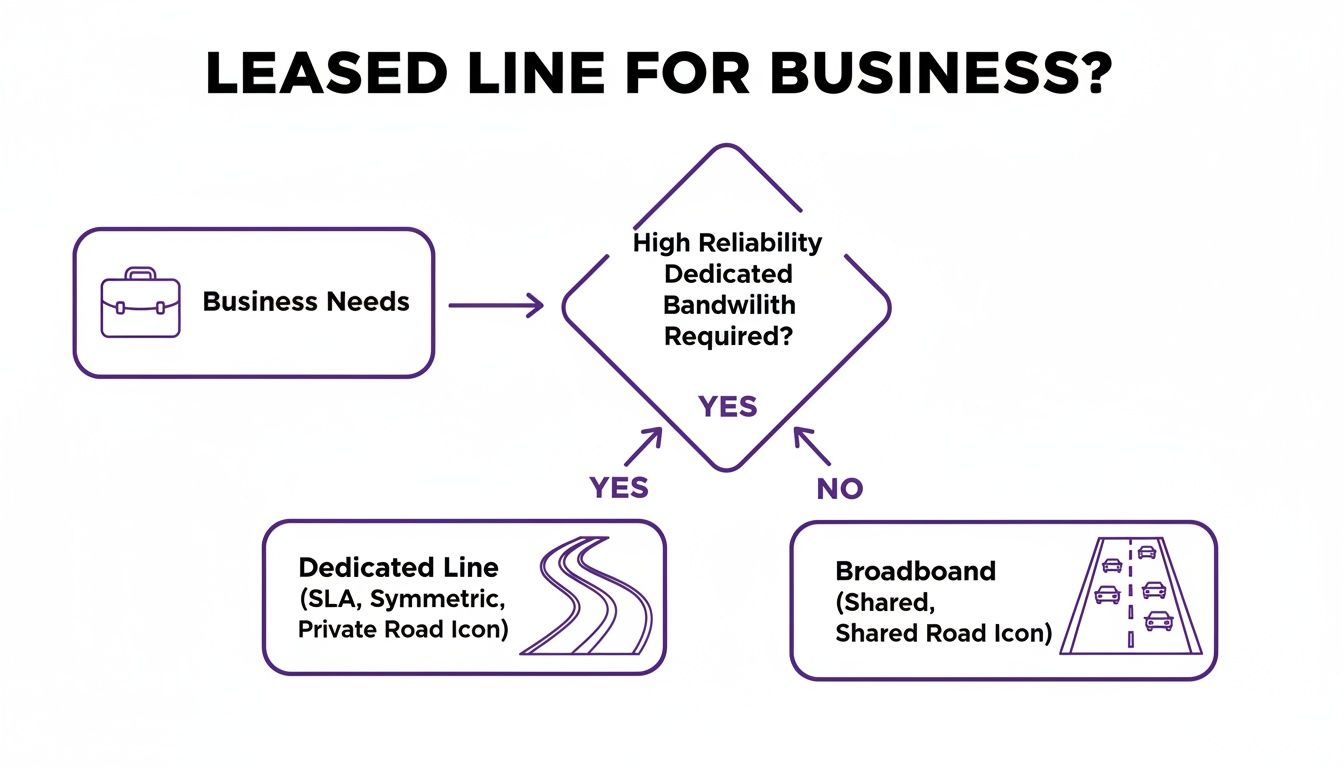
As the graphic shows, if your operations demand unwavering reliability and dedicated performance, a leased line is the only logical path. Standard broadband is fine for less critical needs.
A Direct Comparison of Your Options
To really grasp the divide, it helps to put the key features side-by-side. The decision isn't just about raw speed; it's about reliability, support, and the fundamental design of the service your business will depend on.
Leased Line vs Business Broadband At a Glance
This table breaks down exactly what you get with each service, cutting through the jargon to show what really matters for your operations.
Ultimately, a leased line is an investment in operational certainty. It acts as the stable core for more complex network setups, which is why many organisations explore how it fits into their wider infrastructure. For those interested, you can learn more about how these connections underpin larger networks by reading our guide on what a Wide Area Network is and how it works.
While broadband certainly has its place, a leased line provides the performance and peace of mind that mission-critical operations demand.
Understanding Leased Line Costs and UK Providers
Figuring out the price of a leased line isn't as simple as picking a number off a shelf. The final monthly cost isn't arbitrary; it’s a direct reflection of the physical work needed to deliver your own private, dedicated connection. A few key factors come together to determine the quote you'll receive.
Think of it like building a private road directly to your office. If a major motorway already runs past your front door, laying a new slip road is relatively straightforward and less expensive. But if your office is tucked away in the countryside, miles from any existing highways, the cost to build that access road will be significantly higher. There's just more ground to cover, more materials to use, and more planning involved.
That analogy holds perfectly true for leased lines. Your business's physical location is the single biggest factor driving the cost. A company in a bustling city centre, already surrounded by fibre optic networks, will find a 1Gbps connection far more affordable than a rural business where new trenches might need to be dug just to lay the cable.
Key Factors That Shape Your Bill
The final price on your contract comes from several variables clicking into place. If you understand these components, you can budget accurately and ask the right questions when you start talking to suppliers.
Here’s what really influences your monthly cost:
- Geographical Location: Nothing matters more than your proximity to a provider's existing fibre network. Urban areas are almost always cheaper to connect than rural or remote sites.
- Required Bandwidth: The speed you need has a direct impact on the price. A 100Mbps line will be more affordable than a 1Gbps or 10Gbps service, so it’s crucial to match the bandwidth to what your business actually needs.
- Contract Length: Providers offer pretty hefty discounts for longer commitments. A three-year or five-year contract will have a much lower monthly cost than a one-year term, rewarding that loyalty and predictability.
- Excess Construction Charges (ECCs): If significant civil engineering work is needed to connect your building—like digging up a road—these one-off costs will be passed on to you as ECCs.
Navigating the UK Provider Landscape
The UK leased line market is mature and competitive, with a healthy mix of established giants and agile challengers. This competition is great news for businesses, giving you a real choice when it comes to network reach, service levels, and pricing.
Your main options generally fall into two camps. First, you have the major network operators like BT and Virgin Media O2 Business, who own and operate vast national fibre infrastructures. They offer extensive coverage and are often the underlying carrier that many other providers rely on.
Second, there’s a growing number of alternative network providers, or "alt-nets," like CityFibre and TalkTalk Business. These companies have been aggressively building their own fibre networks, often focusing on specific cities or regions to inject more competition and give businesses more choice.
Choosing a provider isn't just about finding the lowest price. It's about aligning their network footprint with your business locations and ensuring their service level commitments meet your operational resilience requirements.
Typical UK Pricing Structures
While costs are highly dependent on the factors we've covered, it helps to have a general idea of the market rates. Thankfully, the UK leased line market has become much more accessible for organisations of all sizes, with competitive pricing now the norm.
To give you a clearer picture, businesses can often find 100Mbps leased lines starting from around £200 per month, while the more popular 1Gbps connections typically begin closer to £300 per month. For enterprises with extreme data needs, premium 10Gbps services command prices well above £1,000 monthly. You can discover more insights about UK leased line costs and pricing trends on babble.cloud.
Ultimately, securing the right leased line requires a careful balance of cost, performance, and provider reliability. By understanding what drives the price, you can make a smart, surprise-free investment that truly supports your company's growth.
Why Service Level Agreements Are a Business Lifeline
A Service Level Agreement (SLA) is far more than just a technical document filed away with your contract. For any business serious about its connection, it's a legally binding promise from your provider and a critical part of your continuity plan. It’s what turns your internet from a simple utility into a guaranteed, resilient service.
While standard business broadband often runs on a "best effort" basis, an SLA gives you concrete, contractual assurances. This agreement details specific performance metrics, uptime guarantees, and—most importantly—the maximum time it will take to fix a problem if your service ever goes down. It’s the difference between hope and certainty.

Beyond Uptime Percentages
When you're looking at an SLA, it's easy to get fixated on the headline uptime figure, like 99.9%. While that number is important, the real value for your business is buried in the details of the service guarantee. The metrics that truly affect day-to-day operations are often found in the small print.
Think about a large e-commerce business during its peak Black Friday sales. An SLA with a four-hour fix guarantee is the difference between a minor hiccup and a day of catastrophic revenue loss. In contrast, a broadband outage could knock that same business offline for days with little to no recourse.
Key SLA metrics you need to scrutinise include:
- Target Fix Time: The absolute maximum time the provider has to resolve a total loss of service. This can range from four to six hours for premium leased lines.
- Latency (Ping): The time it takes for data to travel from your network to its destination and back. Low latency is essential for real-time applications like VoIP calls and video conferencing.
- Jitter: The variation in latency over time. High jitter is what causes distorted audio and glitchy video, making calls unusable.
- Packet Loss: The percentage of data packets that simply fail to reach their destination. Even a tiny amount can severely degrade how your applications perform.
An SLA is your business’s insurance policy against costly downtime. It ensures that when things go wrong, your provider is contractually obligated to act swiftly and decisively to get you back online.
The Financial Safety Net of Service Credits
A robust SLA also includes a clear process for compensation if the provider doesn't meet its promises. These are known as service credits. If your provider misses a guaranteed fix time or fails to deliver the promised uptime, you're entitled to a credit on your next bill.
This isn't just about getting a small refund; it holds your provider financially accountable for the quality of their service. It gives them a powerful incentive to maintain a resilient network and respond to faults with genuine urgency, because their own revenue is on the line.
Choosing the Right Provider and SLA
The UK market for leased line services has matured, with a wide range of providers offering different levels of service. Top UK leased line providers—including BT, Virgin, CityFibre, TalkTalk, and ITS—all cater to different business needs with their own distinct offerings and SLAs.
When you're choosing a provider, their SLA should be a central part of your decision-making. Make sure it aligns perfectly with your business's tolerance for downtime and performance issues. Our guide on understanding the critical components of SLAs can offer more valuable insights here.
Ultimately, the right SLA empowers your business to operate with confidence, knowing your digital lifeline is protected by a solid, enforceable guarantee.
Powering Managed WiFi And Security With A Leased Line
Think of a leased line as more than just a fast internet pipe. It's the high-performance engine that drives your entire internal network experience. For any business that depends on seamless WiFi and solid security, the quality of that core connection dictates everything. It’s the difference between a frustrating user experience and a flawless one.
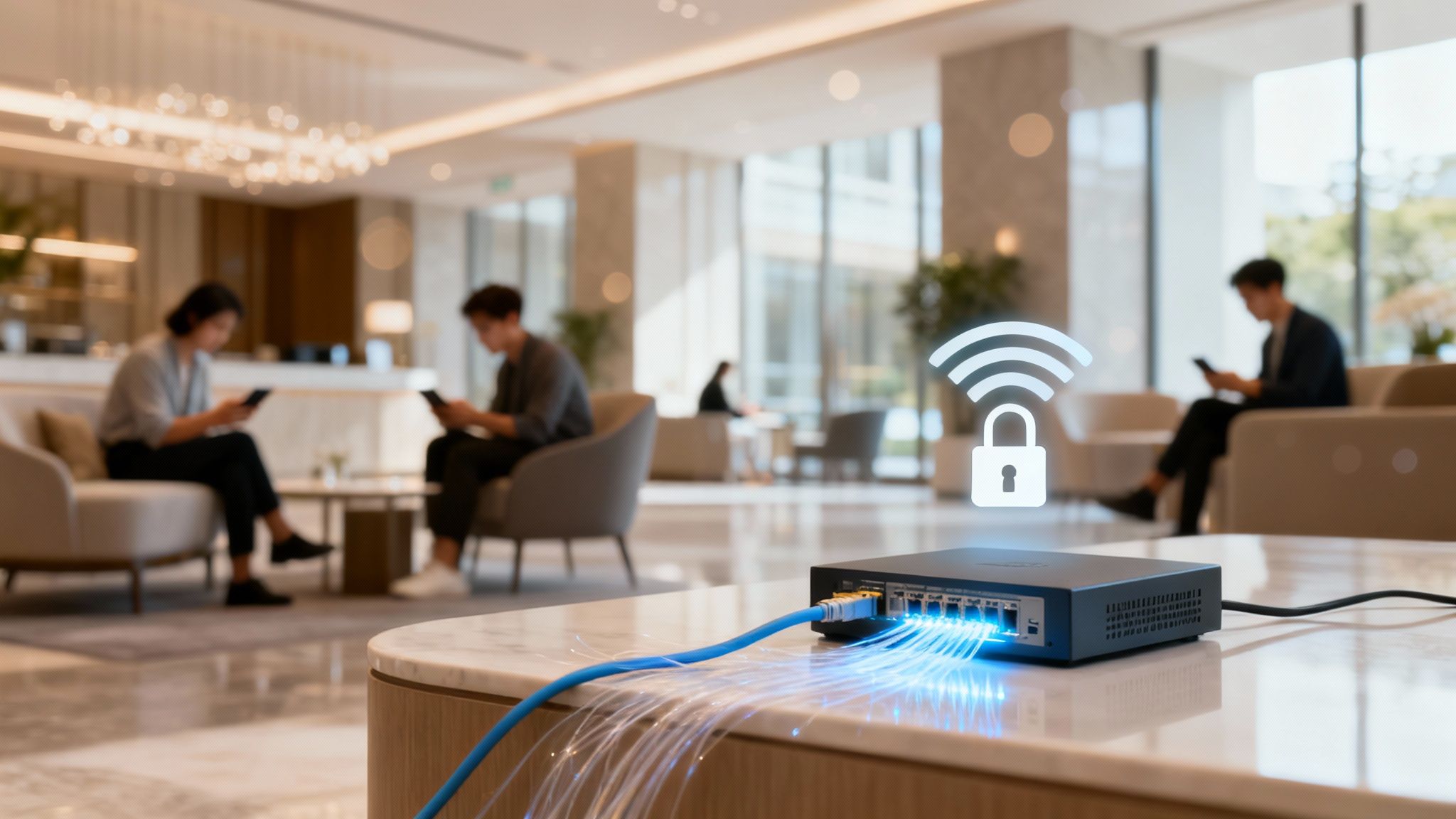
This is especially true for managed WiFi in high-density places. Picture a bustling hotel, a large corporate office, or a busy event venue. In these scenarios, hundreds of users are all trying to connect, stream, and collaborate at the same time. A standard broadband connection would quickly buckle under this pressure, creating a bottleneck that ruins performance for everyone.
A leased line business solution provides the stable, high-capacity bandwidth needed to stop this from happening. Because the connection is uncontended, performance stays consistent, no matter how many devices are online. This allows sophisticated guest WiFi platforms—which handle everything from user authentication to traffic shaping—to run without a single hitch.
Enabling A Superior User Experience
Modern network expectations have moved far beyond just getting online. Users now expect secure, passwordless authentication systems that simply work. A leased line's reliability is the foundation that allows these advanced systems to function properly, providing a smooth and professional experience for guests and staff alike.
For instance, a hotel using a platform with Passpoint certification relies on its leased line to handle the complex authentication handshakes happening behind the scenes. The guaranteed bandwidth ensures this process is instant, giving guests secure, encrypted connectivity from their very first visit.
A leased line transforms your infrastructure investment into a tangible user benefit. It’s the invisible force ensuring that your WiFi network is perceived as reliable, fast, and professional, which directly impacts customer satisfaction and staff productivity.
A Stronger Security Posture
Beyond performance, a leased line brings significant security advantages to the table. Because it's a private, dedicated circuit, it creates a more secure and easily defensible perimeter for your network right from the start. Your data isn't travelling alongside public internet traffic, which inherently reduces your exposure to certain threats.
This private connection is the ideal starting point for building a modern, zero-trust security model. A zero-trust approach works on the assumption that threats can exist both inside and outside the network, so it verifies every single request as if it came from an untrusted source.
When you pair a dedicated leased line with modern access controls and identity management solutions, you create a formidable security framework. Our overview of data and security best practices explores how these layers work together to protect sensitive information. This setup helps you enforce strict access policies and monitor network activity with much greater precision.
Future-Proofing Your Network Foundation
Investing in a leased line is also a strategic move to future-proof your business operations. The UK's full-fibre infrastructure has expanded at an incredible rate, transforming how accessible these dedicated connections are. Full fibre availability soared to 78% of UK premises by mid-2025, a massive leap from just 14% in May 2020, thanks to huge infrastructure investment. This growth has made high-capacity leased lines more competitive and attainable than ever.
This robust foundation ensures you can adopt new technologies without worrying about your connection becoming a bottleneck. To truly get the most out of a leased line's capabilities, consider integrating it with comprehensive managed IT services for small business. This ensures your powerful connection is expertly configured to support everything from advanced security protocols to demanding cloud applications, turning your connectivity into a genuine business asset.
Common Questions About Leased Line Business Solutions
When you're thinking about a major network upgrade like a leased line, it’s completely natural for practical questions to pop up. Moving from familiar business broadband to a dedicated, private connection is a big step. Getting your head around the real-world implications of installation, availability, and support is the key to making a confident decision.
This section cuts through the noise and answers the most common queries we hear from businesses exploring a leased line business solution. We'll skip the dense technical jargon and focus on what this all means for your day-to-day operations, your budget, and your timeline.
How Long Does a Leased Line Installation Take?
This is usually one of the first questions businesses ask, and it's a critical one for planning. Unlike a broadband connection that can sometimes be activated in days, a leased line installation is a much more involved process. You should typically expect a lead time of 45 to 90 working days, so planning well in advance is absolutely essential.
This timeframe isn't arbitrary; it covers several crucial stages:
- Site Survey: An engineer has to visit your premises to physically assess the existing infrastructure and map out the best route for the new fibre.
- Wayleave Agreements: If the new cable needs to cross private land, legal permissions (known as wayleaves) must be secured from the landowners, which can take time.
- Civil Works: This is the hands-on part. It might involve pulling new fibre through existing ducts or, in more complex cases, digging trenches to lay new infrastructure.
If that initial survey uncovers the need for significant construction—like digging up a road to lay fresh cable—this can trigger what are known as Excess Construction Charges (ECCs) and extend the timeline. The main takeaway here is to kick off the ordering process long before your required service date to avoid any disruption.
Can I Get a Leased Line at My Business Location?
The good news is that leased lines are available to the vast majority of UK business premises. The relentless expansion of fibre networks means that even locations once considered hard-to-reach are now often serviceable. However, availability and, more importantly, cost, are tied directly to your specific location and how close you are to the provider's existing network.
To find out for sure, the first step is always a fibre availability check. Any potential provider will run this for you, free of charge. It’s a desk-based survey that uses your postcode to see which networks are in the vicinity.
The availability check is the foundational step. It doesn't just confirm if a connection is possible; it also gives you a ballpark figure for potential installation costs, providing a clear picture from the very beginning.
If that initial check looks promising, it will be followed by the more detailed on-site survey to lock down the final plan and confirm any costs. This two-stage process ensures there are no nasty surprises down the line.
What Happens If My Leased Line Goes Down?
This question gets right to the heart of why businesses invest in a leased line in the first place: rock-solid reliability and guaranteed support. Unlike broadband's "best effort" service, a leased line is backed by a robust, legally binding Service Level Agreement (SLA). Think of it as your insurance policy against downtime.
The moment you report a fault, the clock starts ticking on your provider's guaranteed fix time. This is a contractual promise to resolve the issue within a specific window, which for most leased lines is between four and six hours. This rapid-response support is active 24/7/365, ensuring that even an issue at 2 AM on a Sunday is treated with urgency.
If the provider fails to hit that target, you are typically entitled to service credits as compensation. This financial penalty gives the provider a powerful incentive to maintain their network impeccably and resolve any faults with lightning speed, protecting your business from costly outages.
Is a 1Gbps Leased Line Overkill for My Business?
Choosing the right bandwidth is all about matching the connection to your real-world needs. While 1Gbps (that's 1,000Mbps) might sound like a colossal amount of bandwidth, it's quickly becoming the new standard for businesses that are planning for the future. Whether it’s "overkill" really depends on how your company uses the internet.
A small office that mainly sticks to email and basic web browsing could find a 100Mbps connection is more than enough. It would provide a super stable, reliable service without you paying for capacity you simply don't need.
However, a 1Gbps connection shifts from a luxury to an essential tool if your business relies on:
- Heavy Cloud Usage: Constantly syncing huge files with platforms like Microsoft 365, Google Workspace, or other hungry cloud applications.
- VoIP and Video Conferencing: Supporting dozens or even hundreds of staff on crystal-clear calls and video meetings without a hint of lag or jitter.
- High-Density WiFi: Providing a flawless connection for a large number of employees, guests, or customers in a busy office, hotel, or retail space.
- Large Data Transfers: Regularly moving massive datasets, like high-resolution video files, complex architectural plans, or critical off-site data backups.
Ultimately, picking your bandwidth is about making sure your connection is an enabler, not a bottleneck. A 1Gbps leased line gives you the headroom to embrace new technologies and scale your operations without ever worrying about hitting a performance ceiling.
At Purple, we understand that a powerful connection is just the beginning. Our platform turns your high-performance leased line into an intelligent network, offering secure, passwordless authentication for staff and guests. By integrating seamlessly with your infrastructure, we help you leverage your investment to improve user experience, strengthen security, and gain valuable insights. Find out how you can elevate your network at https://www.purple.ai.
Made with the Outrank app