A Hotelier's Guide to PMS in Hotel Operations for 2026
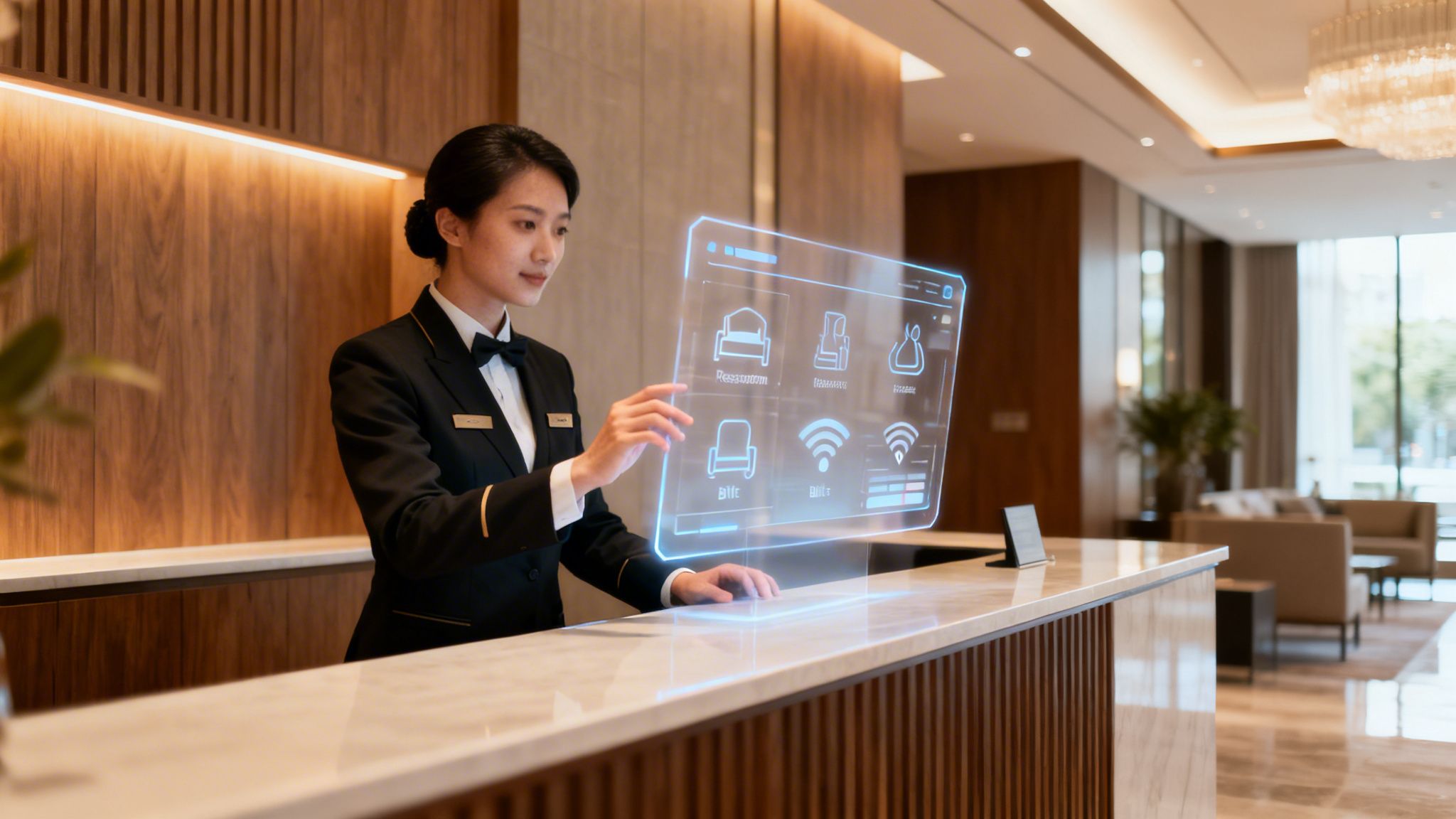
A Property Management System (PMS) in a hotel is the central software platform that manages and automates all major operational functions. Think of it as the hotel's digital heartbeat, coordinating everything from bookings and guest check-ins to housekeeping and billing from a single, unified dashboard. It is the core technology that enables modern hospitality.
Understanding the Hotel PMS
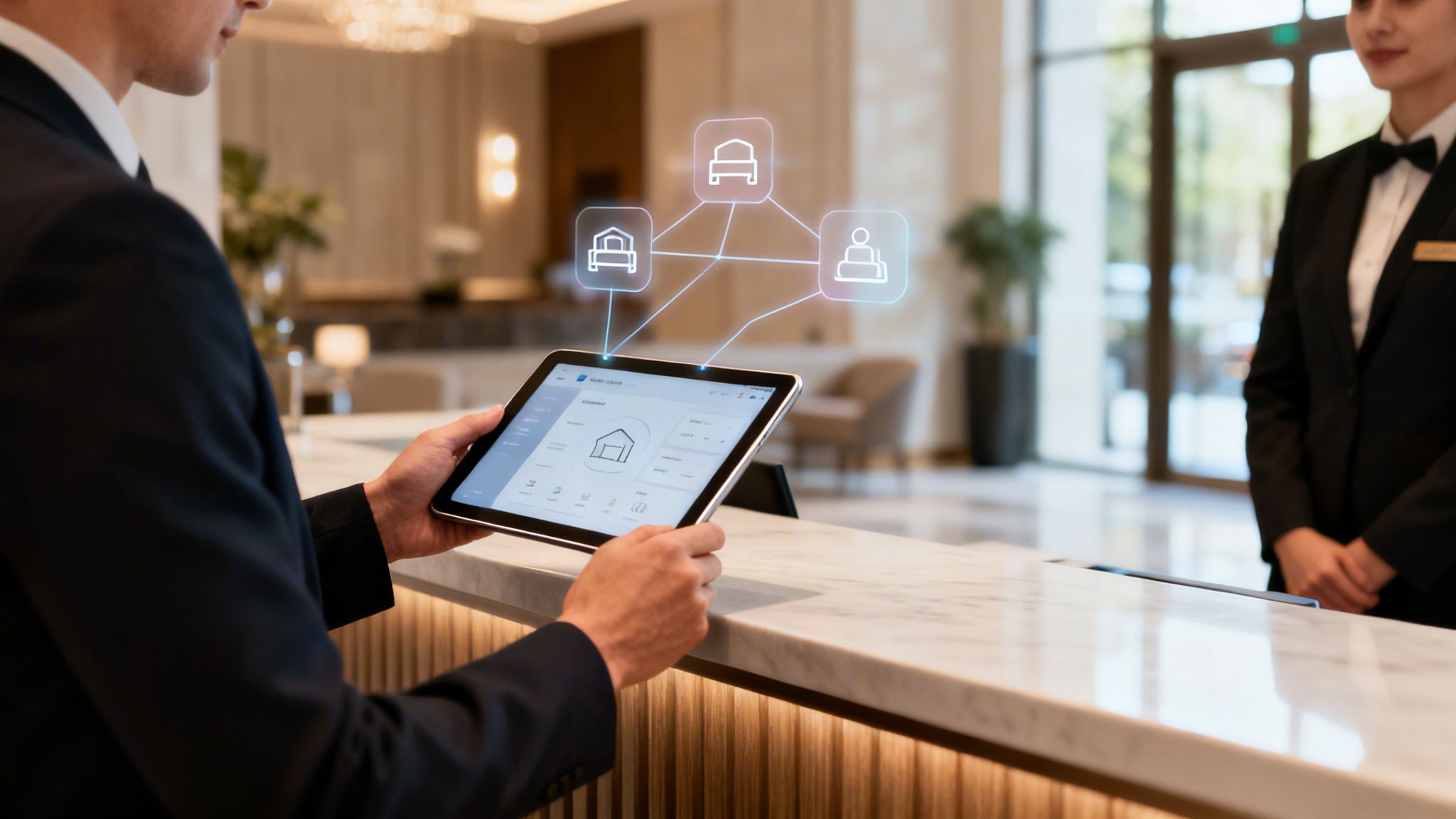
Picture your hotel as a symphony orchestra. You have all these different sections—the front desk, housekeeping, food and beverage, and sales—that all need to play in perfect harmony. A PMS in a hotel is your conductor, making sure every department gets the right information at precisely the right time to create a flawless guest experience.
Without it, you’re back to a world of disjointed spreadsheets, scribbled notes, and endless radio chatter. It’s a recipe for costly mistakes and operational friction. At its heart, a PMS is the central nervous system of your property, giving you a real-time, bird's-eye view of your entire operation. It's so much more than a digital replacement for the old reservation book; it’s a strategic asset you can’t afford to ignore.
From Operational Tool to Strategic Asset
The role of a hotel PMS has ballooned over the years. What started as a simple tool for managing reservations and room inventory now touches every single part of the guest journey and your broader business strategy.
This shift has been pushed forward by a few key developments:
- Automation of Tedious Tasks: The system handles the repetitive grind, like firing off confirmation emails, updating room availability across all your booking channels, and processing payments. This frees up your staff to focus on what really matters: high-value, personal interactions with guests.
- Reduction in Human Error: By centralising all your data and automating workflows, a PMS drastically cuts down on expensive blunders like double-booking a room or generating an incorrect bill for a guest.
- Data-Driven Decision Making: A modern PMS is a goldmine of data. It tracks guest preferences, booking patterns, and operational performance, handing you the insights needed to sharpen your marketing campaigns and build a smarter revenue management strategy.
Running a hotel in 2026 without a smart, integrated PMS is like trying to navigate a busy city without a map. It’s not just about being efficient; it’s about having the visibility you need to stay competitive and profitable.
Getting to grips with the unique technological needs of hotels, including the right way to implement a robust PMS, often calls for specialised expertise found in broader IT solutions for the hospitality sector. This technology is absolutely fundamental. When you start to explore smart integrations that improve the guest experience in hotels, you'll quickly realise the PMS is the foundation upon which every memorable stay is built, making it an indispensable part of modern hotel management.
The Core Functions of a Modern Hotel PMS
To get what a Property Management System (PMS) really does, you have to look past the software and see it as the central nervous system of your hotel. A modern PMS in a hotel isn’t one single tool; it’s a suite of interconnected modules, each built to handle a specific part of your day-to-day operations.
When these functions work together, they create a fluid experience for both your guests and your staff. It’s the difference between a well-oiled machine and a collection of disconnected departments. The PMS breaks down the operational silos that so often lead to guest frustration and costly internal mistakes.
Reservations and Channel Management
Every guest's journey starts with a booking. A capable PMS has a central reservation system (CRS) that acts as the single source of truth for all your rooms. It pulls in bookings from every channel—your website, online travel agencies (OTAs) like Booking.com, phone calls, and walk-ins—and puts them into one clear, manageable dashboard.
This real-time synchronisation is absolutely critical. When a guest books your last deluxe suite on an OTA, the PMS instantly updates your inventory across all other channels, including your own direct booking engine. This simple action eliminates the risk of double-bookings, a common and damaging error that kills guest trust and puts your front desk team in an impossible position.
Front Desk and Guest Services
The front desk is your hotel’s command centre, and the PMS is its most important tool. It smooths out the entire check-in and check-out process, turning what could be a queue and a bottleneck into a quick, welcoming experience.
With just a few clicks, your staff can find a reservation, assign a clean room, take payment, and issue a key card. But modern systems go further, helping your team provide genuinely better service. For instance, if a guest's profile notes a preference for a high floor or a specific newspaper, the PMS flags this during check-in. It lets your staff be proactive and thoughtful, making guests feel seen and valued from the second they arrive.
A PMS transforms guest data from a simple record into an actionable insight. By tracking preferences and stay history, it enables staff to offer personalised welcomes, upgrades, and services, which directly leads to higher satisfaction and loyalty.
Housekeeping and Maintenance Coordination
One of the most frequent guest complaints is turning up to find their room isn't ready. An integrated PMS tackles this head-on by creating a direct, real-time link between the front desk and the housekeeping department.
Housekeeping staff can update a room’s status—from "dirty" to "clean" to "inspected"—using a mobile app or tablet right from the corridor. That information is reflected instantly in the PMS, so the front desk knows precisely which rooms are ready for arriving guests. This immediate visibility cuts down guest wait times, improves efficiency, and helps your team turn rooms over much faster.
A great PMS organises these core tasks so they function as one cohesive operation. Below is a quick breakdown of how these essential modules directly impact your hotel.
Core PMS Functions and Their Direct Impact
Ultimately, each function is designed to remove friction—for your guests, your front desk, your housekeepers, and your accounts team. By automating and connecting these processes, the PMS frees up your staff to focus on what truly matters: delivering exceptional hospitality.
How a PMS and Guest WiFi Integration Creates a Better Stay
A modern Property Management System shouldn't be a silo. Its real power is unlocked when you connect it with other hotel technologies, and one of the most powerful pairings is with your guest WiFi network. This simple link turns a basic amenity into a smart tool for personalisation and smoother operations.
Think about a guest arriving after a long trip. Instead of wrestling with a paper voucher or a clunky login page, their phone just connects to the WiFi as they walk through the door. This isn't science fiction; it’s what happens when your PMS talks to an advanced WiFi authentication platform.
Automating Access and Personalising the Welcome
When your PMS and WiFi network communicate, guest details like their name, room number, and length of stay are used to grant network access automatically. It creates a seamless and secure start to their visit. The system already knows who they are, so the connection is instant—no extra steps needed.
This integration is also your ticket to easy personalisation. As soon as a guest connects, you could send a personalised welcome message straight to their device. Maybe it’s a special offer for a drink at the bar or some quick info about hotel amenities. It’s a small touch that shows you recognise your guests from the very first minute.
This is how a PMS acts as the central hub, connecting all the core parts of the hotel operation.
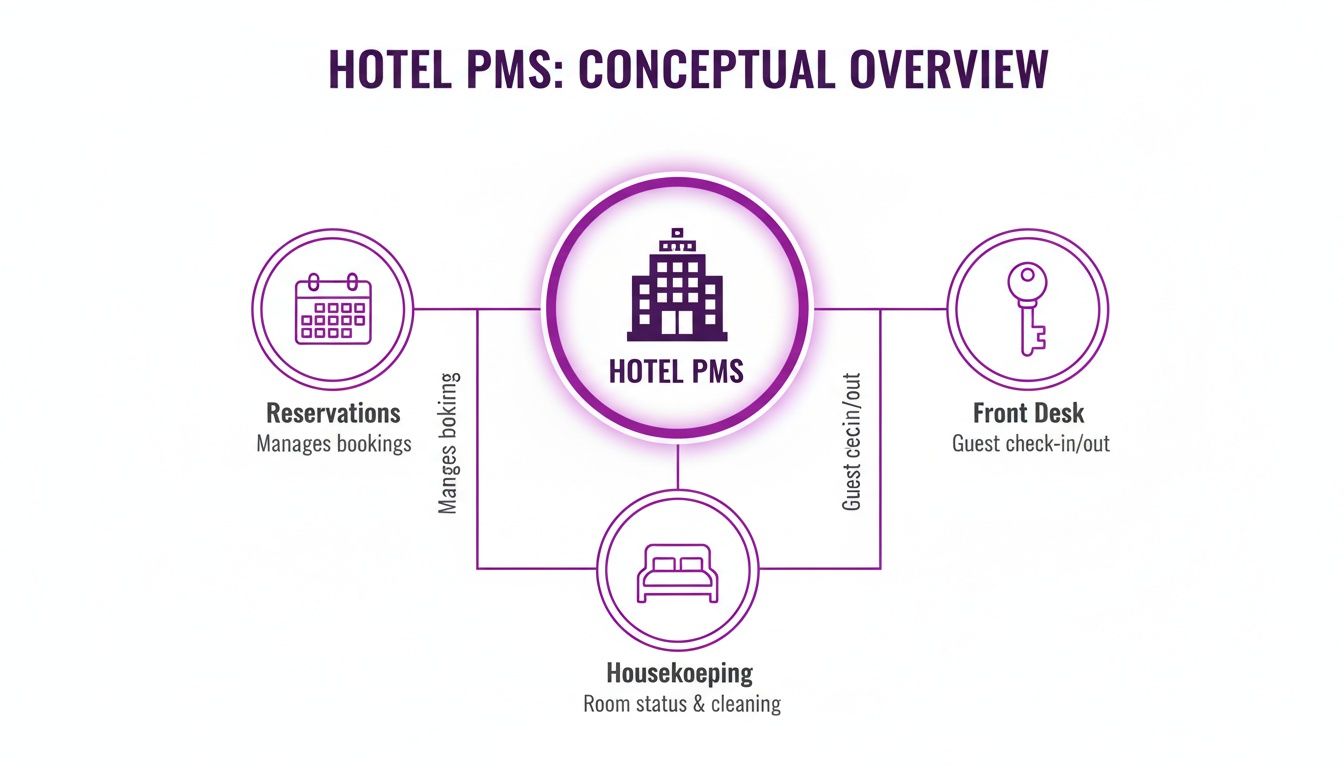
When you plug the guest WiFi network into this system, you add another layer of data and service capability, making the whole operation that much smarter.
Turning Connectivity Into a Strategic Asset
In the UK, reliable internet isn't a perk anymore; it’s an absolute must-have. A staggering 98% of the population relies on constant connectivity, and with 55% of consumers having stayed in a hotel over the past year, the pressure is on to deliver a perfect digital experience.
An integrated system doesn't just meet this demand; it creates new opportunities. By connecting the PMS to the network, you enrich your guest profiles with real behavioural insights.
- Visit Frequency and Loyalty: The system instantly recognises returning guests when their devices connect, letting you trigger loyalty-based perks or personalised greetings.
- On-Site Behaviour: You can see which parts of the hotel are most popular by looking at WiFi connection data, helping you optimise staffing in the lobby, restaurant, or pool area.
- Smarter Marketing: The data gives you a much richer understanding of your guests, which means you can create targeted post-stay marketing campaigns that actually work.
By transforming your WiFi from a cost centre into a data-rich touchpoint, you gain a deeper understanding of guest behaviour. This allows you to not only improve the current stay but also to build more effective strategies for driving future revenue and loyalty.
This connection between systems turns a simple utility into a powerful business asset. By exploring the possibilities of PMS and guest WiFi integrations, hotels can deliver the effortless, personalised, and connected experience that modern travellers now expect. It’s a strategic move that pays off in both guest satisfaction and business intelligence.
Strengthening Security and Ensuring Guest Data Privacy
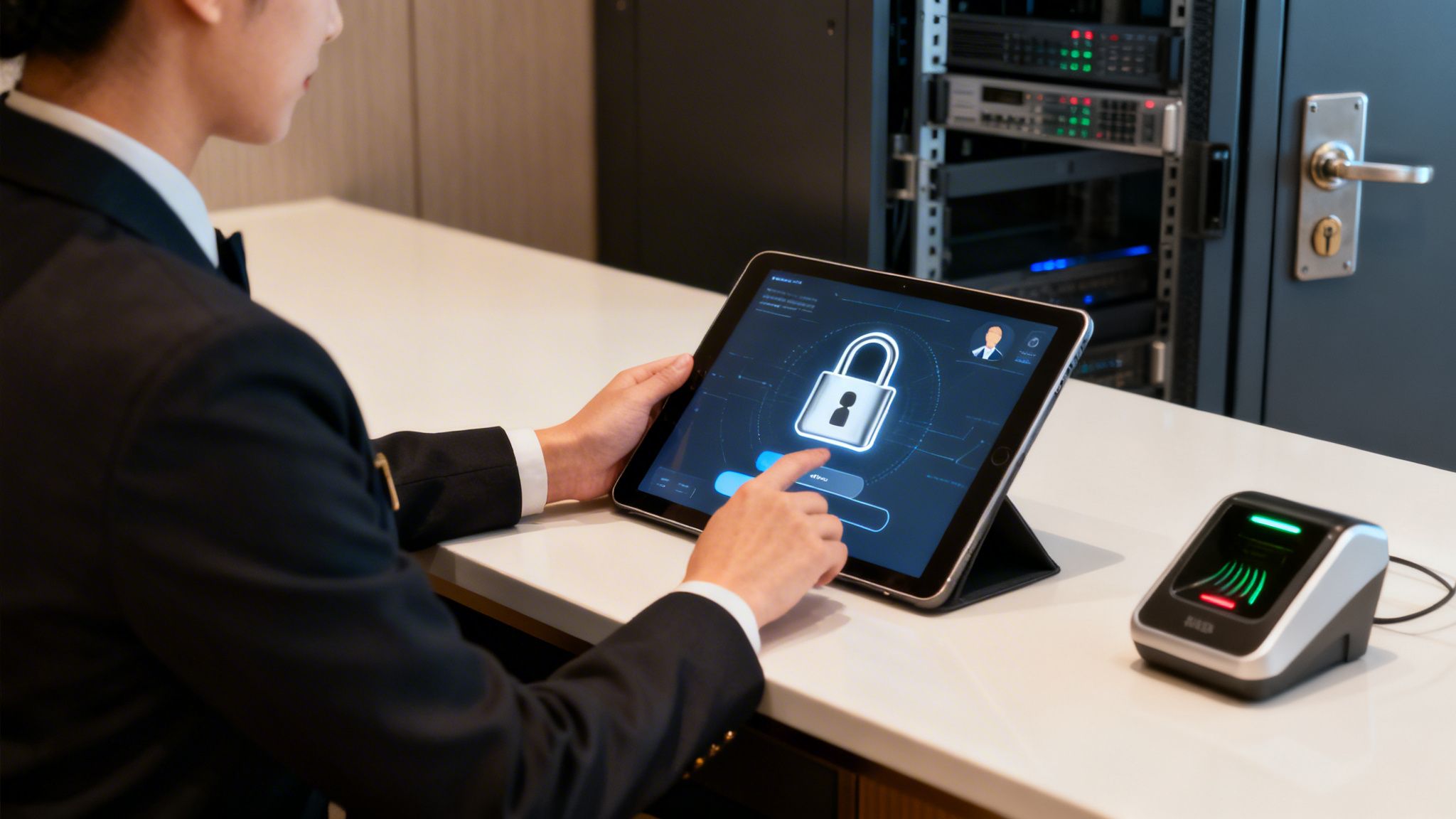
A modern PMS in a hotel is the digital brain of your operation, and it holds a massive amount of guest data. We're talking about everything from personal details and contact information to payment card numbers and travel histories. This makes your PMS a goldmine for cybercriminals.
Handling this data securely isn’t just good practice; it’s a fundamental part of hospitality. A data breach can destroy the trust you've built with your guests in an instant. For this reason, robust security isn't negotiable—it's as vital as a clean room or great service.
Building a Strong Security Posture
Securing your PMS isn't a single action but a multi-layered strategy. It starts with a simple but powerful idea: controlling who can access what. This isn't about locking everyone out; it's about giving your team the exact level of access they need to do their jobs, and absolutely nothing more.
Here are the essential security practices you need to have in place:
- Role-Based Access Control (RBAC): This is your first line of defence. It means a front desk agent can see reservations and check-in notes, but they can't pull up sensitive financial reports. The general manager, on the other hand, gets a much wider view.
- End-to-End Data Encryption: All guest information, whether it’s stored on a server (at rest) or moving across your network (in transit), must be encrypted. This scrambles the data, making it completely unreadable and useless to anyone without authorisation.
- Regular Vulnerability Audits: You have to proactively hunt for weaknesses. Running regular security audits and penetration tests helps you find and patch potential holes in your defence before attackers can exploit them.
Because your PMS is the single source of truth for guest data, its security is paramount. When you implement strong access controls and encryption, you're not just complying with regulations like GDPR. You're building the kind of guest trust that creates loyalty and drives repeat business.
Adopting a Zero-Trust Network Architecture
For the strongest possible defence, you should integrate your PMS into a zero-trust network architecture. The philosophy behind zero-trust is straightforward: never trust, always verify. It operates on the assumption that threats could be anywhere, both inside and outside your network perimeter.
For your staff, this means access is granted based on verified identity using modern tools like Entra ID or Google Workspace, not on shared passwords that are easily compromised. If a staff member leaves, their access can be cut off instantly.
For your guests, it creates a much safer digital experience. The moment they connect to your WiFi, their session is secured and encrypted. By pairing a secure PMS with an identity-based network, you build a protected bubble around your guests' data at every touchpoint. To learn more about creating this kind of comprehensive protection, our guide on data and security best practices is a great place to start.
Choosing and Implementing the Right PMS for Your Hotel
Picking a new Property Management System can feel like a huge undertaking, but breaking it down into logical steps makes it far more manageable. The simple truth is, the best PMS in a hotel is the one that actually fixes your day-to-day problems and has room to grow with you.
So, where do you start? Begin by taking a hard look at your current operations. Where are the real bottlenecks? Is your front desk team drowning in manual data entry? Are you seeing queues of frustrated guests waiting to check in? The answers to these questions are your starting point, forming a ‘must-have’ feature list that cuts through the marketing fluff and focuses on what will genuinely make a difference.
Cloud-Based or On-Premise
One of the first forks in the road is deciding between a cloud-based or an on-premise system. On-premise solutions live on your own servers, which gives you total control but also means you’re on the hook for every bit of maintenance, security, and updating.
A cloud-based PMS, on the other hand, is hosted by the software provider and you access it over the internet. This model gives you far more flexibility, updates happen automatically in the background, and your team can log in from anywhere. For most hotels today, the agility and lower upfront investment of a cloud system make it the clear winner.
The real power of a modern PMS isn't just what it does on its own, but how well it plays with your other hotel technologies. A flexible and well-documented Application Programming Interface (API) is non-negotiable. Think of it as the universal translator that lets your PMS talk to everything from your restaurant’s point-of-sale (POS) system to your guest WiFi platform.
This connectivity is what makes it possible to meet the demands of today's travellers. Modern UK guests expect perfect WiFi everywhere, and a clunky digital experience can hit your bottom line hard. A staggering 52% will abandon an online booking if they run into friction, and that number is only going up. And while many guests are looking to save on the room itself, 87% say they're happy to spend more on add-ons and extras. This shows just how valuable it is to have an integrated system that can offer those personalised upgrades at the right moment. You can get more insights on this from SiteMinder's comprehensive 2025 report.
A Smooth Implementation Plan
Once you've made your choice, the focus shifts to getting it up and running. A smooth rollout is absolutely critical if you want to avoid chaos and get your team to actually use the new tech.
Here are a few proven best practices to follow:
- Strategic Data Migration: Don't just dump all your old data into the new system. This is the perfect chance to have a spring clean. Get rid of duplicate guest profiles, archive ancient booking records, and start fresh. A clean database is the foundation of any good personalisation strategy.
- Hands-On Staff Training: A new PMS is only as effective as the people using it. You have to invest in proper, role-specific training that moves beyond theory. Your team needs to practice their actual, real-world daily tasks in the new system until it feels like second nature.
- Phased Rollout: Whatever you do, avoid a ‘big bang’ launch where you switch everything over at once. A much safer approach is to roll the system out in phases. You could start with back-office functions like reporting and finance, then move to the front desk. This gives your team time to adapt and lets you squash any bugs on a smaller scale.
Measuring the ROI of Your Integrated PMS
Any hotel tech investment has to answer one fundamental question: does it actually make you money? A modern, integrated PMS is no different. When you look beyond the simple tech upgrade, you start to see it for what it is—a core strategy for driving profitability. You just need to know how to measure its impact.
The quickest wins are found in operational efficiency. Think about all the repetitive tasks your team handles daily: sending confirmation emails, processing night audits, and syncing inventory across different booking channels. A good PMS automates these, directly cutting down on the hours your staff spend tied to a desk. This frees them up to focus on what really matters: engaging with guests and making their stay better.
Boosting Revenue and Occupancy
Beyond just saving on costs, an integrated PMS is a serious tool for growing revenue. By connecting to your channel manager, it can adjust pricing and availability in real-time across every OTA and your own direct booking website. This dynamic pricing helps you fill every room at the best possible rate, which directly pushes up your Revenue Per Available Room (RevPAR).
This is especially important in a market that's resilient but also incredibly competitive. For example, recent UK data shows that even when occupancy is stable, getting the most out of every single booking is what keeps you ahead. In January 2026, England's hotel occupancy held steady at 65%, but RevPAR only crept up by 1% to £89, falling behind inflation. This just goes to show how vital it is for a PMS to squeeze revenue from every last room. You can dig into more of these valuable insights from VisitBritain's latest hotel occupancy report.
The Real Value Lies in Guest Loyalty
While the operational gains are nice, the biggest return on your investment comes from building genuine guest loyalty. An integrated system has the power to turn cold, transactional data into warm, relational opportunities. When your PMS talks to your guest WiFi and CRM, it can spot a returning guest the second they connect to the network.
An investment in a PMS isn't just a tech upgrade. It's a strategic tool for creating unforgettable experiences that turn first-time visitors into lifelong advocates for your brand.
Picture this: a guest who booked a spa treatment on their last visit arrives for their stay. The integrated system knows who they are and instantly flags their profile. This could trigger an automated, personalised welcome message sent straight to their phone, perhaps with an exclusive discount on a new spa package. It's a small, automated gesture, but it shows you remember them and value their business, turning a standard check-in into a memorable moment.
This is the kind of personalisation that creates the "wow" factor, driving positive reviews and encouraging guests to book directly with you next time. It's here, in the ability to build real relationships with guests at scale, that a modern PMS delivers its most lasting and powerful return. It's not just software; it's your engine for growth.
Ready to transform your hotel's operations and guest experience? Discover how Purple's identity-based networking platform integrates seamlessly with your PMS to unlock new levels of personalisation, security, and profitability. Learn more at purple.ai.