What Does Fi in WiFi Mean and How Was It Named
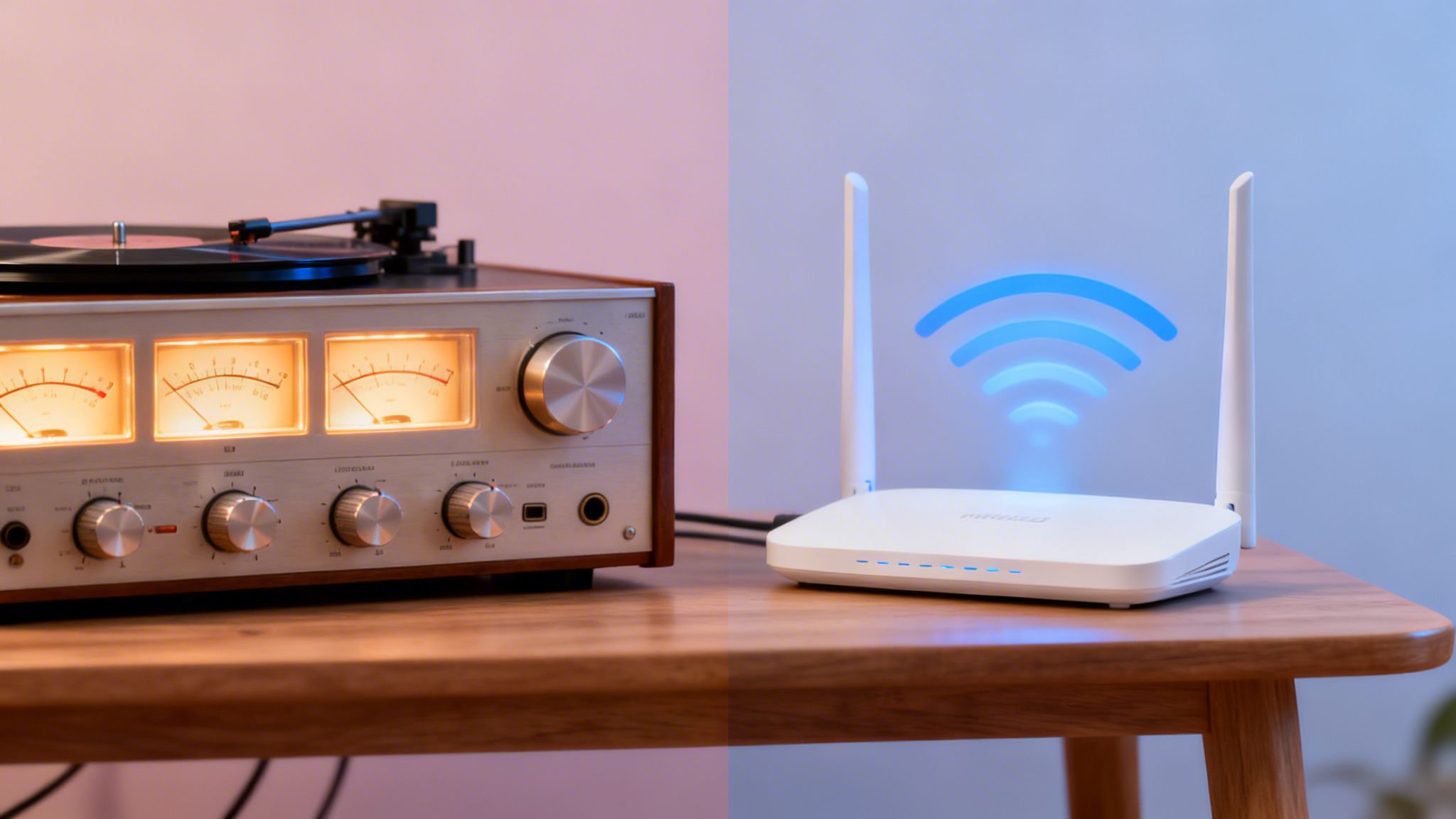
Let's get straight to it: the 'Fi' in Wi‑Fi doesn't actually stand for anything. It’s one of the most common misconceptions in tech that it means 'Wireless Fidelity,' but the real story is much simpler—and a lot more interesting. The name Wi‑Fi is a brand, created purely for marketing.
The Surprising Truth Behind the Name
The idea that Wi‑Fi is short for "Wireless Fidelity" is a myth, but it’s a stubborn one. The truth is a classic case of brilliant branding, designed to make a complex piece of technology feel simple and approachable for everyone.
Back in 1999, the group we now know as the Wi‑Fi Alliance had a serious marketing problem. Their game-changing wireless technology was known by its technical standard, 'IEEE 802.11b Direct Sequence'—a name that was never going to catch on with the average person. To fix this, they hired the consulting firm Interbrand to come up with something a bit more memorable.
Interbrand landed on 'Wi‑Fi', a clever and catchy pun on 'Hi‑Fi' (High Fidelity), a term people already connected with quality audio equipment. The goal was never technical accuracy; it was about instant recognition and appeal. You can get more details on this branding decision by exploring the history of Wi‑Fi technology.
The Wi‑Fi Alliance is the organisation that owns and manages the Wi‑Fi brand, ensuring that devices from different manufacturers can all work together seamlessly.
Their mission says it all: "Connecting everyone and everything, everywhere." This powerful statement shows how the brand has grown from a simple name into a global standard for interoperability and connectivity. For anyone managing a network, that’s far more important than what the 'Fi' stands for.
The True Story Behind the Wi-Fi Name
So, if "Wireless Fidelity" is just a myth, what’s the real story? It all starts back in the late 1990s, when the group we now know as the Wi-Fi Alliance had a serious marketing problem on their hands. Their incredible new wireless technology had an official name: 'IEEE 802.11b'.
While technically accurate, that name was a complete non-starter for the average person. How do you sell something that sounds like a barcode to the masses?
The answer came from the branding agency Interbrand. They were tasked with creating a friendlier, catchier name. Their team came up with 'Wi-Fi', a clever and memorable play on 'Hi-Fi' (High Fidelity), a term people already knew and associated with quality home audio. The goal was never about technical accuracy; it was about creating instant brand recognition and making a complex technology feel simple and approachable.
From a Catchy Name to a Global Symbol
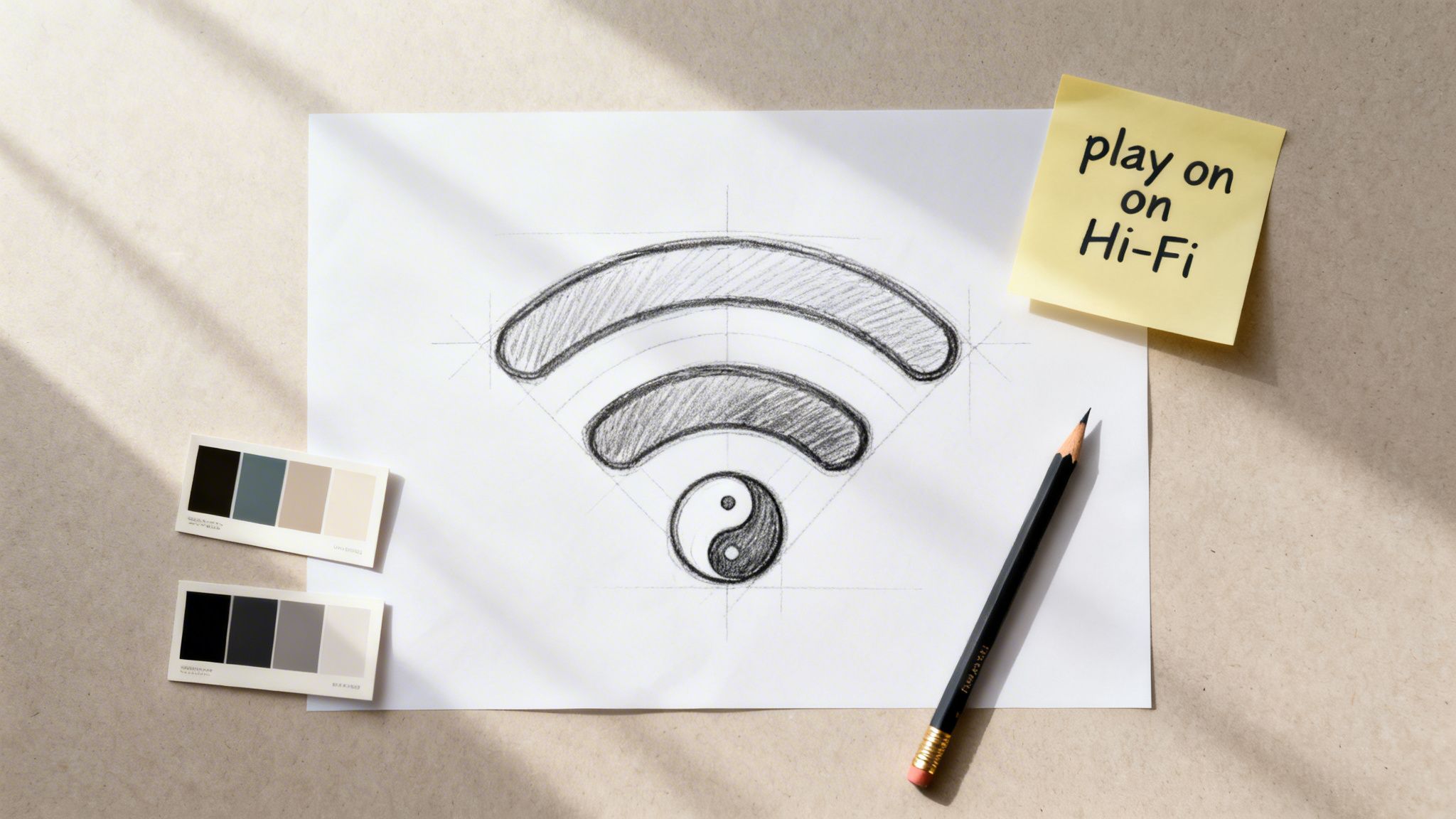
Along with the name, Interbrand cooked up the now-iconic yin-yang style logo. This simple symbol quickly became the universal sign for wireless internet, popping up in coffee shops, airports, and hotels around the world.
This masterclass in branding was the key that unlocked the technology's potential, transforming a niche bit of kit into a household name. It gave the tech an identity that resonated with millions of people who couldn’t care less about the underlying standards. You can dive deeper into this journey in our complete history of Wi-Fi.
The decision to prioritise marketing over technical jargon holds a crucial lesson: user perception and simplicity often drive adoption far more than technical specifications. The name 'Wi-Fi' made wireless networking feel less intimidating, paving the way for its global success.
The table below cuts through the confusion, putting the common myth side-by-side with the marketing reality of the Wi-Fi name.
Wi-Fi Naming: The Myth vs The Reality
Ultimately, 'Wi-Fi' is a testament to the power of great marketing. It took a dry, technical standard and turned it into one of the most recognised and essential brands of the modern era.
Why Branding Mattered More Than Technical Terms
The decision to go with a catchy brand name over a dry technical standard was a stroke of marketing genius. Just think about buying a car; you remember names like ‘Mustang’ or ‘Civic’, not the complex engine codes like ‘V-8 289-4V’. The Wi‑Fi Alliance applied the exact same logic.
Their goal was to make wireless networking feel less intimidating and more approachable. By giving it a simple, memorable name, they turned a complicated piece of engineering into a product anyone could understand. This approach built immediate trust and comfort with home users and small businesses, fuelling its explosive growth.
Making Technology Accessible
This simple branding choice had a massive impact. It tore down the barrier to entry for millions of people who would have been instantly put off by technical jargon. This accessibility is a huge reason why Wi‑Fi is now so deeply woven into the fabric of our daily lives.
In fact, the technology's reach in the United Kingdom is a testament to this success. A recent survey found that 48% of British adults consider Wi‑Fi the most impactful invention of the last 25 years, ranking it above other major innovations. You can read more about this study on the impact of Wi-Fi in the UK for the full picture.
The success of Wi‑Fi offers a powerful lesson for any business: the user experience, starting with the name itself, is often the key to making complex systems approachable and successful for everyone.
This focus on simplicity over technical precision is what allowed a niche technology to go mainstream. It created a foundation where the brand itself became synonymous with wireless internet access, no matter what the underlying standard was.
For a business owner providing guest Wi‑Fi, this lesson is crucial. Your customers don't need to know how the connection works, just that it's simple, secure, and reliable. The name 'Wi‑Fi' set that exact expectation right from the start.
Connecting the Brand to the IEEE 802.11 Technology
If ‘Wi-Fi’ is the brand name on the box, then the IEEE 802.11 family of standards is the powerful engine humming away inside. Getting your head around this distinction is crucial. The friendly name you see on your devices is really just a simple label for some seriously complex technology.
That technology comes from the Institute of Electrical and Electronics Engineers (IEEE). It’s their job to write the technical rulebook that allows all our wireless gadgets to talk to each other. These rules, or standards, get technical names like 802.11b, 802.11ac, and 802.11ax—exactly the kind of jargon the Wi-Fi brand was created to hide.
Translating Tech Speak into Simple Terms
To bridge this gap between engineers and the rest of us, the Wi-Fi Alliance came up with a much simpler, generational naming system. It helps you know exactly what you're getting without needing an engineering degree. You can check out our detailed guide for more on what is Wi-Fi and how it works.
Here’s a quick translation:
- Wi-Fi 4 is the everyday name for the 802.11n standard.
- Wi-Fi 5 is the label for the 802.11ac standard.
- Wi-Fi 6 and Wi-Fi 6E both refer to the 802.11ax standard.
This approach is a lot like USB. You know the difference between a USB-A and a USB-C plug without needing to memorise their technical specifications. The Wi-Fi brand does the exact same thing for wireless networking, making a complex technology feel simple.
Think of it this way: The IEEE 802.11 standard is the detailed, complicated recipe for a cake, while 'Wi-Fi' is the simple, appealing name on the bakery box that tells you it’s going to be delicious and reliable.
The evolution of these standards has delivered some incredible leaps in performance over the years. The first standard to really take off, 802.11b, offered speeds of just 11 Mbps. By contrast, the modern Wi-Fi 6 standard (802.11ax) can hit theoretical speeds of up to 9,608 Mbps, a massive improvement in wireless capability across the UK.
For any IT administrator or business owner, knowing which standard your network is built on is vital for guaranteeing performance, security, and a great user experience.
How the Wi-Fi Alliance Guarantees Your Devices Work Together
The Wi-Fi Alliance does a lot more than just own a catchy brand name; it’s the quiet guardian of interoperability for the entire industry. This global non-profit organisation is the reason that when you buy a new laptop, it will connect seamlessly to any router, regardless of who made it.
Just imagine the chaos if a Samsung phone couldn't connect to a BT router. It would be a nightmare for users and businesses alike. The Alliance prevents this mess by running a strict certification programme. Devices that pass their exhaustive tests earn the right to display the 'Wi-Fi CERTIFIED™' logo.
That logo is much more than just a sticker. It's a seal of quality, a promise that the device meets specific IEEE 802.11 standards for performance, security, and—most importantly—that it will play nicely with every other certified device out there.
The Power of a Unified Standard
For businesses like hotels, cafés, or large venues, this certification is absolutely crucial. It’s the guarantee that the thousands of different guest devices connecting every day can do so without a hitch, ensuring a smooth and dependable experience for every single visitor.
This whole process is about translating a complex technical standard into a simple, user-friendly brand that promises universal compatibility.
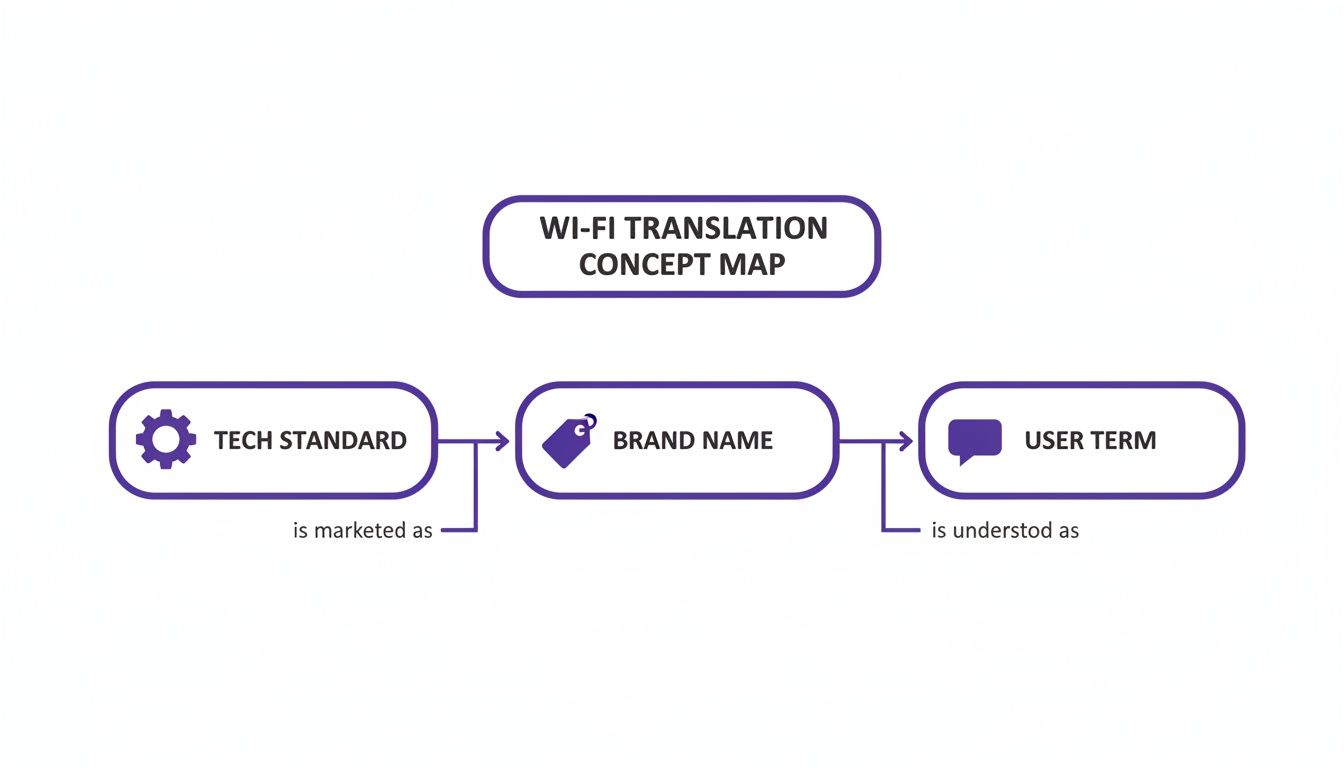
The Alliance effectively bridges the gap between dense engineering specs and the simple, universal expectation that your Wi-Fi will just work. It’s this certified promise that maintains trust in the brand and the technology itself.
The Wi-Fi Alliance’s core mission is to ensure that products from different manufacturers work together flawlessly. This commitment to interoperability is what turned a clever brand name into a reliable global technology.
The Alliance also continues to push the user experience forward with new standards and programmes. These initiatives are designed to make secure, frictionless access available everywhere—something you can explore further by learning more about what is OpenRoaming and its impact on public networks. By doing this, they ensure the simple promise of 'Wi-Fi' continues to hold true for billions of users worldwide.
Beyond the Name: What Really Matters for Your Network
Knowing the origin of the Wi-Fi name is a neat bit of trivia, but for today’s businesses, the conversation has moved on. While the brand helped unify an industry, the real value now comes from performance, security, and reliability. The challenge is no longer about what ‘fi’ stands for, but how to securely manage dozens of devices all fighting for a stable connection.
Modern networks are expected to handle everything. From employee laptops and guest smartphones to a growing army of IoT sensors, they all demand a solid, unwavering connection. This means the focus has to be on using the right technical standards and robust security protocols to keep sensitive data safe.
From Branding to Practical Performance
In a way, the core idea behind the original brand—making complex tech simple—is more relevant than ever. Today, however, simplicity means delivering a flawless user experience in a very crowded wireless world.
Practical issues like network reliability are everything. Ensuring a smooth online experience for every single user often comes down to preventing common headaches, like a malfunctioning Wi-Fi router, a frequent problem in any connected space.
The modern measure of a successful Wi-Fi network isn't its name, but its ability to deliver fast, secure, and uninterrupted connectivity to every user, on every device, every single time.
Ultimately, it all boils down to practical, real-world results:
- Speed: Supporting high-bandwidth applications without frustrating lag.
- Security: Protecting user and business data with strong, reliable encryption.
- Reliability: Providing consistent, dependable connectivity across your entire venue.
This shift from a quirky branding story to a focus on operational excellence brings us full circle. It connects the user-friendly ideals of the past with the very real, practical needs of today's demanding networks.
Frequently Asked Questions
Let's clear up some of the most common questions about the term Wi-Fi, its origins, and what it all really means for your network. This quick guide will help you sort the facts from the long-standing myths.
So What Does Fi in Wi-Fi Mean Again?
Honestly? Nothing at all.
The 'Fi' in Wi-Fi was cooked up by a branding agency as a catchy, memorable name. It was simply a clever play on the familiar term 'Hi-Fi' (High Fidelity) from the audio world. The widespread belief that it stands for 'Wireless Fidelity' is just a popular myth that's stuck around for decades. The name was chosen purely for its marketing punch, not its technical accuracy.
Is Wi-Fi the Same as IEEE 802.11?
Not quite, but they are two sides of the same coin. The easiest way to think about it is like this:
- IEEE 802.11 is the technical standard. It's the dense, complex rulebook that engineers follow to build the actual wireless networking gear. Think of it as the complex engine under the bonnet of a car.
- Wi-Fi is the friendly brand name for that technology. It's the simple badge on the outside that tells you, "This car works".
Essentially, Wi-Fi is the brand, and IEEE 802.11 is the technology that makes it all happen. The brand just makes it much easier for everyone—from IT pros to everyday consumers—to know what they're getting.
The Wi-Fi brand name was created to make a complex technology, IEEE 802.11, accessible and appealing to everyday consumers and businesses. Its purpose was to build trust and drive adoption.
Does the Wi-Fi Alliance Invent the Technology?
No, the Wi-Fi Alliance doesn't invent the core technology. That job belongs to the Institute of Electrical and Electronics Engineers (IEEE), the organisation that develops and publishes the 802.11 standards.
The Wi-Fi Alliance plays a different, but absolutely critical, role. They are the guardians of interoperability. Their job is to test and certify products to make sure they all meet the IEEE standards and, most importantly, work together perfectly, regardless of who made them. They ensure a seamless, reliable experience for all of us.
At Purple, we go beyond the name to deliver what truly matters: secure, reliable, and intelligent Wi-Fi authentication. Transform your network into a tool for insight and growth. Discover the power of identity-based networking at https://www.purple.ai.